
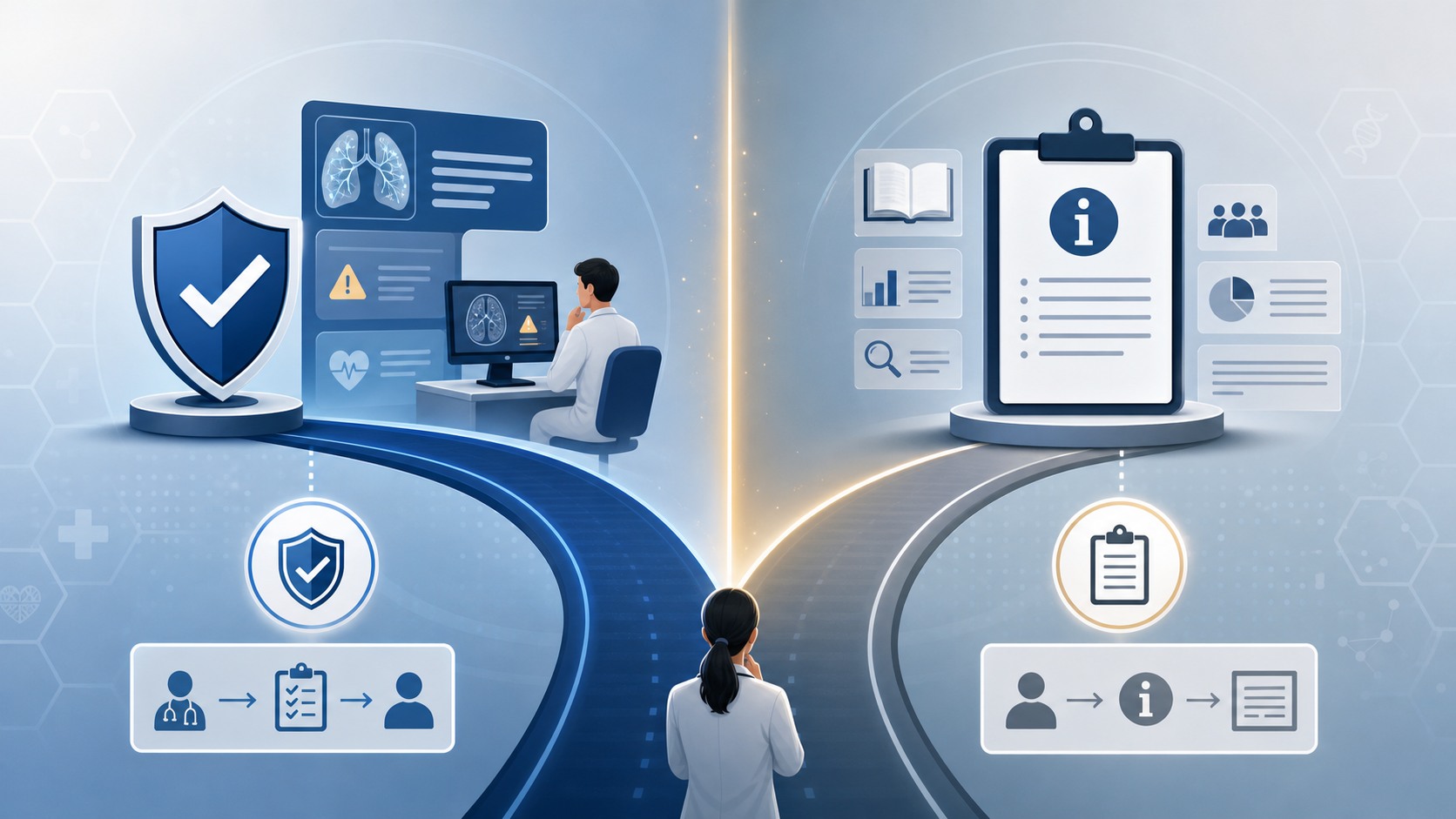
Beyond Documentation: Why Triage and CDS Are the Next Conversational AI Frontier
The first wave of conversational AI in healthcare focused overwhelmingly on ambient documentation — scribes that listen to patient encounters and generate clinical notes. That use case has accumulated the most peer-reviewed evidence, the largest number of FDA clearances, and the most visible EHR integrations. But a second wave is building around a different set of tasks: patient triage and clinical decision support (CDS). These applications do not just transcribe what was said; they interpret symptoms, recommend next steps, and surface evidence-based guidance at the point of care.
This distinction matters for clinical informaticists and health IT decision-makers because triage and CDS systems carry fundamentally different risk profiles than ambient scribes. A documentation error might produce an inaccurate note that a clinician can catch during review. A triage error — sending a patient with chest pain to a self-care pathway instead of the emergency department — can cause direct harm. The regulatory perimeter is also different: the FDA has historically treated CDS software as a potential medical device, while most ambient scribe functions fall outside device regulation.
This article drills into the specific evidence, architecture, regulatory boundaries, and implementation barriers for conversational AI in triage and CDS. It does not rehash the broader conversational AI market landscape or the ambient scribe evidence base, which are covered in separate ClinicalMind analyses. Instead, it provides a focused, evidence-grounded assessment for organizations evaluating whether and how to deploy these systems in clinical workflows.
Operational Evidence from Deployed Triage Systems
The strongest available operational metrics for conversational triage come from real-world deployments documented in vendor case studies. While these lack independent peer-reviewed replication, they represent the best published evidence currently available for production systems at scale.
A regional U.S. health network serving approximately 2.3 million people deployed an intelligent triage system built on Rasa NLU, Node.js, and Amazon Transcribe. According to the implementation report from Master of Code Global, the system achieved a 63% reduction in patient wait times — from 12 minutes to 4.5 minutes — along with 89% patient satisfaction scores and a 47% decrease in abandoned calls. The system uses clinical triage logic based on established protocols and supports multi-channel deployment across web and phone.
In Europe, Regina Maria, a private healthcare network, deployed a symptom checker powered by a medical database covering over 720 conditions. According to Druid AI's case study documentation, the system handled 92,182 investigations in its first year, served 210,000 patients, and saved hospital staff an estimated 23,045 hours annually. A separate AI management assistant deployed alongside the symptom checker saves 16 to 48 hours daily across 200 managers, generating over €100,000 in annual savings.
At Weill Cornell Medicine, deploying an AI chatbot for appointment scheduling resulted in a 47% increase in digitally booked appointments. These metrics suggest that conversational triage systems can meaningfully reduce operational burden and improve patient access — but the evidence base remains thin compared to the volume of peer-reviewed studies available for ambient documentation.
| Metric | Master of Code (Regional US Health Network) | Regina Maria (Druid AI) | Weill Cornell (Druid AI) |
|---|---|---|---|
| Wait time reduction | 63% (12 min → 4.5 min) | Not reported | Not reported |
| Patient satisfaction | 89% | Not reported | Not reported |
| Abandoned call reduction | 47% | Not reported | Not reported |
| Patients served | 2.3M population | 210,000 | Not reported |
| Staff hours saved annually | Not reported | 23,045 | Not reported |
| Digitally booked appointments | Not reported | Not reported | +47% |
Architecture for Safe Clinical Decision Support
Conversational AI for clinical decision support differs fundamentally from general-purpose chatbots or even triage systems. The core architectural requirement is that the system must provide clinically safe, evidence-based answers — not plausible-sounding ones. This imposes design constraints that are absent in consumer applications.
The most critical architectural element is the knowledge base. Unlike a general-purpose large language model (LLM) that generates responses from its training data, a clinical CDS system must draw answers from a curated, maintained repository of medical evidence. Merative, for example, has developed conversational AI assistants that allow clinicians to ask specific questions — such as whether a medication is safe during pregnancy — and receive answers drawn from Micromedex, a structured drug information database. The system does not generate answers from scratch; it retrieves them from a vetted source.
A second architectural requirement is deterministic fallback logic. When the system cannot confidently answer a question — because the query is ambiguous, the evidence is insufficient, or the condition falls outside the knowledge base — it must explicitly say so and escalate to a human clinician. Rasa's hybrid architecture for healthcare triage workflows combines deterministic natural language understanding (NLU) for intent classification with LLM-based response generation, but with guardrails that prevent the LLM from generating answers when confidence thresholds are not met.
- Curated medical knowledge base: Responses are drawn from a maintained, vetted repository (e.g., Micromedex, UpToDate, specialty-specific guidelines) rather than generated from model training data.
- Deterministic fallback: When confidence is low or the query is out of scope, the system escalates to a human clinician rather than generating a plausible but unverified answer.
- Hybrid NLU + LLM architecture: Deterministic intent classification handles structured triage pathways, while LLMs are used only for response generation within tightly scoped, guardrailed contexts.
- Continuous quality monitoring: Clinical validation, clinician involvement in system design, and ongoing performance auditing are essential for safety, as Merative emphasizes in its deployment guidance.
The January 2026 FDA CDS Guidance: What It Means for Conversational AI
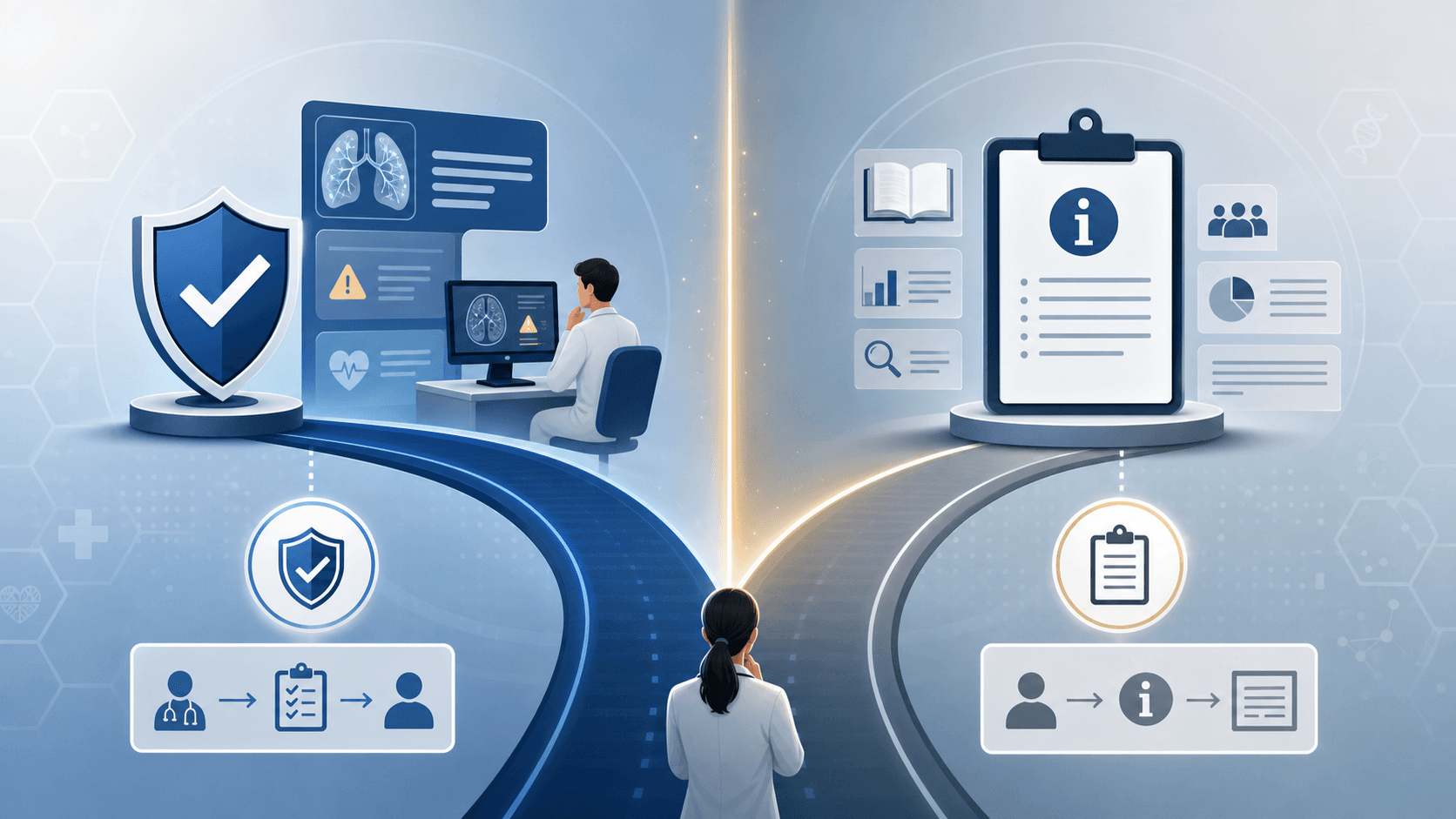
In January 2026, the FDA issued an updated final guidance on Clinical Decision Support software, superseding the 2022 version. According to an analysis by Arnold & Porter, the guidance introduces several changes that directly affect how conversational AI for triage and CDS is regulated.
The most significant change is a new limited enforcement discretion policy for CDS software functions that provide a single output or recommendation in scenarios where only one option is "clinically appropriate." This means that some conversational CDS tools that previously fell into a regulatory gray area may now be subject to enforcement discretion — or, conversely, may now be clearly classified as devices requiring clearance.
The guidance also removes the per se exclusion for time-critical decision-making CDS. Previously, software that provided recommendations in time-critical situations was automatically excluded from device regulation. Under the updated guidance, this exclusion is removed, meaning that conversational triage systems that provide time-sensitive recommendations — such as whether a patient with acute symptoms should go to the emergency department — may now fall within the FDA's regulatory scope.
Additionally, the guidance modifies Criterion 4, which governs how the basis for recommendations is presented to healthcare professionals. The updated language may affect conversational CDS systems that provide recommendations without clearly surfacing the underlying evidence or reasoning.
| Change | Previous Rule (2022) | Updated Rule (January 2026) | Impact on Conversational CDS |
|---|---|---|---|
| Single-output recommendations | Not explicitly addressed | Limited enforcement discretion for single clinically appropriate options | Some triage systems may qualify for enforcement discretion; others may need clearance |
| Time-critical CDS exclusion | Per se exclusion from device regulation | Exclusion removed | Triage systems providing time-sensitive recommendations may now be regulated as devices |
| Criterion 4 (basis for recommendations) | Required presentation of basis to HCP | Modified presentation requirements | Conversational CDS must clearly surface evidence and reasoning behind recommendations |
FDA Commissioner Makary described the guidance as cutting "unnecessary regulation" and promoting innovation for AI and medical devices. The agency also announced plans for a new risk-based AI framework focusing on post-marketing monitoring. For health systems evaluating conversational CDS tools, the key takeaway is that regulatory exposure depends on the specific function of the system — not on whether it is called a "chatbot" or a "decision support tool." Systems that provide specific clinical recommendations, especially in time-sensitive contexts, are more likely to require FDA clearance.
Implementation Barriers: Lessons from the Nair et al. Framework

A 2024 mixed-method study by Nair et al., published in PLOS ONE, provides the most comprehensive structured analysis of AI implementation barriers in healthcare currently available. The study analyzed 38 empirical cases and conducted 69 interviews with healthcare leaders and professionals, identifying 12 concepts (barriers and strategies) across three implementation phases: planning, implementing, and sustaining use.
Several of these barriers are particularly relevant for conversational triage and CDS adoption:
- Clinician liability uncertainty: Interviewees consistently identified an uncertain legal framework for clinician liability when using AI as a top barrier. If a conversational CDS system recommends a course of action and the patient experiences a poor outcome, who is responsible — the clinician, the health system, or the vendor?
- The 'black box' problem: Clinicians expressed concern that AI output might be opaque and difficult to verify. For conversational CDS, this is especially acute because the system's reasoning may be embedded in natural language responses rather than structured outputs.
- Data quality and bias: Insufficient data quality and algorithmic bias were cited as significant barriers. Conversational triage systems trained on datasets that underrepresent certain populations may produce systematically different recommendations for those groups.
- Risk of impersonalizing care: Both clinicians and patients expressed concern that AI-mediated interactions could depersonalize the care experience. For triage systems that replace human phone calls with chatbots, this concern is particularly salient.
A notable finding from the Nair et al. study is that ethics emerged as a distinct concept only from clinician interviews, not from the published literature analyzed. This suggests that the academic literature on AI implementation may underrepresent the ethical concerns that frontline clinicians consider most pressing.
| Implementation Phase | Key Barriers (from Nair et al.) | Relevance to Conversational Triage/CDS |
|---|---|---|
| Planning | Leadership buy-in, Change management, Engagement | Triage/CDS requires cross-functional governance (clinical, IT, legal, compliance) from the outset |
| Implementing | Workflow integration, Finance/HR, Legal, Training | Conversational CDS must integrate with existing triage protocols and EHR workflows; liability concerns are acute |
| Sustaining | Data quality, Evaluation/monitoring, Maintenance, Ethics | Continuous monitoring for model drift, bias, and safety incidents is essential; ethics concerns are under-addressed in literature |
The study also identified strategies that successful implementations share: early involvement of interdisciplinary stakeholders from planning through sustaining, creating a shared vision and communicating a sense of urgency, building trust through local clinician-initiated problem definitions and transparent model information, and establishing cross-functional governance committees for sustained AI use.
Future Direction: Agentic AI and Proactive Decision Support
The next evolution of conversational AI in clinical workflows is agentic AI — systems that do not just respond to queries but proactively collect pre-visit data, surface clinical recommendations, and initiate actions. Instead of waiting for a patient to describe symptoms, an agentic triage system might send a pre-appointment questionnaire, analyze the responses, and present a structured summary to the clinician before the encounter begins.
This shift from reactive to proactive decision support raises the same implementation challenges discussed above — but at greater intensity. Agentic systems that initiate clinical actions without direct clinician oversight will face heightened regulatory scrutiny, more complex liability questions, and greater demands for transparency and explainability. The vendor architecture choices that health systems make today — between closed proprietary platforms and modular, standards-based systems — will shape their ability to adopt agentic capabilities as they mature.
For a broader view of how vendor architecture choices and market competition are shaping health system adoption decisions, see the companion analysis: The Competitive Landscape of AI in Healthcare 2026: Big Tech, Startups, and the EHR Counteroffensive.
Key Takeaways for Clinical Informatics and Procurement Teams
- Prioritize systems with curated medical knowledge bases and deterministic fallback logic. A conversational CDS system is only as safe as the evidence it retrieves and the logic that governs what happens when it cannot find an answer.
- Assess regulatory exposure under the January 2026 CDS guidance. Systems that provide specific clinical recommendations — especially in time-sensitive contexts — are more likely to require FDA clearance. Consult legal and regulatory experts early in the evaluation process.
- Plan for the full implementation lifecycle using the Nair et al. framework. Barriers in the planning phase (leadership buy-in, engagement) are as important as barriers in the implementing phase (workflow integration, training) and sustaining phase (monitoring, ethics).
- Establish cross-functional governance committees that include clinician input on ethical concerns. The Nair et al. study found that ethics emerged as a distinct concern only from clinician interviews — not from published literature — suggesting that frontline perspectives are essential for identifying and addressing ethical risks.
- Treat vendor case study metrics as indicative, not definitive. The strongest available operational figures — 63% wait-time reduction, 89% satisfaction, 23,045 hours saved annually — come from vendor sources and lack independent peer-reviewed replication. Demand evidence from independent studies or commit to generating it through your own deployment evaluation.
Comments
Join the discussion with an anonymous comment.