
 Amazon Connect Health
The Administrative Burden Crisis in US Healthcare
For more than a decade, time-motion studies have quantified a reality that every clinician knows firsthand: the electronic health record (EHR) has become a dominant presence in the workday, often at the expense of direct patient care. A widely cited analysis across four specialties found that physicians spend 49.2% of their time on EHR and desk work, with only 27% devoted to direct clinical face time with patients. This imbalance is not merely a source of professional dissatisfaction; it is a driver of burnout, a contributor to the projected shortfall of primary care physicians, and a financial drain on health systems that must support large administrative workforces.
The administrative burden is not monolithic. It spans patient intake and identity verification, appointment scheduling, clinical documentation, medical coding, and the generation of after-visit summaries. Each of these tasks, individually modest, accumulates into hours of daily work that pull clinicians away from their core clinical responsibilities. For broader context on how this problem is being addressed across the industry, see our analysis of AI in healthcare administration adoption benchmarks and cost savings.
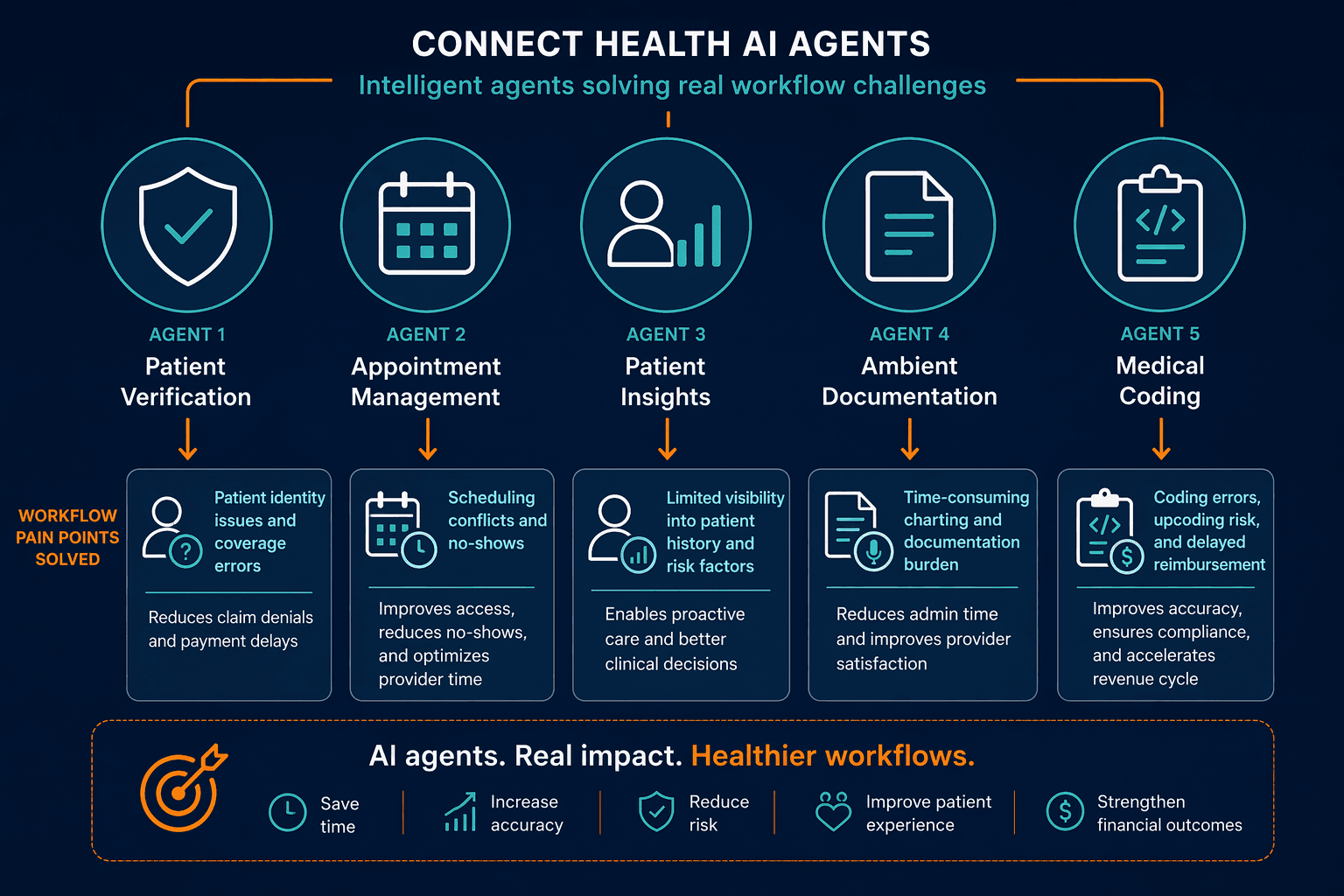
In March 2026, Amazon Web Services (AWS) launched Amazon Connect Health, a suite of five AI agents designed specifically to address this workflow fragmentation. Rather than offering a single ambient documentation tool, Connect Health targets the entire patient encounter lifecycle — from the first phone call to the final billing code. This article examines each agent, the evidence from early deployments, and how the platform compares to established competitors in the clinical documentation space.
Mapping Connect Health's Five AI Agents to Workflow Pain Points
Amazon Connect Health is built on the existing Amazon Connect contact center platform and extends it with healthcare-specific AI agents. Each agent is designed to automate a distinct administrative task that currently consumes clinician or staff time. The table below maps each agent to its specific function, deployment status, and the workflow pain point it addresses.
| Agent | Function | Status | Workflow Pain Point Addressed |
|---|---|---|---|
| Patient Verification | Conversational identity verification using voice and knowledge-based authentication | General Availability (GA) | Staff time spent on manual identity checks; 30-60% call abandonment rates at some health systems |
| Appointment Management | Scheduling, rescheduling, and cancellation of appointments via natural language | Preview | High volume of inbound scheduling calls; no-show rates and scheduling errors |
| Patient Insights | Generation of pre-visit patient history summaries from EHR data | Preview | Clinician time spent reviewing charts before appointments (1-2 hours daily per provider) |
| Ambient Documentation | Real-time generation of clinical notes from clinician-patient conversations | General Availability (GA) | 49.2% of physician time spent on EHR and desk work; documentation after hours |
| Medical Coding | Generation of ICD-10 and CPT codes from clinical documentation with confidence scores and source traceability | Preview | Coding backlogs, revenue cycle delays, and audit risk from manual coding errors |
All five agents are HIPAA-eligible and initially available in the us-east-1 and us-west-2 AWS regions. The platform integrates natively with Epic and connects to other EHR systems through data integration partners, as well as to AWS HealthLake for FHIR-based data access.
Deployment Evidence: What Early Adopters Are Reporting
The evidence base for Connect Health currently consists of case studies published by AWS and coverage in healthcare trade publications. While independent peer-reviewed studies are not yet available — the platform launched only in March 2026 — the reported outcomes from pilot sites provide early signals of potential impact.
UC San Diego Health: Call Center Transformation
UC San Diego Health, which handles approximately 3.2 million patient interactions annually, deployed the Patient Verification agent. According to AWS-published data, the health system saved an average of 1 minute per call and diverted 630 hours of staff labor per week from patient verification tasks to direct patient assistance. In some departments, call abandonment rates dropped by 30-60%. For a large health system, these figures translate into meaningful operational cost savings and improved patient access.
One Medical: Ambient Documentation at Scale
One Medical, the primary care network acquired by Amazon in 2022, has used Connect Health's ambient documentation agent across more than one million patient visits. AWS reports strong clinician adoption and regular weekly usage, though specific metrics on time savings or clinician satisfaction at One Medical have not been published separately.
Netsmart: Behavioral Health and Human Services Adoption
Netsmart, a technology provider for behavioral health and human services organizations, reported that ambient documentation adoption increased by 275% across its network of more than 1,300 client organizations after deploying Connect Health. This figure suggests that the tool addresses a particularly acute documentation burden in behavioral health settings, where narrative notes are often lengthy and unstructured.
Tel Aviv Sourasky Medical Center: Comprehensive Workflow Impact
Tel Aviv Sourasky Medical Center reported a 50% reduction in documentation time, a 30% improvement in treatment plan optimization, 40% faster guideline review, and 25% better clinical trial matching using the broader AWS Health AI Hub, which includes HealthScribe, HealthLake, and Bedrock. While these metrics encompass a wider set of tools than Connect Health alone, they demonstrate the potential of AWS's integrated approach to clinical workflow automation.
The Ambient Documentation Workflow: From Conversation to Clinical Note
The ambient documentation agent is the centerpiece of Connect Health's clinical workflow offering. It operates through real-time audio streaming during the clinician-patient encounter, generating a draft clinical note that is structured according to the encounter type and specialty.
Key workflow characteristics include:
- Real-time streaming: The agent processes audio in near real-time, generating note sections as the conversation progresses.
- Specialty-specific output: The agent supports 22+ clinical specialties, with note templates and terminology adapted to each field.
- After-visit summary auto-population: Key elements from the note — medications, follow-up instructions, referrals — are automatically extracted to populate the patient's after-visit summary.
- Human-in-the-loop requirement: A clinician must review and approve the generated note before it is finalized in the EHR. This is a mandatory step, not an optional quality check.
- Epic integration: The agent writes directly into the Epic EHR, reducing the need for manual copy-paste or separate login workflows.
AWS has stated that it employs clinicians on staff to evaluate AI outputs and uses a separate "large language model as a judge" to critique model performance. This dual-review approach is designed to catch errors and hallucinations before they reach the clinical record.
Medical Coding Automation: ICD-10 and CPT Code Generation with Audit Trails
The medical coding agent, currently in preview, addresses one of the most labor-intensive and error-prone tasks in the revenue cycle. It generates ICD-10 and CPT codes directly from the clinical documentation produced by the ambient documentation agent or from other clinical notes.
Two features distinguish this agent from basic code suggestion tools:
- Confidence scores: Each generated code includes a confidence score, allowing coders and clinicians to prioritize review of low-confidence suggestions.
- Source traceability: The agent links each code to the specific text in the clinical note that supports it, creating an audit trail that can be reviewed during internal audits or payer disputes.
As with the ambient documentation agent, a human must review and approve generated codes before they are submitted. This is not a fully autonomous coding system; it is an assistive tool designed to reduce the time coders spend searching for supporting documentation.
Comparative Effectiveness: Connect Health vs. Nuance DAX Copilot and Abridge
The ambient documentation market is increasingly crowded, with Nuance DAX Copilot (Microsoft) and Abridge being the most established competitors. A focused comparison limited to the clinical documentation use case reveals both areas of parity and points of differentiation.
| Feature / Metric | AWS Connect Health | Nuance DAX Copilot | Abridge |
|---|---|---|---|
| Ambient documentation | Yes (GA) | Yes | Yes |
| Medical coding automation | Yes (preview) | No native coding agent | No native coding agent |
| Patient verification agent | Yes (GA) | No | No |
| Appointment management agent | Yes (preview) | No | No |
| EHR integration | Epic native; others via partners | Epic, Oracle Health, others | Epic, Oracle Health, others |
| Specialty support | 22+ specialties | 40+ specialties | 30+ specialties |
| Pricing | $99/user/month (up to 600 encounters) | Not publicly disclosed | Not publicly disclosed |
| Published RCT evidence | None yet | Limited | Yes (NEJM AI, Dec 2025) |
| Human-in-the-loop | Mandatory for documentation and coding | Mandatory for documentation | Mandatory for documentation |
A randomized controlled trial published in NEJM AI in December 2025 found that Abridge reduced clinician burnout and cut documentation time by approximately 30 minutes per day per provider. This remains the strongest published evidence for any ambient documentation tool. Connect Health does not yet have comparable independent trial data, though its broader workflow coverage — spanning the full encounter from verification to coding — may offer advantages for health systems seeking a unified platform rather than point solutions.
For a broader analysis of the evidence base for conversational AI in clinical settings, see our review of conversational AI accuracy, safety, and outcomes.
Limitations, Human-in-the-Loop Requirements, and Adoption Considerations
While the early deployment data from Connect Health is promising, several limitations and adoption considerations warrant attention.
Mandatory Human Review
Both the ambient documentation and medical coding agents require clinician or coder review before outputs are finalized. This is a deliberate design choice that reflects the high stakes of clinical documentation and coding errors. However, it also means that the time savings are not purely additive — clinicians must still allocate time to review and edit AI-generated notes, though AWS and early adopters report that this review time is substantially less than writing notes from scratch.
Patient Escalation and Frustration Detection
Connect Health includes a feature that detects patient frustration during AI-agent interactions and automatically escalates the call to a human. Patients can also explicitly request to speak to a human at any point. This is a critical safety and satisfaction feature, but its effectiveness depends on the accuracy of the frustration detection model, which has not been independently evaluated.
Geographic and Regional Availability
Connect Health launched in us-east-1 and us-west-2. The broader AWS Health AI Hub, which includes tools like HealthLake and Bedrock, is initially focused on the EMEA region. Health systems outside these regions should verify availability timelines before planning deployments.
Need for Independent Validation
As noted earlier, the most compelling deployment statistics come from AWS-published sources. Independent, peer-reviewed studies of Connect Health's impact on clinician time, documentation quality, and patient outcomes have not yet been published. Health systems should treat the reported metrics as directional rather than definitive and should conduct their own pilots before making procurement decisions.
For a deeper look at the real-world challenges of deploying conversational AI in clinical workflows, including lessons from health system implementations, see our analysis of barriers and success factors for conversational AI deployment.
Adoption Outlook and Integration Landscape
Connect Health is priced at $99 per user per month for up to 600 encounters. For a typical primary care physician with approximately 300 encounters per month, this represents a relatively low per-encounter cost. For a 100-provider organization, estimated monthly costs for Connect Health range from $15,000 to $25,000, depending on the number of users and encounter volume.
Several factors will influence adoption velocity:
- Epic integration: Native integration with Epic reduces implementation friction for the large segment of US health systems that use Epic as their primary EHR.
- Specialty breadth: Support for 22+ specialties makes the platform relevant across most clinical departments, though depth of specialty-specific tuning may vary.
- Unified platform value proposition: The ability to manage patient verification, scheduling, documentation, and coding within a single platform may appeal to health systems seeking to reduce vendor count and integration complexity.
- Competitive pressure: The established presence of Nuance DAX Copilot and Abridge, combined with their published evidence bases, means Connect Health must demonstrate comparable or superior outcomes to gain share in the ambient documentation market.
- Preview feature timelines: The GA dates for Appointment Management, Patient Insights, and Medical Coding will determine how quickly health systems can realize the full platform vision.
The broader trend toward agentic AI in healthcare administration — where AI systems not only generate content but also take actions such as verifying identities, scheduling appointments, and generating codes — positions Connect Health as part of a significant shift in how health systems approach administrative workflow automation. The coming year will be critical for determining whether the early deployment signals translate into sustained, independently verified outcomes.
For context on how AI in primary care is evolving from pre-2024 machine learning tools to post-2024 large language model systems, see our analysis of the evidence gap between two eras of primary care AI.
Comments
Join the discussion with an anonymous comment.