
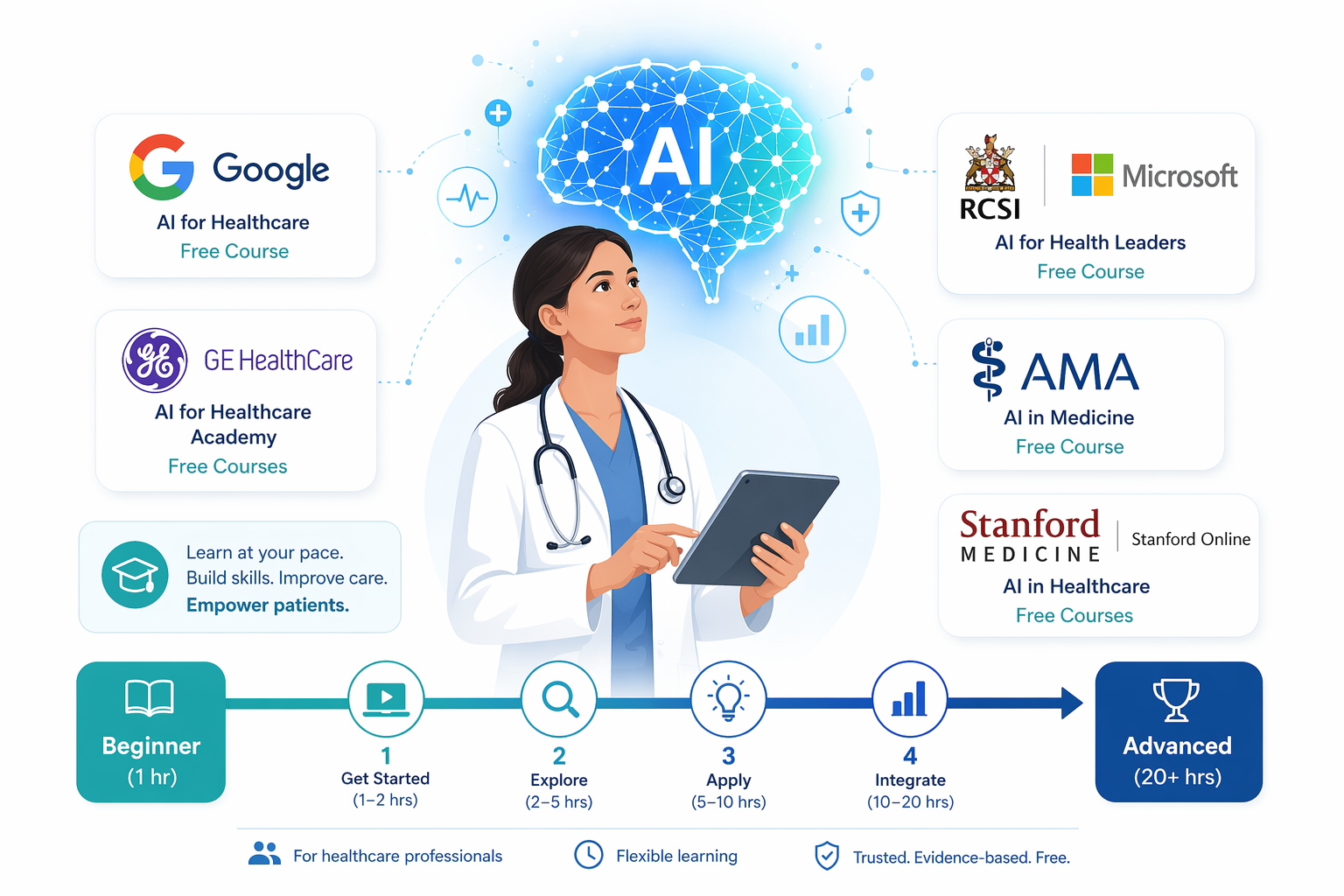
 Multiple (Google/DiMe, RCSI, GE HealthCare, Great Learning, AMA, AAFP, Medmastery, Stanford)
Why AI Fluency Matters Now: The Training Gap Behind the 81% Adoption Stat
The American Medical Association reported in 2026 that physician use of artificial intelligence has more than doubled since 2023, reaching 81%. That figure, cited by GE HealthCare in its May 2026 announcement of a free training program, captures a striking shift: AI tools have moved from experimental curiosity to routine clinical presence in just three years. Yet the same data point exposes a structural problem. Adoption has raced ahead of the formal training infrastructure needed to use these tools safely, critically, and effectively.
Clinicians who never encountered machine learning in medical school now face AI-powered triage systems, ambient documentation scribes, and clinical decision support tools embedded in their daily workflow. Administrators must evaluate procurement decisions for products whose technical claims they may not be equipped to assess. Researchers need to understand model architectures and validation methodologies to design studies that survive peer review.
The response from the training ecosystem has been fragmented. Medical societies, technology vendors, universities, and device manufacturers have all launched courses, but the landscape is difficult to navigate. Some offerings are deep and CME-accredited; others are brief primers. Some are genuinely free; others charge for certificates. This guide provides a structured, role-matched comparison of the major free AI-in-healthcare courses available as of mid-2026, so you can identify the option that fits your role, time budget, and credential requirements without wading through marketing claims.
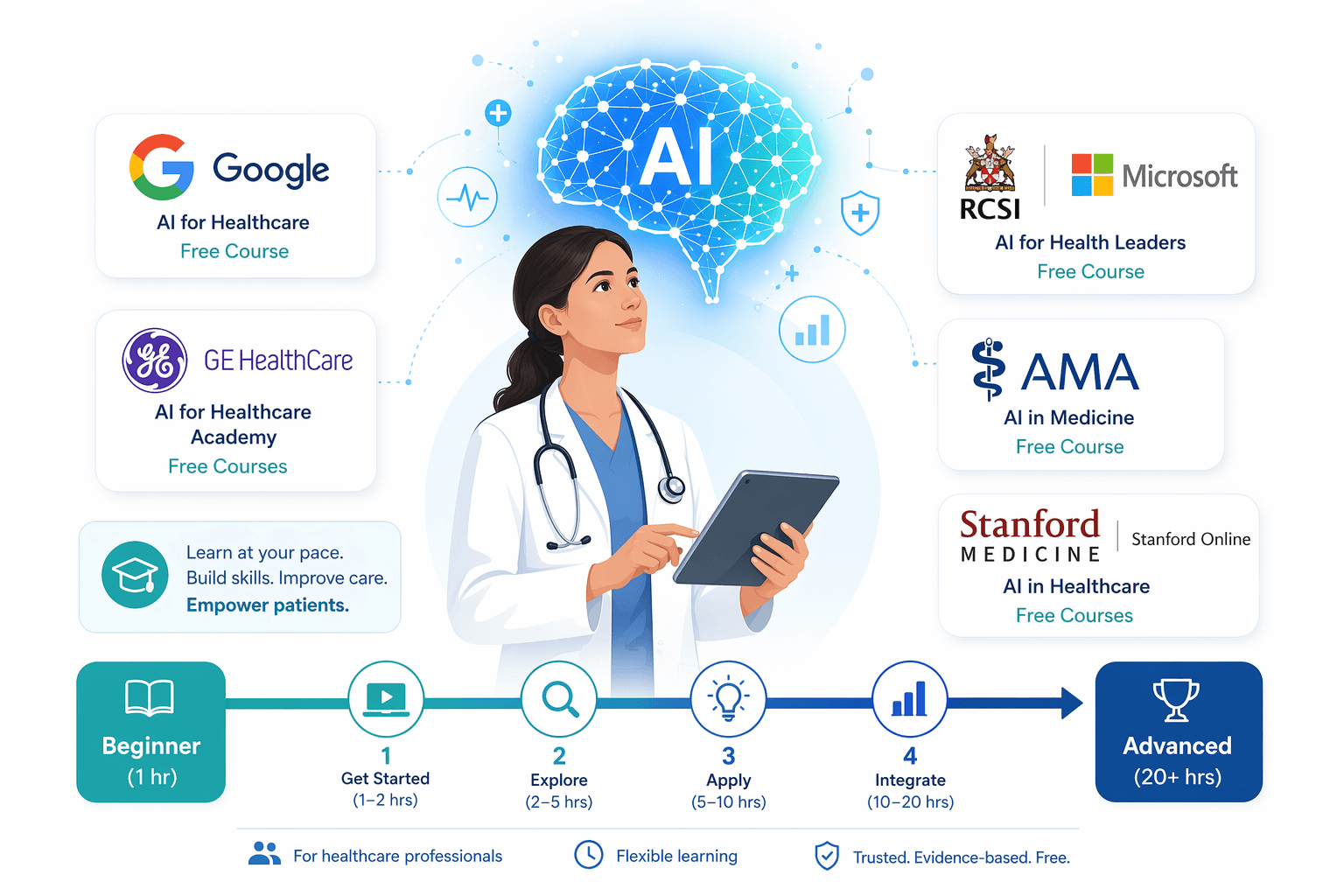
At a Glance: 8 Free AI-in-Healthcare Courses Compared
The table below provides a side-by-side comparison of eight free courses across the dimensions that matter most for selection: provider type, duration, CME or CPD credit availability, certificate options, and primary target audience. Use this as your starting point to narrow the field before reading the detailed descriptions.
| Course / Provider | Provider Type | Duration | CME / CPD Credit | Certificate | Best For |
|---|---|---|---|---|---|
| Google GenAI for Healthcare (via DiMe) | Tech vendor | ~1 hour | No | Free (DiMe community) | Clinicians, researchers, administrators wanting a quick primer |
| RCSI AI in Healthcare | University / Medical society | ~10 hours | 10 CPD credits (free) | €50 for certificate with CPD points | Clinicians and non-clinical staff seeking CPD-accredited depth |
| GE HealthCare HelloAI | Medical device vendor | 20+ hours | No | Free | Administrators and clinicians wanting broad operational AI literacy |
| Great Learning AI in Healthcare | Online learning platform | ~3 hours | No | Nominal fee | Beginners wanting structured fundamentals with a case study |
| AMA Ed Hub AI in Health Care Series | Medical society | Varies (multiple modules) | CME (requires account) | CME credit (requires account) | Physicians needing CME from a trusted medical source |
| AAFP AI in Family Medicine | Medical society | 3 parts | CME (free) | CME credit | Primary care clinicians seeking specialty-specific CME |
| Medmastery ChatGPT Essentials for Clinicians | Medical education platform | 14 lessons | No | Free access | Clinicians wanting practical LLM and ChatGPT skills |
| Stanford Free Webinars (multiple topics) | University | Varies (1 hour each) | No | Free access | Researchers and clinicians seeking expert perspectives |
Deep Dive: What Each Free Course Actually Teaches
Google Generative AI for Healthcare (via Digital Medicine Society / DiMe)
This course, hosted by the Digital Medicine Society (DiMe), is designed to demystify generative AI and large language models (LLMs) for healthcare professionals, administrators, medical researchers, and technology innovators. It covers key fundamentals of generative AI, how to describe AI and machine learning (supervised, unsupervised, deep learning), an overview of LLMs for decision-making and patient care, and prompt engineering skills. The course takes approximately 1 hour to complete and is self-paced with animated explainer videos. It is free to access for the DiMe community.
RCSI University of Medicine and Health Sciences: AI in Healthcare
RCSI offers a fully online, self-paced short course led by consultant radiologist Dr. John Sheehan, developed in conjunction with Microsoft. It is free to access and provides 10 CPD credits. The course requires approximately 10 hours to complete across four modules: core concepts, ethics and governance, clinical applications, and administrative applications. It is suitable for both clinical and non-clinical roles with no prior AI experience required. A certificate of completion with 10 CPD points is available for a fee of €50 after passing the MCQ knowledge check.
GE HealthCare HelloAI Program
GE HealthCare announced on May 19, 2026 that it is making more than 20 hours of healthcare AI training publicly available at no cost through its HelloAI program. The curriculum includes digital on-demand learning and webinars with healthcare experts. This is in addition to the one-hour HelloAI Foundations course. GE HealthCare Global Head of AI Advocacy Jan Beger stated the program aims to "empower more people across healthcare to participate in the AI journey." This is the largest single free AI healthcare curriculum from a vendor.
Great Learning Academy: AI in Healthcare
Great Learning Academy offers a free online AI in Healthcare course at a beginner level requiring approximately 3 learning hours. The curriculum covers AI fundamentals, GenAI, LLMs, ChatGPT, AI applications in healthcare (medication development, diagnosis, treatment, monitoring), a case study on AI-driven pneumonia identification using medical image analysis, and risks, challenges, ethics, and the future of AI in healthcare. Over 38,400 learners have enrolled. The course is free to access; a certificate of completion is available for a nominal fee upon successful completion. The instructor is "Glaide," an AI-powered teacher.
AMA Ed Hub: AI in Health Care CME Series
The AMA Ed Hub offers a series of CME modules on AI in health care. The content includes video discussions with experts such as Dr. Vincent Liu from Kaiser Permanente, who discusses implementation of AI programs including the Advanced Alert Monitor (AAM) program, which uses a machine learning algorithm on millions of data points to predict patient deterioration within 12 hours. The series covers practical AI implementation topics. Access requires creating an AMA Ed Hub account.
AAFP: AI in Family Medicine: Transforming Your Practice
The American Academy of Family Physicians offers a free 3-part course on AI in family medicine. The curriculum focuses on reducing administrative burden, improving patient care, and understanding machine learning in primary care. It is designed specifically for family physicians and offers CME credit. This is one of the few specialty-specific free AI courses available.
Medmastery: ChatGPT Essentials for Clinicians
Medmastery offers free access to a course titled "ChatGPT Essentials for Clinicians," which includes 14 lessons covering ChatGPT integration, generating medical and academic texts, and enhancing learning. This course is focused on practical, hands-on skills for using large language models in clinical and academic contexts. It is designed for clinicians who want to immediately apply AI tools to their daily work.
Stanford University: Free Webinars and Recorded Content
Stanford Online offers a collection of free webinars and articles on AI topics relevant to healthcare. Healthcare-relevant free content includes: "Bringing AI into Healthcare" (challenges of integrating AI into healthcare safely and ethically), "How Artificial Intelligence Can Improve Healthcare" (usefulness analysis for AI in hospitals), "Stanford Medcast Episode 28: Hot Topics Mini-series – Artificial Intelligence in Medicine" (current and future impact of AI in medicine), and "AI + Health 2021 Recorded Webinar, Track 1: Advancing the Practice + Science of Medicine via AI." These are free, standalone resources but are not structured courses with CME or certificates.
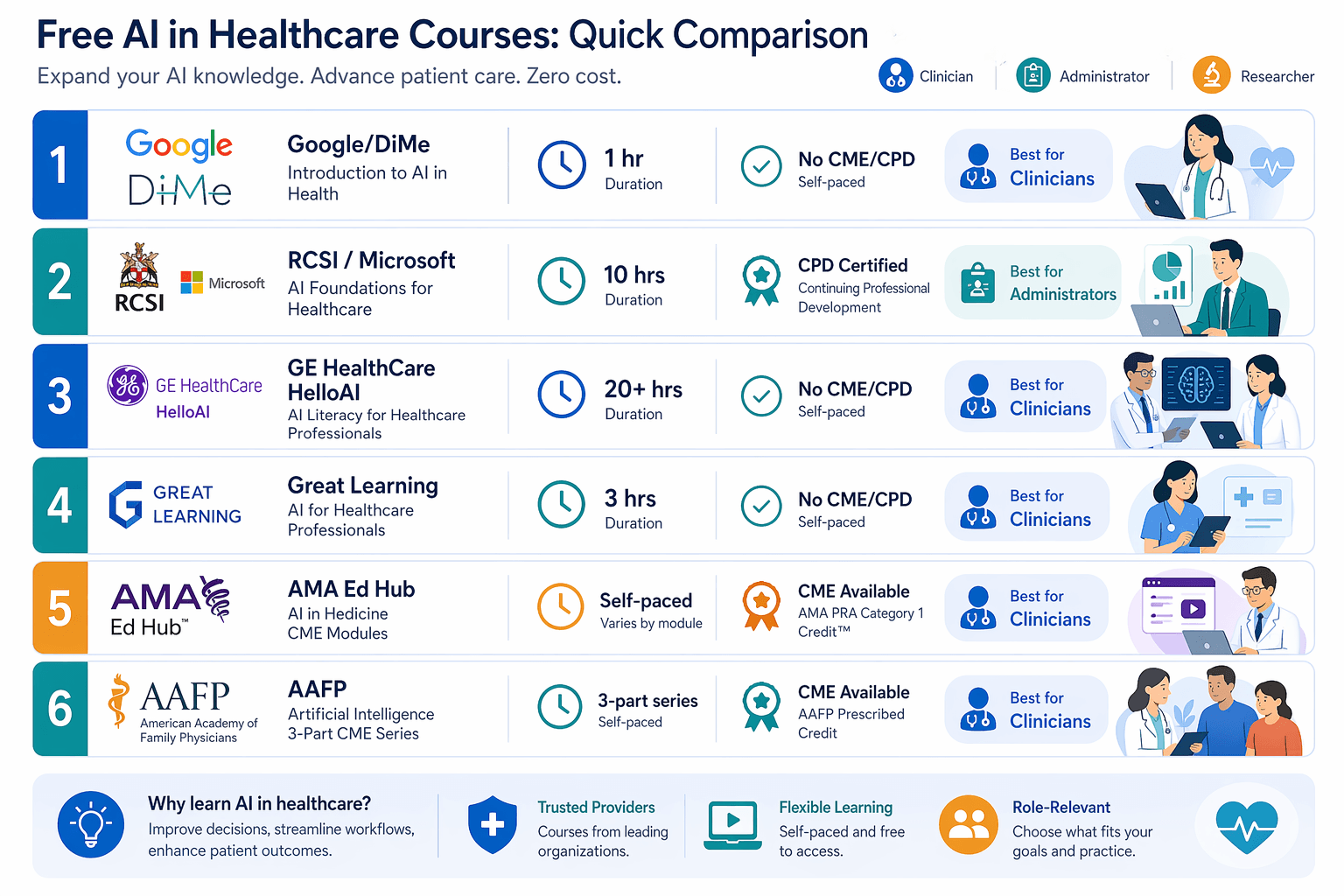
Which Course Fits Your Role? A Selection Guide for Clinicians, Administrators, and Researchers
The best course for you depends on your professional role, your primary goal, and the time you can commit. The table below organizes the courses by target reader profile and primary need.
| Your Role | Primary Need | Recommended Courses | Why |
|---|---|---|---|
| Clinician (physician, nurse, allied health) | CME/CPD-accredited training with clinical relevance | RCSI AI in Healthcare, AAFP AI in Family Medicine, AMA Ed Hub AI Series | These courses offer formal CME/CPD credits and are designed by or for medical professionals. RCSI provides 10 CPD credits free; AAFP offers specialty-specific CME for primary care. |
| Clinician (any specialty) | Practical, hands-on LLM skills for daily workflow | Medmastery ChatGPT Essentials for Clinicians, Google GenAI for Healthcare (DiMe) | Medmastery focuses on practical ChatGPT integration. Google/DiMe provides a quick conceptual foundation for generative AI. |
| Healthcare administrator / manager | Broad operational AI literacy for procurement and strategy decisions | GE HealthCare HelloAI, Great Learning AI in Healthcare | GE HelloAI offers the most comprehensive overview (20+ hours) of AI across healthcare operations. Great Learning provides a structured 3-hour foundation with a case study. |
| Medical researcher / academic | Technical depth and exposure to cutting-edge AI concepts | Google GenAI for Healthcare (DiMe), Stanford Free Webinars, RCSI AI in Healthcare | Google/DiMe covers generative AI fundamentals. Stanford webinars provide expert perspectives. RCSI offers a structured academic approach with CPD credit. |
| Medical student / resident | Foundational AI literacy with minimal time commitment | Great Learning AI in Healthcare, Google GenAI for Healthcare (DiMe) | Both are short, self-paced, and require no prior AI knowledge. Great Learning includes a case study; Google/DiMe focuses on generative AI. |
| Any healthcare professional | Quick overview (under 2 hours) | Google GenAI for Healthcare (DiMe), Medmastery ChatGPT Essentials for Clinicians | Both can be completed in 1-2 hours and provide immediately useful knowledge without a major time investment. |
Time-Budget Decision Framework
If you have only 1 hour: Start with Google Generative AI for Healthcare via DiMe. It is the fastest route to understanding what generative AI and LLMs mean for healthcare.
If you have 3 hours: Great Learning AI in Healthcare provides a structured curriculum with a case study and covers the full spectrum of AI applications.
If you have 10 hours and need CPD credit: RCSI AI in Healthcare is the strongest option. It offers depth across four modules and formal CPD accreditation.
If you have 20+ hours and want comprehensive coverage: GE HealthCare HelloAI is the most extensive free curriculum available, covering AI across the healthcare enterprise.
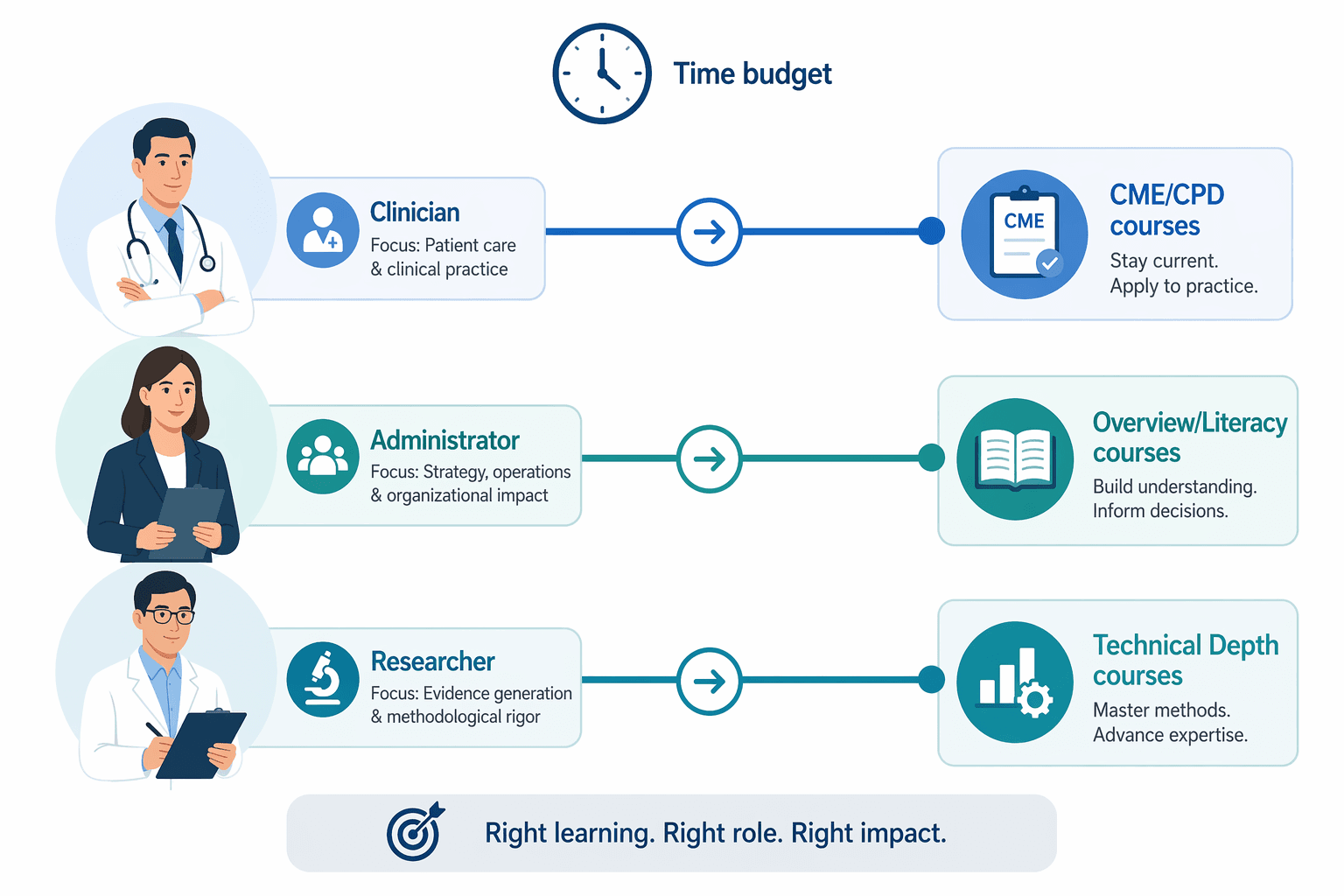
What to Watch Out For: Certificate Fees, Access Requirements, and Update Schedules
The word "free" in course descriptions requires careful interpretation. Most courses offer free access to content but charge for formal credentials. Here are the key caveats to consider before enrolling.
- Certificate fees: RCSI charges €50 for a certificate with 10 CPD points. Great Learning charges a nominal fee for its certificate. The Google/DiMe course offers a free certificate for DiMe community members. GE HelloAI, AAFP, Medmastery, and Stanford webinars do not charge for certificates.
- Account requirements: The AMA Ed Hub requires account creation to access its CME modules. The Google/DiMe course requires joining the DiMe community. These are free but add a registration step.
- Update schedules: The RCSI course was undergoing scheduled updates until June 22, 2026, and enrollment was closed at time of research. Always check the course website for current availability before planning your study schedule.
- New program uncertainty: GE HealthCare HelloAI was announced in May 2026. Curriculum details beyond the press release were limited at time of research. The program may expand or change as it matures.
- CME verification: The AMA Ed Hub modules require authentication to verify CME credit specifics. The AAFP course details could not be independently verified from the AAFP website at time of research.
- Regional restrictions: Some courses may be region-restricted or require institutional affiliation for full access. Check the terms before enrolling.
How to Choose: A Step-by-Step Decision Framework
Use the following five-step process to identify the best course for your situation.
- Identify your role and primary goal. Are you a clinician who needs CME credit? An administrator evaluating AI procurement? A researcher building technical vocabulary? Your role determines which courses are relevant.
- Check your time budget. Be realistic about how many hours you can dedicate. A 1-hour course completed today is more valuable than a 20-hour course you never start.
- Determine if CME or CPD credit is required. If your employer or licensing board requires formal continuing education credits, prioritize RCSI (10 CPD credits), AAFP (CME), or AMA Ed Hub (CME). If you only need knowledge, any course on the list will serve you.
- Review the comparison table. Cross-reference your role, time budget, and credential needs against the table in Section 2 to identify your top 2-3 candidates.
- Start with the best-fit course. Enroll in one course and complete it before considering additional options. Building AI fluency is a cumulative process; starting with a single well-chosen course is more effective than sampling multiple courses without finishing any.
The Bottom Line: Free Training Is Available — But Choose Deliberately
The 2026 landscape of free AI-in-healthcare courses is remarkably rich. A clinician can earn 10 CPD credits at no cost through RCSI. An administrator can access 20+ hours of vendor-agnostic training through GE HealthCare HelloAI. A researcher can build generative AI literacy in one hour through Google and DiMe. A primary care physician can get specialty-specific CME from the AAFP.
The challenge is no longer finding free training. It is choosing the right training for your specific role, time budget, and credential requirements. The courses listed in this guide represent the best available options across provider types as of June 2026, but the field is evolving rapidly. New programs will emerge, and existing ones will update their curricula.
Start with one course. Complete it. Apply what you learn to your daily work. Then decide whether you need more depth, a different focus, or formal certification. The goal is not to consume all available training but to build the AI fluency your role demands.
Comments
Join the discussion with an anonymous comment.