
 Multiple (UIUC, Harvard, AMA, ABAIM, JHU, MIT xPRO, Stanford Coursera, Imperial College, Udacity)
Why Clinicians Need AI Literacy — and Why Most Course Roundups Miss the Mark
Artificial intelligence is no longer a future prospect in clinical medicine — it is already embedded in diagnostic imaging, clinical decision support, ambient documentation, and sepsis prediction systems. For practicing physicians, nurses, and clinical leaders, understanding how these tools work, where they fail, and how to evaluate their output is becoming a core professional competency. Yet most AI course roundups treat clinicians as a secondary audience, burying CME eligibility and clinical relevance under generic market statistics.
The numbers confirm the urgency. According to the AAMC's 2024 Curriculum SCOPE survey, 77% of US and Canadian medical schools now incorporate AI into their curricula, up from 53% in 2023. That shift reflects a broader recognition: clinicians entering practice today will spend their careers alongside AI systems. The AAMC is developing a national set of AI competencies spanning undergraduate, graduate, and continuing medical education. The public comment period on the second draft closed June 10, 2026, and the final report is expected in fall 2026. When those competencies land, CME-eligible training will not be optional — it will be the baseline expectation.
The problem is that existing course directories rarely filter for what clinicians actually need: programs that offer CME credits, respect demanding schedules, and teach practical evaluation skills rather than abstract machine learning theory. This guide is built around that gap. Every program listed below has been verified for CME or CEU accreditation, clinical relevance, and realistic time commitment.
To see what real clinical AI deployments look like — from diagnostic imaging triage to ambient documentation — read our case study roundup: AI and Healthcare: What Real Clinical Deployments Actually Look Like.
CME-Eligible AI Courses: Programs That Count Toward Your License
For practicing clinicians, the first filter is always accreditation. A course that does not offer CME credits or CEUs is difficult to justify against competing demands for time and budget. The following programs have confirmed CME or CEU eligibility and are designed for healthcare professionals.
| Program | Cost | CME / CEU Credits | Format | Duration | Target Audience |
|---|---|---|---|---|---|
| UIUC AI in Medicine Certificate | $750 | CME credits (exact hours: verify on ACCME) | Self-paced online | 6 modules | Clinicians, no coding required |
| Harvard AI in Clinical Medicine | $3,050 | Up to 27 AMA PRA Category 1 credits | Live virtual (3 days) | 3 days | Physicians, clinicians |
| AMA ChangeMedEd AI Series | Free | CME credits (7 modules, exact hours: verify) | Self-paced online | 7 modules | Medical students, residents, practicing physicians |
| ABAIM Certification | Varies | CME-accredited | Virtual | Self-paced | Clinicians, health IT professionals |
| JHU AI in Healthcare Certificate | $2,990 | 6 CEUs | Online with live masterclasses | 10 weeks | Healthcare professionals, no coding required |
| MIT xPRO AI in Healthcare | $2,650 | 3.5 CEUs | Self-paced online | 8 weeks (5–7 hrs/week) | Technical professionals, requires Python and calculus |
The University of Illinois AI in Medicine Certificate stands out as the most affordable university credential with CME credits at $750. Its six modules are designed for non-technical clinicians, covering AI fundamentals, clinical applications, and ethical considerations without requiring programming. For clinicians who need a concentrated, immersive experience, Harvard Medical School's AI in Clinical Medicine offers up to 27 AMA PRA Category 1 credits in a three-day live virtual format — ideal for those who can block out a long weekend but cannot sustain weeks of coursework.
The AMA ChangeMedEd Artificial Intelligence in Health Care Series is a free seven-part online module series developed with the University of Michigan DATA-MD team. It covers ethical and legal considerations, practical applications in health systems, and AI in diagnosis. While originally targeted at medical students, the content is equally relevant for residents, fellows, and practicing physicians. The zero-cost entry point makes it an excellent starting point for clinicians who are new to AI and want to test the waters before committing to a paid program.
Clinician-Focused Courses Without Coding: Build Practical AI Evaluation Skills
Many clinicians do not need to write Python code or train neural networks. What they need is the ability to critically evaluate AI tools: assess diagnostic accuracy, identify algorithmic bias, understand regulatory clearance, and determine whether a given tool is appropriate for their patient population. The following programs are designed for that purpose.
| Program | Cost | Format | Duration | Key Focus Areas |
|---|---|---|---|---|
| Stanford Coursera AI in Healthcare Specialization | $49/month (Coursera subscription) | Self-paced online | ~4 months at 3 hrs/week | AI fundamentals, clinical applications, ethics, no coding |
| Harvard AI in Clinical Medicine | $3,050 | Live virtual (3 days) | 3 days | Diagnostic AI, clinical decision support, regulatory literacy |
| Imperial College: Leading Responsible Adoption of AI in Healthcare | Varies | Online cohort | 6 weeks | Regulatory frameworks (EU AI Act, FDA), ethics, implementation |
| JHU AI in Healthcare Certificate | $2,990 | Online with live masterclasses | 10 weeks | AI foundations, predictive analytics, LLMs, ethics, change management |
The Stanford Coursera AI in Healthcare Specialization is a popular entry point. At $49 per month with a Coursera subscription, it is affordable and flexible. The specialization covers AI fundamentals, clinical applications, and ethics without requiring any programming background. For clinicians who prefer a structured cohort experience with live faculty interaction, Imperial College's 'Leading Responsible Adoption of AI in Healthcare' offers a six-week online program with a strong regulatory focus, covering the EU AI Act and FDA frameworks — increasingly important as AI governance matures.
The JHU AI in Healthcare Certificate ($2,990, 10 weeks) is notable for its breadth: it covers six machine learning algorithms, predictive analytics, large language models in healthcare, robotic process automation, ethics and regulation, and change management — all without requiring prior programming experience. The program includes ten real-world case studies, from COVID-19 chest X-ray analysis to hospital readmission prediction and sepsis detection, making it directly applicable to clinical practice.
Technical Options for Clinician-Researchers: When You Need to Go Deeper
Some clinicians — particularly those involved in research, clinical informatics, or AI development — need to understand the technical underpinnings of machine learning models. These programs require programming or quantitative backgrounds but offer deeper engagement with model architecture, validation, and deployment.
| Program | Cost | Prerequisites | Format | Duration | Credits |
|---|---|---|---|---|---|
| MIT xPRO AI in Healthcare | $2,650 | Python, calculus, linear algebra, statistics | Self-paced online | 8 weeks (5–7 hrs/week) | 3.5 CEUs, certificate |
| Udacity AI for Healthcare Nanodegree | $399/month | Intermediate Python, basic ML knowledge | Self-paced online | ~3–4 months | Nanodegree certificate |
| University of Florida AI-Based Medicine CME | $200 | Python basics | Online | Self-paced | CME credits |
The MIT xPRO Artificial Intelligence in Healthcare program is the most rigorous option for clinicians with a quantitative background. It requires proficiency in Python, calculus, linear algebra, statistics, and probability. Over eight weeks (5–7 hours per week), participants work through AI design processes, machine learning algorithms, deep learning, neural networks, natural language processing, and biomechatronics. Hands-on projects include ideating an ingestible robot, running machine learning in Python, and developing an AI product proposal for healthcare. Graduates earn a certificate and 3.5 Continuing Education Units (CEUs) from MIT xPRO.
For clinicians who want a project-based approach at a lower cost, the Udacity AI for Healthcare Nanodegree ($399/month) includes medical imaging projects and requires intermediate Python skills. The University of Florida AI-Based Medicine CME course ($200) is a budget-friendly option for clinicians who already know Python basics and want CME credits while learning to apply AI to clinical data.
How to Critically Evaluate AI Literature Using Course Frameworks
The ultimate goal of AI training for clinicians is not to become data scientists — it is to become informed evaluators of AI tools and studies. Every CME-eligible program listed above teaches some version of critical appraisal. Here is a framework you can apply immediately, drawn from the evaluation skills these courses emphasize.
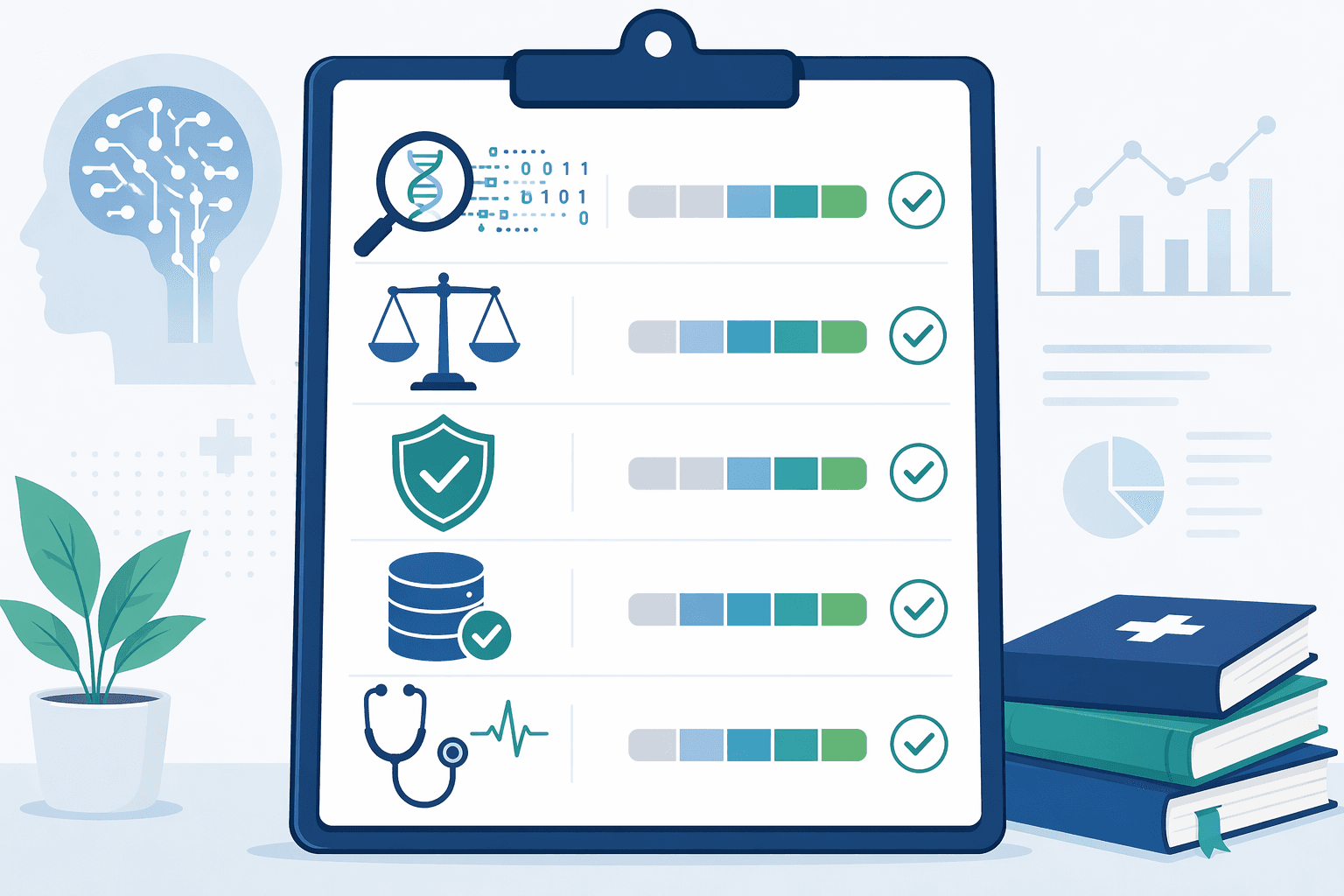
| Evaluation Criterion | What to Look For | Red Flags |
|---|---|---|
| Diagnostic Accuracy | Reported AUC, sensitivity, specificity, and positive/negative predictive values. Compare against clinical benchmarks. | Only accuracy reported without sensitivity/specificity; metrics on a single, non-representative dataset. |
| Algorithmic Bias | Demographic breakdown of the study population. Subgroup analyses by age, sex, race, and socioeconomic status. | No demographic data reported; model trained on data from a single institution or homogeneous population. |
| Regulatory Status | FDA clearance (510(k), De Novo, PMA) or CE mark. Note the intended use stated in the clearance. | No regulatory status mentioned; claims of 'FDA registered' without specifying clearance pathway. |
| External Validation | Model tested on an independent dataset from a different institution, population, or time period. | Validation only on a hold-out set from the same dataset; no external validation performed. |
| Clinical Relevance | Study conducted in a real clinical workflow, not a retrospective simulation. Measures patient outcomes, not just model performance. | No workflow integration described; outcomes measured only in terms of model accuracy, not clinical impact. |
When reading an AI study, start with the regulatory status. FDA clearance does not mean the tool is clinically effective — it means the manufacturer demonstrated safety and effectiveness for a specific intended use. Check whether the clearance was through the 510(k) pathway (substantial equivalence to a predicate device) or De Novo (novel device with no predicate). Then examine the study population: if the training data came from a single academic medical center, the model may not generalize to community hospitals or diverse patient populations.
Many courses cover AI governance frameworks in depth. For a deeper resource on the NIST AI Risk Management Framework and its healthcare applications, see our deep dive: NIST AI Risk Management Framework in Healthcare: How GOVERN, MAP, MEASURE, and MANAGE Bridge FDA Voluntary Governance and Algorithmic Accountability.
Emerging Trends: AAMC National AI Competencies and HMS Curriculum Integration
Two developments signal that AI literacy is moving from optional to mandatory in medical education and continuing professional development.
First, the AAMC's national AI competencies framework is nearing completion. The public comment period on the second draft closed June 10, 2026, and the final report is targeted for fall 2026. Supported by the Josiah Macy Jr. Foundation, this framework will define what AI competencies are expected across undergraduate medical education (UME), graduate medical education (GME), and continuing medical education (CME). When released, it will likely influence accreditation standards, board certification requirements, and CME planning for years to come. Clinicians who complete CME-eligible AI training now will be ahead of the curve.
Second, Harvard Medical School has introduced a month-long introductory AI in healthcare course (HT 16/18) for its Health Sciences and Technology (HST) track students. This course is currently mandatory for the approximately 30 HST track students per year out of a total medical class of roughly 160. While it is not yet required for all HMS students, the move signals that elite medical schools view AI literacy as a core competency. HMS is also integrating AI into the curriculum in three categories: as an educational tool (an AI tutor bot planned for 2025), preparing MD/MD-PhD students for clinical AI impact, and through dedicated AI research labs.
Making Your Choice: A Decision Framework for Clinicians
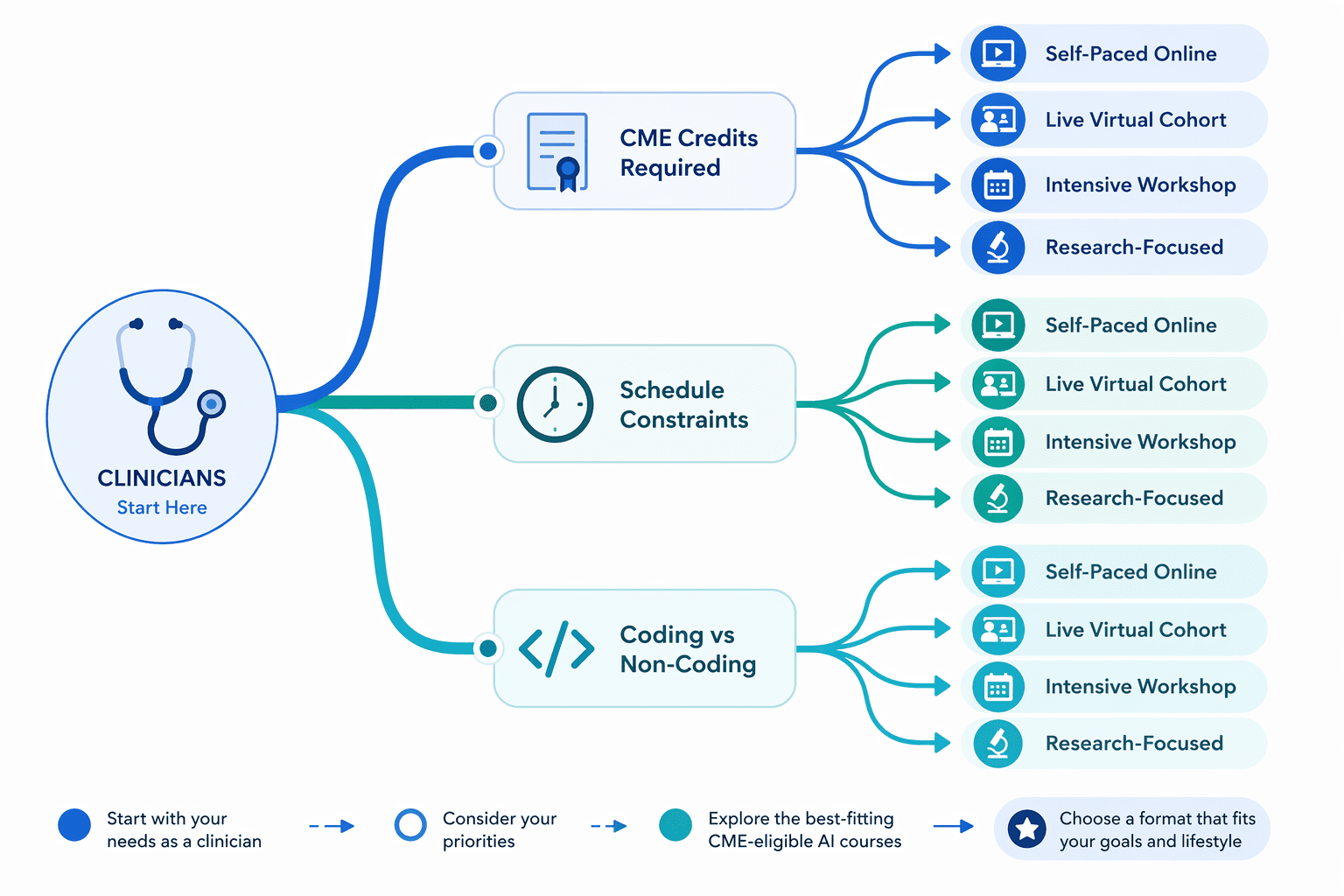
With multiple programs available, the right choice depends on your specific constraints. Use the following decision framework, prioritizing CME eligibility and clinical relevance above all other factors.
- Start with CME eligibility. If you need credits for license renewal, filter out any program that does not offer AMA PRA Category 1 credits, AAFP credits, or CEUs recognized by your state board. The UIUC certificate ($750) and Harvard AI in Clinical Medicine (up to 27 credits) are strong first choices.
- Assess your schedule. Can you block out three consecutive days? Harvard's live virtual format works. Do you need self-paced learning spread over weeks? The UIUC certificate, AMA ChangeMedEd series, or Stanford Coursera specialization are better fits.
- Determine your technical depth. If you never want to write code, choose a non-technical program like UIUC, Harvard, Imperial College, or JHU. If you plan to build or validate models, invest in MIT xPRO or Udacity — but only after meeting the prerequisites.
- Consider your budget. The AMA ChangeMedEd series is free. The Stanford Coursera specialization costs $49/month. The UIUC certificate is $750. JHU is $2,990. Harvard and MIT xPRO are in the $2,600–$3,100 range. Choose the highest-quality program you can afford without financial strain.
- Verify current details before enrolling. Pricing, CME credit hours, and program dates change. Always check the official program page and the ACCME website for the most current information.
Comments
Join the discussion with an anonymous comment.