
The clinical value of AI for wildfire smoke health monitoring is not that it draws a sharper plume on a screen. The value begins when exposure estimates separate wildfire-specific PM2.5 from the background fine-particle mixture and show that the same microgram per cubic meter may not carry the same respiratory risk.
That distinction matters at the bedside. A child with asthma, an older adult with COPD, or a patient recovering from pneumonia does not need a generic reminder that air quality is “moderate” or “unhealthy for sensitive groups.” The more useful question is whether today’s PM2.5 is ordinary urban particle pollution, wildfire smoke, or a mixture in which smoke is the dominant component. The emerging evidence suggests that wildfire PM2.5 should be treated as a higher-risk signal, not just a higher number.
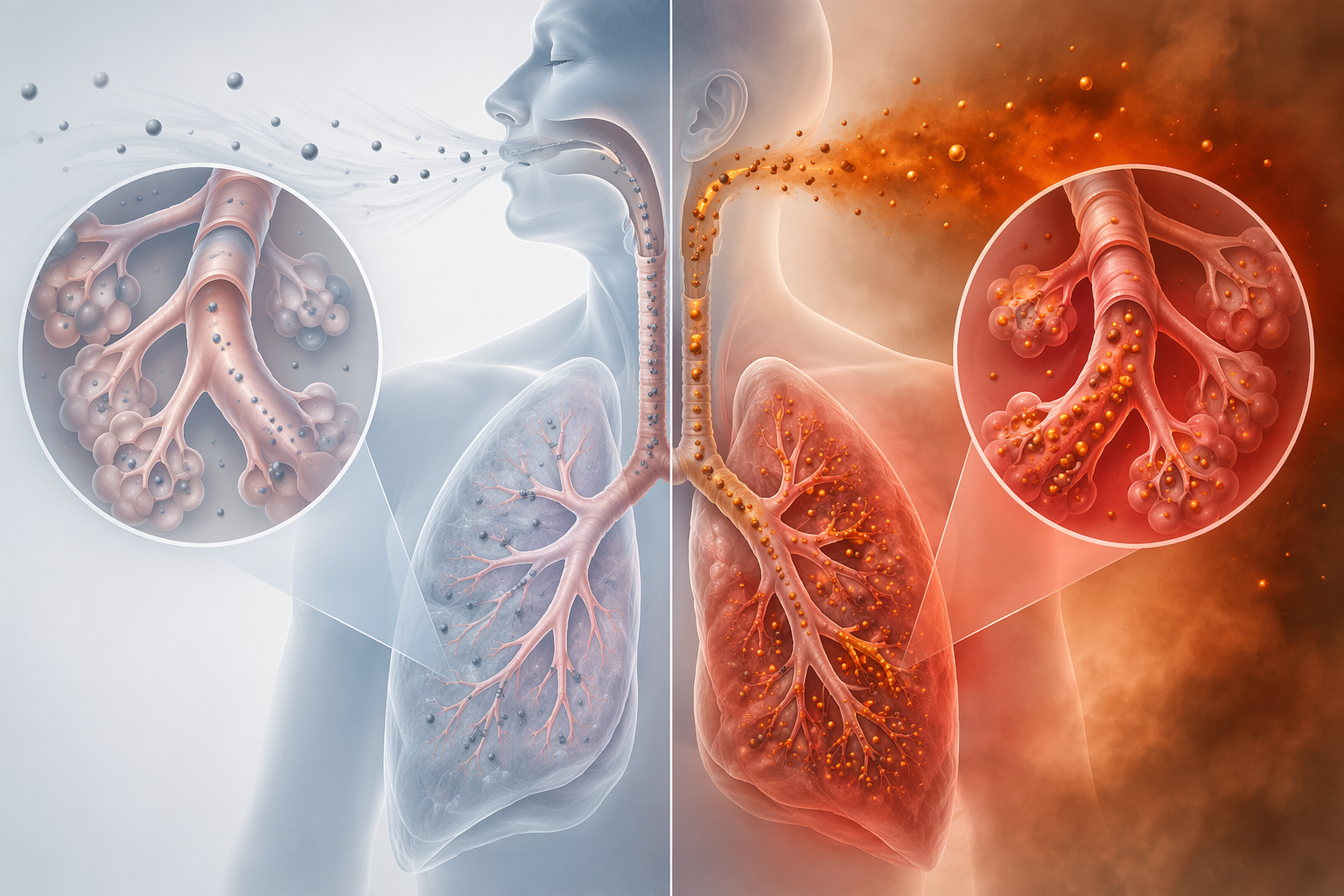
The Key Finding Is About Source, Not Just Concentration
Aguilera et al. is the study that most directly connects smoke-specific exposure estimation to a clinically meaningful respiratory outcome. The investigators examined 696 Southern California zip codes over 14 years and linked PM2.5 exposure estimates with 1,655,011 respiratory hospital admissions. Crucially, they did not simply ask whether more PM2.5 was associated with more admissions. They separated wildfire PM2.5 from non-wildfire PM2.5 and compared the health associations across four analytical approaches: instrumental variable two-stage regression, spatio-temporal multiple imputation, interaction effect models, and seasonal interpolation.[1]
Across those approaches, wildfire PM2.5 was associated with a 1.3% to 10% increase in respiratory hospitalizations per 10 μg/m³, while non-wildfire PM2.5 was associated with a 0.67% to 1.3% increase per 10 μg/m³.[1] The cleanest way to read that is not as a single magic multiplier. It is a patterned signal: when the source is wildfire smoke, the respiratory association per unit mass is larger than when the particles come from non-wildfire sources.
This is where the monitoring problem becomes clinical. If a dashboard reports only total PM2.5, it can hide the difference between a winter pollution episode and a wind-driven smoke episode. The concentration may look comparable; the conversation with a vulnerable patient should not. A pulmonologist deciding how strongly to counsel avoidance, medication readiness, symptom thresholds, and follow-up has reason to weigh wildfire-attributed PM2.5 more heavily than the same mass concentration from mixed ambient sources.
For broader background on smoke-related respiratory and cardiovascular effects, a separate overview can do that work; the important point here is narrower. The strongest actionable evidence is not merely that wildfire smoke is bad for health, but that source attribution changes the apparent risk attached to the PM2.5 number. For readers who need the broader clinical context, see the internal review on health risks of wildfire smoke and AI air quality monitoring.
Why the Aguilera Design Deserves the Weight
The study’s strength is not that it makes uncertainty disappear. Its strength is that it attacks the same question from several directions. Wildfire smoke exposure is difficult to estimate because smoke plumes move, monitors are unevenly distributed, hospital admissions reflect many drivers, and high-smoke days are not randomly assigned. A single model can look deceptively precise under those conditions.
By comparing four analytical approaches, Aguilera et al. made the source-specific result harder to dismiss as an artifact of one modeling choice. Instrumental-variable analysis addressed smoke transport patterns; spatio-temporal multiple imputation filled exposure gaps; interaction models compared whether wildfire and non-wildfire PM2.5 behaved differently; seasonal interpolation offered another way to isolate wildfire-related increments.[1] The estimates did not collapse into one identical value, and that matters. Wide variation is a warning against overselling precision, but directional consistency supports the clinical inference that wildfire PM2.5 is not interchangeable with other PM2.5.
| Clinical Question | What the Evidence Supports | What It Does Not Prove |
|---|---|---|
| Is wildfire PM2.5 associated with respiratory admissions? | Yes, in the Southern California analysis, wildfire PM2.5 was associated with higher respiratory hospitalization risk per 10 μg/m³. | It does not prove that every smoke event in every region has the same effect size. |
| Is wildfire PM2.5 more harmful per unit mass than non-wildfire PM2.5? | The study supports a larger respiratory association for wildfire PM2.5 than for non-wildfire PM2.5. | It does not settle a universal toxicity multiplier. |
| Can clinicians use source attribution in risk communication? | Yes, especially for at-risk patients during smoke events. | It does not prove that any specific monitoring platform improves outcomes. |
The limits are not footnotes. The study domain was Southern California, a region shaped by Santa Ana wind events, and the analysis excluded summer months.[1] That makes sense for the exposure question the investigators were asking, but it constrains generalization. A smoke episode in the Pacific Northwest, the Mountain West, Canada, or the eastern United States may differ in fuel, chemistry, meteorology, background pollution, housing stock, and population vulnerability. The Southern California result is strong enough to change how clinicians read smoke-attributed PM2.5; it is not strong enough to assign the same numeric risk coefficient to every patient everywhere.
The Measurement Breakthrough Is Exposure Attribution
Three tasks are often blurred together when people talk about AI smoke monitoring. They should stay separate.
- Fire detection identifies where burning is occurring or likely occurring.
- Smoke-specific exposure estimation estimates how much PM2.5 at a given place and time is attributable to wildfire smoke.
- Clinical outcome evidence tests whether the monitored or modeled exposure is associated with health events, and whether using the tool changes care.
The first task can be operationally impressive without answering the clinical question. The second task is where AI and statistical modeling become medically useful. The third task is the hardest, and it is where claims about health benefit need the most discipline.
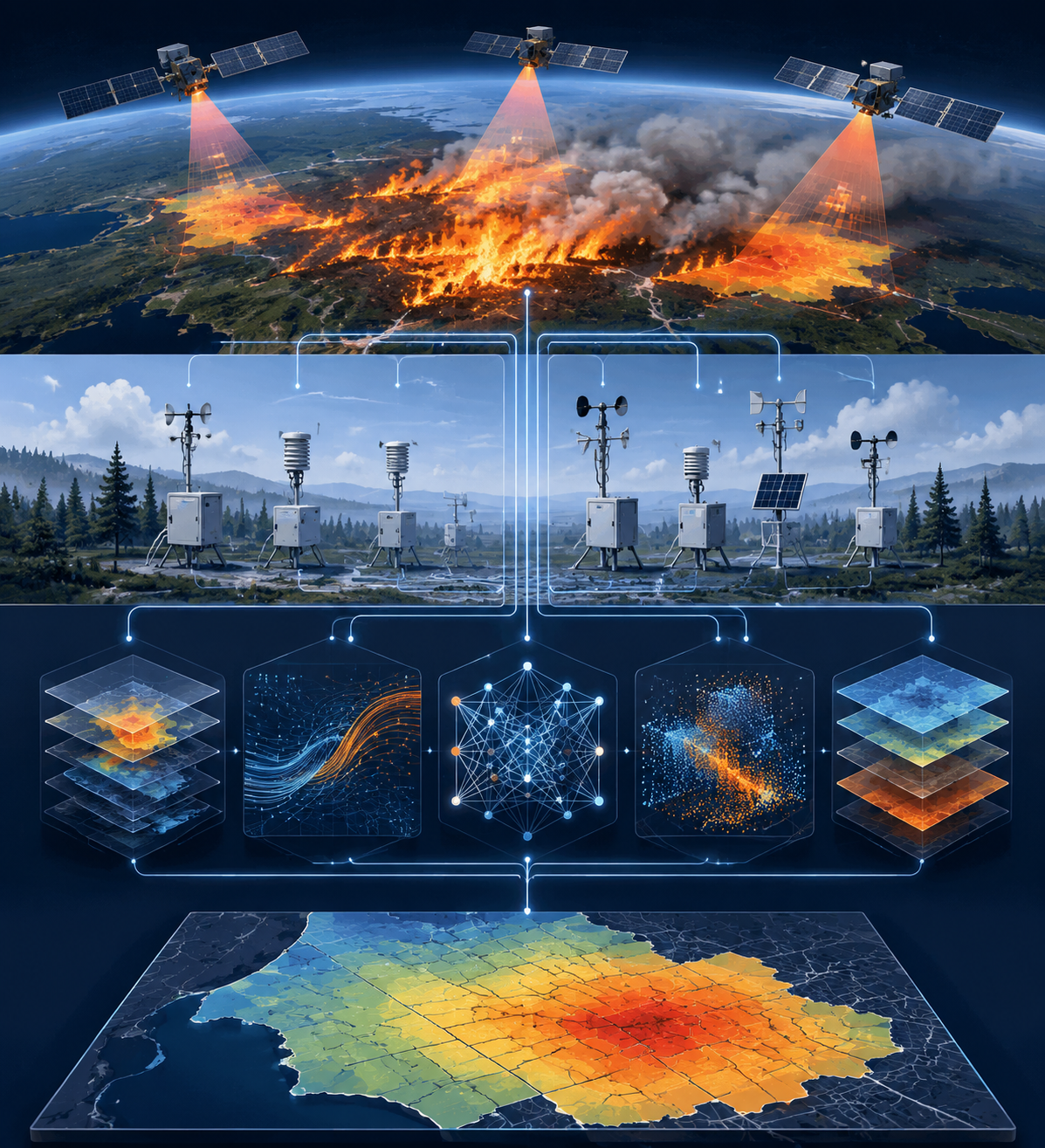
Modern exposure systems combine satellite observations, ground monitors, meteorology, chemical transport information, and machine learning or related statistical models to estimate smoke at finer spatial and temporal scales than sparse regulatory monitors alone can provide. That matters because patients do not inhale county averages. They inhale what reaches their neighborhood, school, workplace, shelter, or bedroom.
Daily zip-code-level estimates are especially useful for health research because they can be linked to hospital admissions, emergency visits, medication fills, school attendance, or mortality records without pretending that a single regional monitor describes everyone’s exposure. They are still estimates, with error structures that can vary by geography and smoke conditions. But they make a more clinically relevant question possible: not “Was PM2.5 elevated?” but “How much of the patient’s local exposure was wildfire smoke?”
The Plausible Mechanism Is Chemical and Biological, Not Mystical
The epidemiology does not stand alone. Toxicological work gives a plausible reason wildfire PM2.5 may carry more respiratory harm per unit mass: smoke particles can contain higher concentrations of polycyclic aromatic hydrocarbons and show greater oxidative potential than some ambient PM mixtures. Toxicological studies have described wildfire smoke particulate matter as 3 to 4 times more toxic to the respiratory system than equivalent doses of ambient PM, while the Stanford Report summarizes wildfire smoke as roughly 10 times more toxic than fossil-fuel air pollution and states that no safe level of exposure has been identified.[2]
Those statements should be handled as mechanism support and risk framing, not as a settled bedside calculator. “Ten times” is useful when it prevents complacency about an orange AQI day during a smoke event. It becomes less useful if it is repeated as though every wildfire plume, fuel type, exposure window, patient group, and outcome has the same multiplier. The clinically safer interpretation is that wildfire-attributed PM2.5 deserves more concern than an equal mass of background PM2.5, particularly in patients whose airways or cardiovascular systems have little reserve.
Stanford’s report also points to longer clinical tails after major smoke exposure: children followed 2 to 4 years after major wildfire smoke exposure showed reduced lung function, increased antibiotic use, and increased healthcare utilization.[2] That does not mean every child exposed to smoke will develop persistent impairment. It does mean pediatric counseling should not treat a major smoke episode as a nuisance that ends when the sky clears.
Long-Term National Modeling Extends the Concern, With More Distance From the Bedside
The Yale School of Public Health summary of Ma et al. in PNAS shows the same exposure-attribution logic applied nationally and over longer time horizons. The study used a deep learning model to estimate wildfire smoke PM2.5 across all 3,108 contiguous U.S. counties from 2007 through 2020 and estimated about 11,415 non-accidental deaths per year attributable to long-term wildfire smoke PM2.5 exposure, including 4,512 cardiovascular deaths.[3]
That scale is important, but it should not be confused with the more immediate respiratory-admission evidence from Southern California. The national mortality estimates are modeled associations, not direct proof that a given patient’s death was caused by smoke exposure. They depend on the deep learning exposure model, mortality modeling assumptions, and the quality of county-level exposure reconstruction. Still, they push the clinical frame beyond same-day wheeze and next-day admissions. Wildfire smoke exposure may be relevant to chronic risk assessment, especially for patients with cardiovascular disease, chronic lung disease, pregnancy-related vulnerability, or repeated seasonal exposure.
The practical implication is modest but real. When clinicians take environmental histories, “Do you live in a smoky area?” is too blunt. A better history asks about repeated smoke seasons, indoor filtration, occupational outdoor exposure, housing leakage, school or childcare exposure, and whether symptoms track with smoke alerts. AI-modeled exposure data can make that history less impressionistic, but it cannot replace the patient’s actual circumstances.
Operational AI Is Moving Faster Than Clinical Validation
Operational fire intelligence has advanced quickly. NOAA’s Next-Generation Fire System combines GOES geostationary satellite data with AI algorithms, detects fires as small as a quarter acre, and delivers alerts within about 1 minute. NOAA reported that 90% of National Weather Service Weather Forecast Offices were subscribed, and that during the March 2025 Oklahoma outbreak, NGFS-enabled response saved about $850 million in structures.[4]
That is emergency-response value, not clinical outcome validation. Faster fire detection can help incident commanders, forecasters, hospitals, and public health agencies prepare earlier. It does not by itself prove fewer asthma admissions, fewer COPD exacerbations, or better patient adherence to smoke precautions. The same distinction applies to AI-enhanced risk platforms such as Pacific Disaster Center’s DisasterAWARE, which integrates real-time AQI monitoring with wildfire hotspot tracking and issues Smart Alerts for decision-makers.[5]
For health systems, the useful question is not whether the platform is technically elegant. It is whether the alert reaches the right team early enough to change the next action: opening a clean-air room, delaying outdoor clinics, messaging high-risk patients, adjusting staffing, checking oxygen and inhaler supply, or advising schools and long-term care facilities before symptoms surge. For a fuller discussion of the monitoring pipeline and evidence gap, see AI Monitors Wildfire Smoke, but Does It Protect Health?.
What Clinicians Can Responsibly Do With Smoke-Specific Estimates
Smoke-specific PM2.5 estimates are most useful when they sharpen risk communication for patients already known to be vulnerable. The message does not need to become dramatic. It needs to become more specific: today’s particle level is elevated, much of it is wildfire smoke, and wildfire-attributed PM2.5 has been associated with larger respiratory hospitalization increases than non-wildfire PM2.5 at the same mass concentration.
- For asthma and COPD patients: review rescue medication access, controller adherence, symptom thresholds, and when to seek urgent care before the plume arrives.
- For children, older adults, pregnant patients, and people with cardiovascular disease: treat smoke-event exposure as a higher-risk environmental trigger, even when total PM2.5 resembles familiar urban pollution levels.
- For clinics and health systems: connect smoke-specific alerts to workflows, not just dashboards, so someone knows who receives the alert and what action follows.
- For public health teams: distinguish warnings about fire proximity, smoke exposure, and expected health burden, because each requires a different response.
There is also a communication hazard. If clinicians say “PM2.5 is PM2.5,” they may understate smoke-specific risk. If they say “wildfire smoke is always ten times worse,” they may overstate precision. A disciplined version is better: wildfire PM2.5 appears more harmful per unit mass for respiratory outcomes, the exact magnitude varies by method and setting, and vulnerable patients should act earlier and more conservatively during smoke-attributed PM2.5 episodes.
The Evidence Gap Is Not in Detection; It Is in Health Benefit
The current evidence supports exposure attribution and differential toxicity more strongly than it supports claims about specific monitoring products improving clinical outcomes. That distinction should be kept visible in procurement, research design, and patient-facing communication. A commercial platform may detect smoke quickly, generate beautiful maps, and deliver alerts. Unless independent studies show that using it reduces admissions, exacerbations, missed school days, occupational exposure, or other health outcomes, the clinical benefit remains plausible rather than proven.
That does not make the tools irrelevant. It means the next standard should be higher than technical validation alone. Health systems need studies that follow the full chain: exposure model accuracy, alert timing, clinician or public health action, patient comprehension, behavior change, and measurable health outcomes. Without that chain, monitoring can coexist with delayed warnings, confused patients, and unchanged management.
The clinical judgment available now is clear enough to use carefully. AI-enabled monitoring improves the ability to attribute local PM2.5 to wildfire smoke. The strongest epidemiological evidence supports greater respiratory toxicity for wildfire-specific PM2.5 than for non-wildfire PM2.5. Clinicians should let that source information change the urgency and specificity of counseling for at-risk patients, while remaining honest that independent proof of outcome improvement from monitoring tools themselves is still limited.
References
- Wildfire smoke impacts respiratory health more than fine particles from other sources. Nature Communications, 2021.
- Assessing wildfire health risks. Stanford Report, 2025.
- Long-term exposure to wildfire smoke associated with higher risk of death. Yale School of Public Health, 2024.
- NOAA unveils powerful convergence of AI and science with revolutionary Next Generation Fire System. NOAA.
- Wildfire Weather Warning AI. Pacific Disaster Center.
Comments
Join the discussion with an anonymous comment.