
The most useful question about AI for foodborne outbreak detection is not whether it sounds modern. It is whether it sends an inspector to a restaurant where the visit is more likely to matter.
On that narrow, operational test, Google’s FINDER system produced a result worth taking seriously. In deployments in Las Vegas from May to August 2016 and Chicago from November 2016 to March 2017, health departments conducted 132 inspections initiated by FINDER. Of the restaurants FINDER identified, 52.3% were found unsafe, compared with 24.7% under baseline inspections; the relative effectiveness was 3.06, with a 95% confidence interval of 2.14 to 4.35. In Chicago, FINDER also outperformed the city’s advanced complaint-based system, with a relative effectiveness of 1.68.[1]
That comparison matters because local food programs do not usually suffer from a lack of restaurants to inspect. They suffer from too many possible targets, too many delayed signals, and too little certainty about which establishment deserves scarce inspection time today.
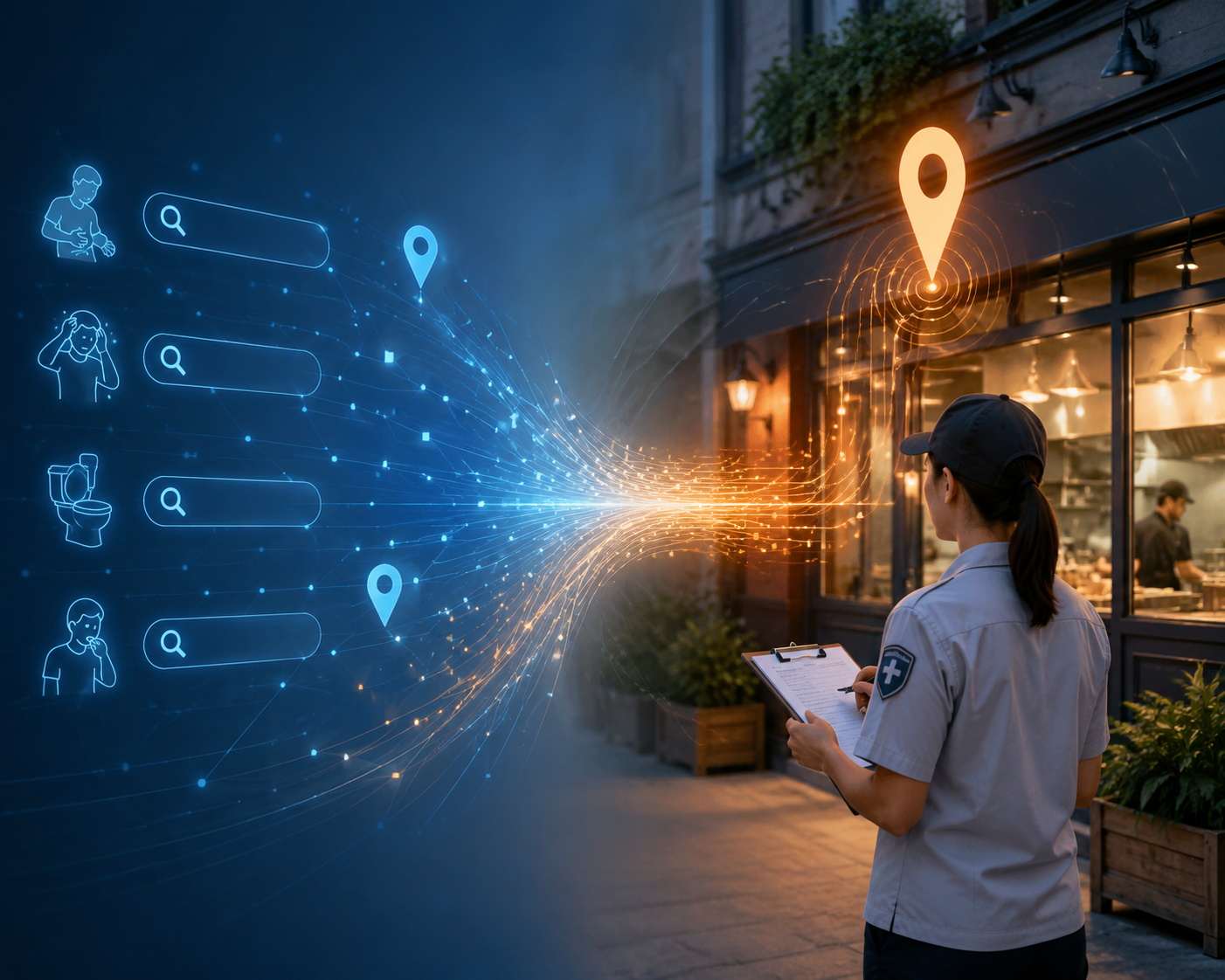
What FINDER improved against
Routine restaurant inspections are necessary, but they are not built primarily as real-time illness detectors. They are scheduled, risk-based, or otherwise assigned through local inspection rules. Complaint systems are closer to symptom-triggered surveillance, but they depend on a sick person deciding to report, knowing where to report, and remembering the likely source well enough for the complaint to be useful.
The recall problem is not a small administrative inconvenience. In the FINDER study, only 62% of cases involved the most recent restaurant visited, meaning 38% would have been attributed to the wrong restaurant by patient recall alone.[1] Anyone who has worked through a food history knows how quickly a confident interview can become a list of meals, snacks, takeout stops, and shared dishes with uncertain timing. FINDER’s value is partly that it tries to correct that attribution problem before an inspector is sent out.
That places FINDER in the detection and hypothesis-generation portion of the outbreak workflow rather than in diagnosis, case confirmation, or enforcement. It is closer to an extra triage signal for environmental health than to an automated outbreak investigation. For readers mapping the tool onto public health process, that is the same part of the workflow discussed in how AI fits into each step of CDC’s GI outbreak protocol.
The inspection findings were not just marginally better
The headline unsafe-restaurant yield is the cleanest result, but the violation pattern is important too. FINDER-identified restaurants had more critical violations than baseline inspections, 0.40 versus 0.21, with p=0.001. They also had more major violations, 0.74 versus 0.56, with p=0.04.[1]
| Inspection comparison | FINDER result | Comparator result | What it means operationally |
|---|---|---|---|
| Unsafe restaurants | 52.3% | 24.7% baseline | FINDER-generated inspections were more likely to find restaurants requiring action. |
| Relative effectiveness | 3.06 | Baseline inspections | The system identified unsafe restaurants more than three times as effectively as baseline inspection selection. |
| Chicago complaint-system comparison | 1.68 | Advanced complaint-based system | In Chicago, FINDER beat an already more active complaint-based approach, not just routine scheduling. |
| Critical violations | 0.40 | 0.21 baseline | The inspection difference included higher-severity findings, not only minor documentation issues. |
| Major violations | 0.74 | 0.56 baseline | FINDER-targeted sites also had more major violations. |
The cuisine mix also weakens one easy dismissal. FINDER flagged restaurants spanning 26 cuisine types, rather than merely rediscovering one obvious category such as fast food.[1] That does not prove equal performance across all restaurant types or neighborhoods. It does show that the signal was broader than a crude stereotype about where foodborne illness occurs.
How search behavior became an inspection lead
FINDER’s credibility rests on the pipeline, not on the word “AI.” The system joined two models: a Web Search Model that identified likely foodborne illness searches, and a Location Model that inferred restaurants associated with those searches while using differential privacy to de-identify users.[1]
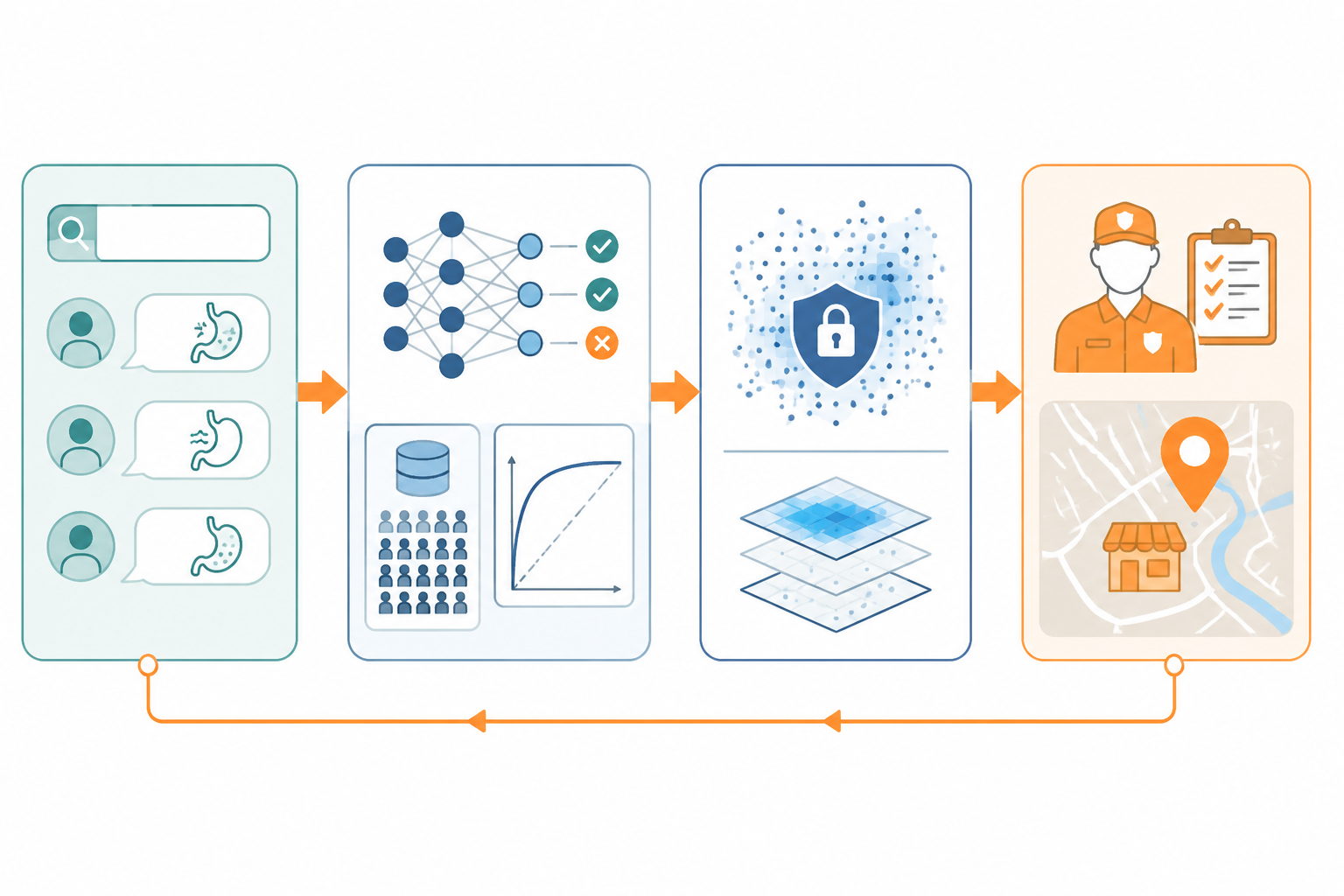
The Web Search Model was trained on more than 9,500 ground-truth queries from the Chicago health department, using a 50,000-dimension feature space. The reported ROC AUC was 0.85, and the system did not require ongoing human labeling for training.[1] In practical terms, the first model was trying to separate searches consistent with foodborne illness from the enormous background noise of ordinary health, recipe, restaurant, and stomach-related searches.
The Location Model then tried to connect those anonymous illness-related search events to recent restaurant visits. Its reported F1 score was 0.74.[1] This is the part that changes the task from “people in the city are searching about symptoms” to “this establishment may be worth inspecting.” Without that location step, the search signal would be too diffuse for environmental health staff who need an address, not just a trend line.
- A person searches for terms that the Web Search Model classifies as consistent with possible foodborne illness.
- The system uses privacy-protected location history to infer recent restaurant exposure.
- Candidate restaurants are ranked as possible inspection targets.
- Health department staff decide whether to inspect; FINDER does not diagnose illness or confirm an outbreak.
This architecture explains why FINDER could beat patient recall. It does not need the sick person to remember the correct meal, know the incubation period, or file a complaint. It uses the search as an illness-adjacent signal and the location history as a candidate exposure map. That is also why the privacy tradeoff is real: differential privacy protects users, but reducing location precision can also weaken restaurant-level attribution.[1]
Why this is different from ordinary complaint surveillance
Complaint systems wait for a person to convert illness into a report. FINDER starts earlier in the behavior chain, at the point where someone searches symptoms or related terms. That does not make the person a confirmed case. It does make the signal less dependent on civic follow-through, website navigation, or a phone call to the right office.
The Chicago comparison is therefore particularly useful. FINDER was not only compared with routine inspection selection; it was also compared with an advanced complaint-based system and still showed higher effectiveness.[1] For a health department already using a sophisticated complaint workflow, that is the relevant benchmark. The question is not whether AI can beat a clipboard. The question is whether it adds useful signal on top of the better tools agencies already have.
There is a parallel here with other surveillance gaps in foodborne disease: some systems are excellent once laboratory-confirmed cases accumulate, but less helpful when early cases are sparse, scattered, or not captured in the expected channel. That same limitation is central to discussions of Cyclospora surveillance gaps. FINDER sits in that uncomfortable early period, when there may be enough illness behavior to justify a look but not enough confirmed evidence to declare an outbreak.
The evidence stops well before general public health readiness
The strongest published evidence for FINDER remains the 2018 study, and it is a two-city deployment with 132 FINDER-initiated inspections.[1] That is enough to justify attention. It is not enough to assume that the same performance will hold across smaller jurisdictions, rural counties, non-English-speaking populations, or places where Google search and location-history coverage differs.
The authorship and data source also matter. FINDER was developed and studied by Google researchers, and the key data asset was Google search and location data.[1] From a health department’s view, that can make the tool attractive because the agency does not need to build the entire data infrastructure itself. It also means most public agencies cannot independently reproduce the system with their own data. The low operating burden for the health department depends on a private platform that controls the underlying signals.
Coverage bias is not a footnote. FINDER can only capture people whose illness behavior appears in the relevant data stream: users who search in ways the model recognizes and have usable location signals. Communities with different language patterns, lower smartphone use, different search behavior, or privacy settings that limit location history may generate weaker or different signals. The 2018 deployment does not establish how large those differences are.[1]
There is also no large published replication across many more jurisdictions in the materials available here. That absence does not erase the Las Vegas and Chicago findings. It keeps the claim appropriately narrow: FINDER showed that anonymous search and location data can improve restaurant-level inspection targeting in those deployments, under those data conditions, with those participating health departments.
Where FINDER belongs in the surveillance stack
FINDER is best understood as a supplement to mandated inspections, complaint systems, and laboratory-confirmed surveillance. It can help decide where to send an inspector sooner or with better odds. It cannot replace the legal, environmental, epidemiologic, and laboratory work that determines whether illness cases are related, whether a violation explains transmission, or whether enforcement is warranted.
That modest role is also what makes the evidence compelling. A local agency does not need an AI system to solve foodborne disease. It needs better leads that arrive while an inspection can still find something actionable. In Las Vegas and Chicago, FINDER produced those leads at a higher unsafe-restaurant yield than baseline inspections and, in Chicago, better than an advanced complaint-based system.[1]
For agencies comparing FINDER with other AI surveillance tools, the right comparison is not only technical sophistication but operational fit: what signal the system uses, what staff action it triggers, and what evidence shows that the action improves. A broader comparison of AI-powered outbreak detection platforms can help place FINDER beside tools that monitor different data streams or serve different points in the response cycle.
The fair judgment is therefore neither dismissal nor broad endorsement. FINDER is credible evidence that anonymous search and location data can improve food safety inspection targeting. Its limits are just as clear: a 2018 two-city evidence base, a modest inspection sample, dependence on Google-controlled data, privacy-location tradeoffs, and uncertain performance outside the populations and jurisdictions where it was tested.
References
- Machine-learned epidemiology: real-time detection of foodborne illness at scale, npj Digital Medicine, 2018.
Comments
Join the discussion with an anonymous comment.