
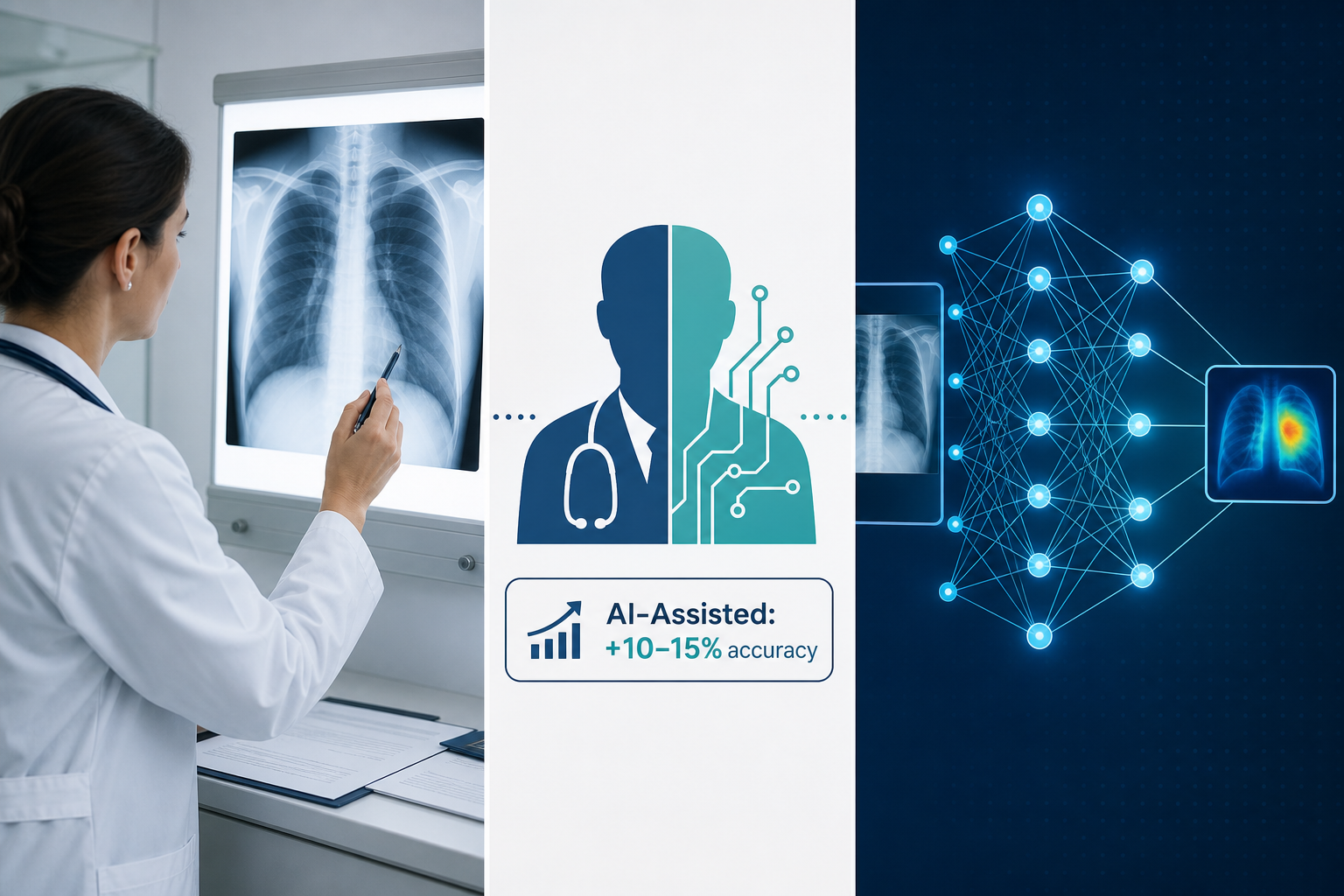
Why a Single Accuracy Number Misleads in Medical AI
A hospital administrator evaluating an AI diagnostic tool encounters a vendor claiming "90% accuracy." A clinician reads a headline that "AI matches doctors." A researcher scans a press release stating "AI achieves 96% accuracy in detecting disease." All three statements can be simultaneously true and deeply misleading, because they collapse fundamentally different AI architectures, tasks, and evaluation standards into a single number that obscures more than it reveals.
The most important distinction any clinical adopter must understand in 2026 is the gap between narrow AI — deep-learning models trained on a single, bounded task like detecting diabetic retinopathy from retinal photographs — and generative AI — large language models (LLMs) that attempt to reason across the full breadth of medical knowledge. These two paradigms produce radically different diagnostic performance profiles, and conflating them is the source of much of the confusion in the current evidence landscape.
This distinction matters because procurement decisions, workflow integration strategies, and regulatory expectations differ fundamentally depending on which type of AI is being deployed. A narrow AI model for mammography triage and a general-purpose LLM for differential diagnosis are not two versions of the same technology — they are different tools for different jobs, and their accuracy figures cannot be averaged, compared, or substituted. For a structured approach to evaluating specific tools, see our framework for clinicians.
Narrow AI: Task-Specific Models That Match or Exceed Specialists
Narrow AI models — typically convolutional neural networks or vision transformers trained on tens of thousands of labeled medical images — represent the most mature and best-evidenced category of AI in clinical diagnosis. These models operate within tightly defined boundaries: they detect one condition (or a small set of conditions) from one imaging modality, and they are evaluated against a clear reference standard. Within those boundaries, their performance is remarkable.
Diabetic Retinopathy Detection: The Benchmark Case
Diabetic retinopathy screening is the most frequently cited success story for narrow AI in diagnosis, and for good reason. In 2025 trial data, AI algorithms achieved approximately 96% accuracy in detecting referable diabetic retinopathy from retinal photographs, outperforming human specialists by more than 10 percentage points. The U.S. Food and Drug Administration has cleared multiple AI-based diabetic retinopathy screening devices — including IDx-DR (now LumineticsCore) — for autonomous use, meaning the AI can make a screening decision without a specialist reviewing the image.
This performance level has held across multiple prospective validation studies and real-world deployments, making diabetic retinopathy screening one of the few AI applications where the evidence supports autonomous or near-autonomous use in appropriate populations.
Breast Cancer Screening: Sensitivity Gains and Workflow Impact
AI-assisted mammography has accumulated a substantial evidence base, though the performance profile differs from diabetic retinopathy in important ways. Reported sensitivity for early-stage breast cancer detection ranges from 90% to 92%, with a 20% to 25% reduction in false positives compared to double-reading by radiologists alone. The reduction in false positives is clinically significant — it means fewer unnecessary recalls, fewer biopsies, and less patient anxiety.
Beyond accuracy metrics, AI-assisted mammography has demonstrated workflow benefits. Studies report a 25% to 30% increase in radiologist throughput, meaning radiologists can interpret more studies in the same time period when AI serves as a second reader or triage tool. This throughput gain addresses a well-documented workforce shortage in breast imaging, though it raises questions about whether faster reading maintains the same level of diagnostic thoroughness over time.
| Application | Reported Performance | Key Benefit | Deployment Stage |
|---|---|---|---|
| Diabetic retinopathy screening | ~96% accuracy; >10 pp above specialists | Autonomous screening capability | Broad clinical use (FDA-cleared) |
| Breast cancer screening (mammography) | 90-92% sensitivity; 20-25% false positive reduction | Reduced recalls; +25-30% radiologist throughput | Broad clinical use (multiple FDA-cleared devices) |
| Chest X-ray triage (pneumothorax, nodules) | AUC 0.85-0.95 across studies | Prioritization of urgent cases in worklists | Pilot to broad clinical use |
| Dermatology (skin lesion classification) | AUC 0.86-0.96 in controlled datasets | Triage support for primary care | Research to limited clinical use; bias concerns documented |
For a deeper critical appraisal of the evidence base supporting imaging AI, including study quality assessments and known limitations, see our AI Medical Image Analysis evidence review.
Generative AI: The 52% Reality Check from the Largest Meta-Analysis
If narrow AI represents the high-confidence end of the diagnostic accuracy spectrum, generative AI — specifically large language models used for diagnostic reasoning — occupies a far more uncertain position. The most comprehensive evidence available as of mid-2026 comes from a systematic review and meta-analysis published in npj Digital Medicine in March 2025 by Takita and colleagues, which analyzed 83 studies comparing generative AI diagnostic performance against physicians.
The headline finding is sobering: overall generative AI diagnostic accuracy was 52.1% (95% CI: 47.0-57.1%). When compared directly to physicians, AI showed no significant difference overall (p = 0.10) and no significant difference from non-expert physicians (p = 0.93). However, AI was significantly inferior to expert physicians, with a difference of 15.8 percentage points (95% CI: 4.4-27.1%, p = 0.007).
These figures carry an important caveat: 63 of the 83 studies (76%) were rated at high risk of bias using the PROBAST tool, a standardized assessment for prediction model studies. This means the published accuracy figures may overestimate real-world performance, and the evidence base for generative AI in diagnosis is substantially weaker than the volume of publications might suggest.
| Comparison | Finding | Statistical Significance |
|---|---|---|
| Generative AI vs. all physicians | AI 52.1% vs. physicians (varying by subgroup) | p = 0.10 (not significant) |
| Generative AI vs. non-expert physicians | No significant difference | p = 0.93 |
| Generative AI vs. expert physicians | AI inferior by 15.8 percentage points | p = 0.007 (significant) |
| Studies with high risk of bias (PROBAST) | 63 of 83 studies (76%) | N/A |
Model-by-Model Breakdown: Which LLMs Perform Best?
Averaging across all models obscures substantial variation. The Takita meta-analysis performed subgroup analyses by model, revealing a clear hierarchy. Several frontier models — GPT-4, GPT-4o, Claude 3 Opus, Claude 3 Sonnet, Gemini 1.0 Pro, Gemini 1.5 Pro, Llama 3 70B, and Perplexity — showed no statistically significant difference from expert physicians in the studies that evaluated them. In contrast, GPT-3.5, Llama 2, and Med-42 were significantly inferior to experts.
This pattern suggests that the gap between generative AI and expert clinicians is narrowing with each model generation, but it has not closed. The models that approach expert parity are the largest, most expensive to run, and most recently released — a moving target that complicates any static assessment of "how accurate generative AI is."
| Model Tier | Representative Models | Performance vs. Experts | Notes |
|---|---|---|---|
| Frontier (near-expert parity) | GPT-4, GPT-4o, Claude 3 Opus, Gemini 1.5 Pro, Llama 3 70B | No significant difference | Largest, most recent models; highest inference cost |
| Mid-range (non-expert parity) | GPT-4 (earlier versions), Claude 3 Sonnet, Gemini 1.0 Pro, Perplexity | Comparable to non-experts | Widely available; performance varies by specialty |
| Older / smaller (significantly inferior) | GPT-3.5, Llama 2, Med-42 | Significantly below experts | May still be in use; evidence does not support diagnostic use |
Specialty-level subgroup analyses further refine the picture. The meta-analysis found that Urology and Dermatology were the only specialties where generative AI showed a statistically significant difference from physicians — in both cases, AI underperformed. This may reflect the visual and procedural nature of these specialties, where diagnostic reasoning depends heavily on pattern recognition that current LLMs, even with multimodal capabilities, have not fully mastered.
The Human-AI Collaboration Paradox: When Two Heads Are Worse Than One
The most intuitive assumption about AI in diagnosis is that combining human expertise with machine computation should produce better results than either alone. The evidence, however, tells a more complicated story — one that depends critically on how the collaboration is designed.
A 2024 study from Stanford HAI, published in JAMA Network Open, tested this assumption directly. Fifty physicians from Stanford, Beth Israel Deaconess Medical Center, and the University of Virginia were asked to diagnose clinical cases under three conditions: using conventional resources, using ChatGPT-4 as a diagnostic aid, and with ChatGPT-4 working independently. The results were striking. ChatGPT-4 alone scored approximately 92 (equivalent to an A grade). Physicians using conventional resources scored approximately 74. But physicians using ChatGPT as an aid scored only approximately 76 — no statistically significant improvement over conventional resources. The only measurable benefit was time: physicians using ChatGPT completed case assessments approximately one minute faster.
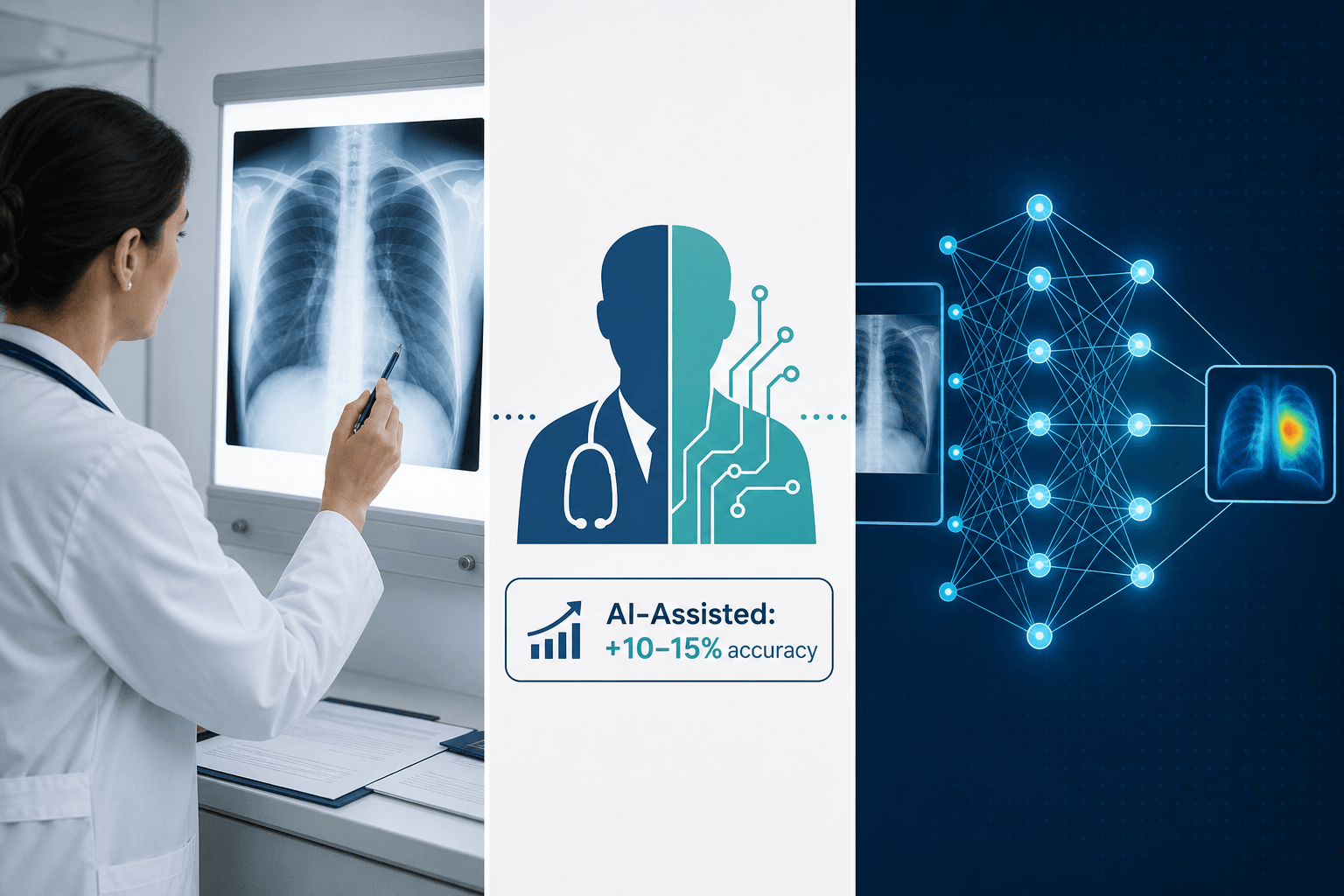
However, not all collaboration models produce the same result. A 2025 study from the Max Planck Institute for Human Development, analyzing over 40,000 diagnoses on more than 2,100 clinical vignettes, found that hybrid human-AI collectives — groups of human diagnosticians working alongside AI systems — achieved the highest accuracy. The key mechanism was error complementarity: humans and AI made systematically different types of errors, and when their judgments were combined, the errors tended to cancel each other out. AI collectives outperformed 85% of human diagnosticians working alone, but the hybrid collectives outperformed both humans-only and AI-only groups.
The apparent contradiction between the Stanford HAI study and the Max Planck study is resolved by examining the collaboration design. In the Stanford study, individual physicians used ChatGPT as a passive reference tool — they could choose to accept or ignore its suggestions. In the Max Planck study, AI and human judgments were combined at the collective level, with the aggregation mechanism designed to exploit error complementarity. The lesson is not that human-AI collaboration is inherently beneficial or harmful, but that the design of the collaboration determines the outcome.
What This Means for Clinical Adoption: Accuracy Is Task-Contingent
The evidence reviewed here supports a single overarching conclusion: diagnostic accuracy is not a property of "AI" as a category. It is a property of a specific model applied to a specific task in a specific clinical context. The 44 percentage point gap between narrow AI (approximately 96% for diabetic retinopathy) and generative AI (approximately 52% overall) is not a ranking of better versus worse technology — it is a reflection of fundamentally different problem scopes.
For clinical adopters, this has direct implications:
- Narrow AI models are ready for deployment in bounded screening and triage tasks where the input is standardized (retinal photographs, mammograms, chest X-rays) and the output is a binary or limited classification. The evidence supports their use as assistive tools and, in some cases, as autonomous screening devices under specific conditions.
- Generative AI models are not yet suitable for independent diagnosis. Their 52% average accuracy, high risk of bias in the underlying studies, and significant inferiority to expert physicians mean they should be used only with expert oversight and in contexts where the cost of error is low.
- Human-AI collaboration can improve diagnostic accuracy, but only when the collaboration is designed to exploit error complementarity. Simply giving clinicians access to an AI tool without workflow integration does not reliably improve outcomes.
- Model selection matters. Within the generative AI category, frontier models (GPT-4, Claude 3 Opus, Gemini 1.5 Pro) substantially outperform older models (GPT-3.5, Llama 2). Any evaluation of generative AI for diagnostic use must specify which model was tested.
The evidence base itself requires critical interpretation. With 76% of generative AI diagnostic studies rated at high risk of bias, published accuracy figures should be treated as upper-bound estimates rather than reliable performance guarantees. Prospective, externally validated studies with diverse patient populations remain the exception rather than the rule.
For broader context on adoption rates, market size, and additional accuracy statistics across healthcare AI, see our AI in Healthcare Statistics 2026 page.
Comments
Join the discussion with an anonymous comment.