
AI in personalized athletic training plans is easiest to overrate when the output looks clinically tidy. A system can ingest age, injury history, activity level, wearable metrics, and basic training principles, then return a four-week rehabilitation progression that appears organized and cautious. That is useful. It is also not the same as watching a runner unload one knee during step-downs, noticing that sleep and soreness trends are moving in opposite directions, or deciding that a plan is safe precisely because it is too timid to create adaptation.
The evidence is stronger for AI as a drafting and monitoring layer than as an independent rehabilitation prescriber. Published evaluations suggest that current tools can produce plans that are generally safe and aligned with frequency, intensity, time, and type principles. The problem is narrower and more clinically important: the plans often remain conservative, repetitive, and insufficiently responsive to the physiology and constraints of the person in front of the clinician.
That distinction matters because sports injury diagnosis and rehabilitation prescription are different tasks. Diagnostic models may classify injury patterns or risk signals with impressive performance, and clinicians who want that adjacent evidence can read more in the evidence for AI in sports injury diagnosis and prevention. But detecting a likely knee injury is not the same as adjusting loading, volume, recovery, and sport-specific constraints across a rehabilitation timeline.
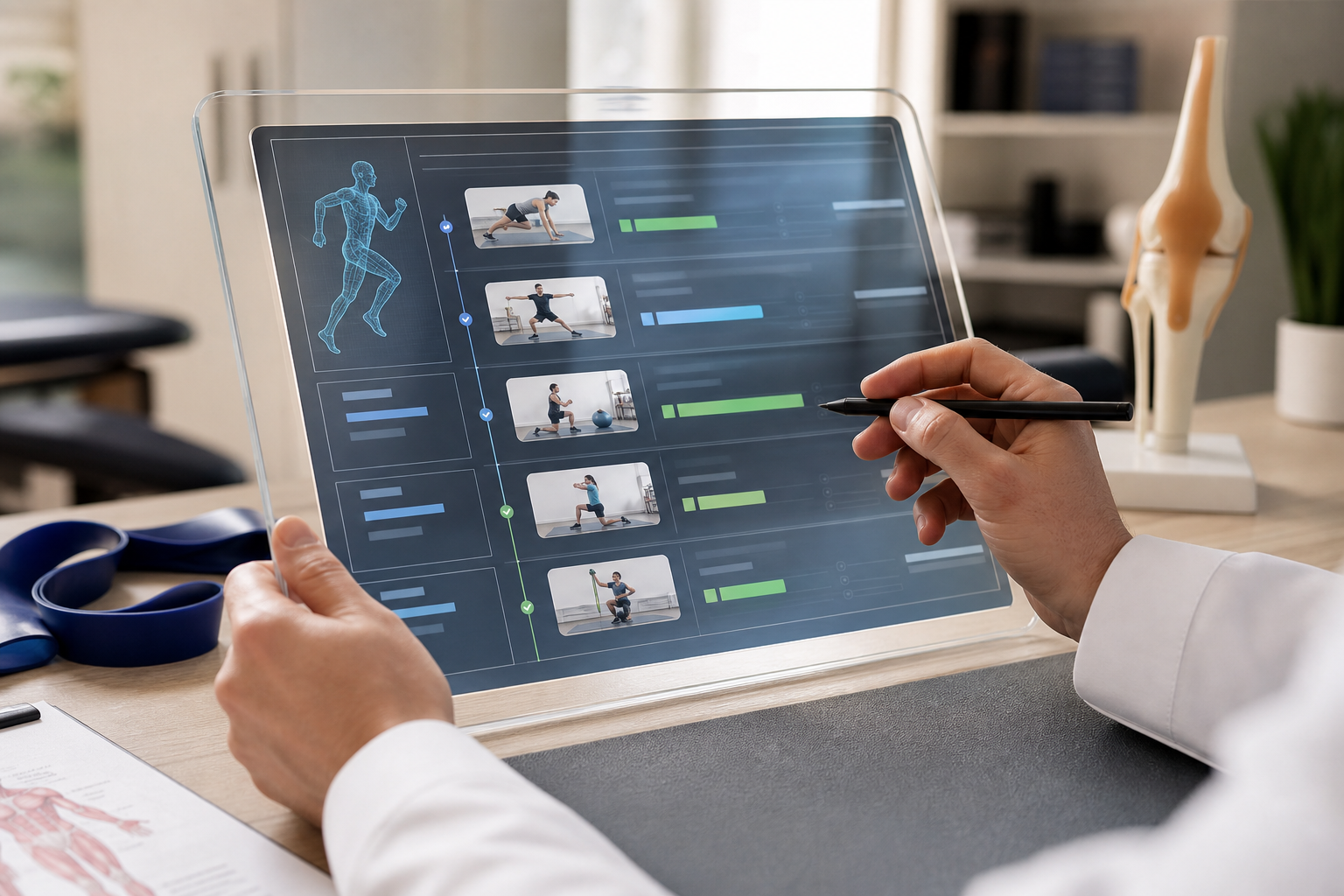
Safe and FITT-compliant is a low bar
The most useful starting point is the 2024 evaluation by Dergaa and colleagues, in which more than 30 international experts reviewed GPT-4-generated exercise prescriptions. Their judgment was not that the model produced reckless plans. The plans were generally considered safe. They also were described as monotonous and imprecise for diverse patient conditions, which is exactly where clinical confidence should pause rather than increase.[1]
In rehabilitation, “safe” can mean several things. It may mean the plan avoids obvious contraindications, does not progress load aggressively, and stays within familiar exercise categories. That kind of safety is valuable for triage, documentation, and first-draft planning. It does not prove that the plan is therapeutically well matched. A prescription can be safe because it is thoughtful, or safe because it never challenges the patient enough to reveal whether tissue capacity, neuromuscular control, or sport tolerance is actually improving.
The Dergaa evaluation is important because the expert criticism was not cosmetic. Monotony in this setting is not merely boring programming. It can signal that the model is repeating a generic template across patients whose limiting factors differ. Imprecision is not just a wording issue. It affects intensity selection, progression timing, exercise substitution, symptom-response rules, and whether the plan accounts for competing diagnoses or constraints.
A clean plan may list sets, repetitions, rest intervals, and weekly frequency while still missing the feature a clinician would use to steer the next decision. The athlete may be guarding into hip strategy after an ankle injury. The older recreational player may have a knee complaint, diabetes, and poor sleep recovery. The post-operative patient may meet a wearable step target while still lacking eccentric control. A template can absorb these facts as fields; personalization requires the plan to change meaningfully because of them.
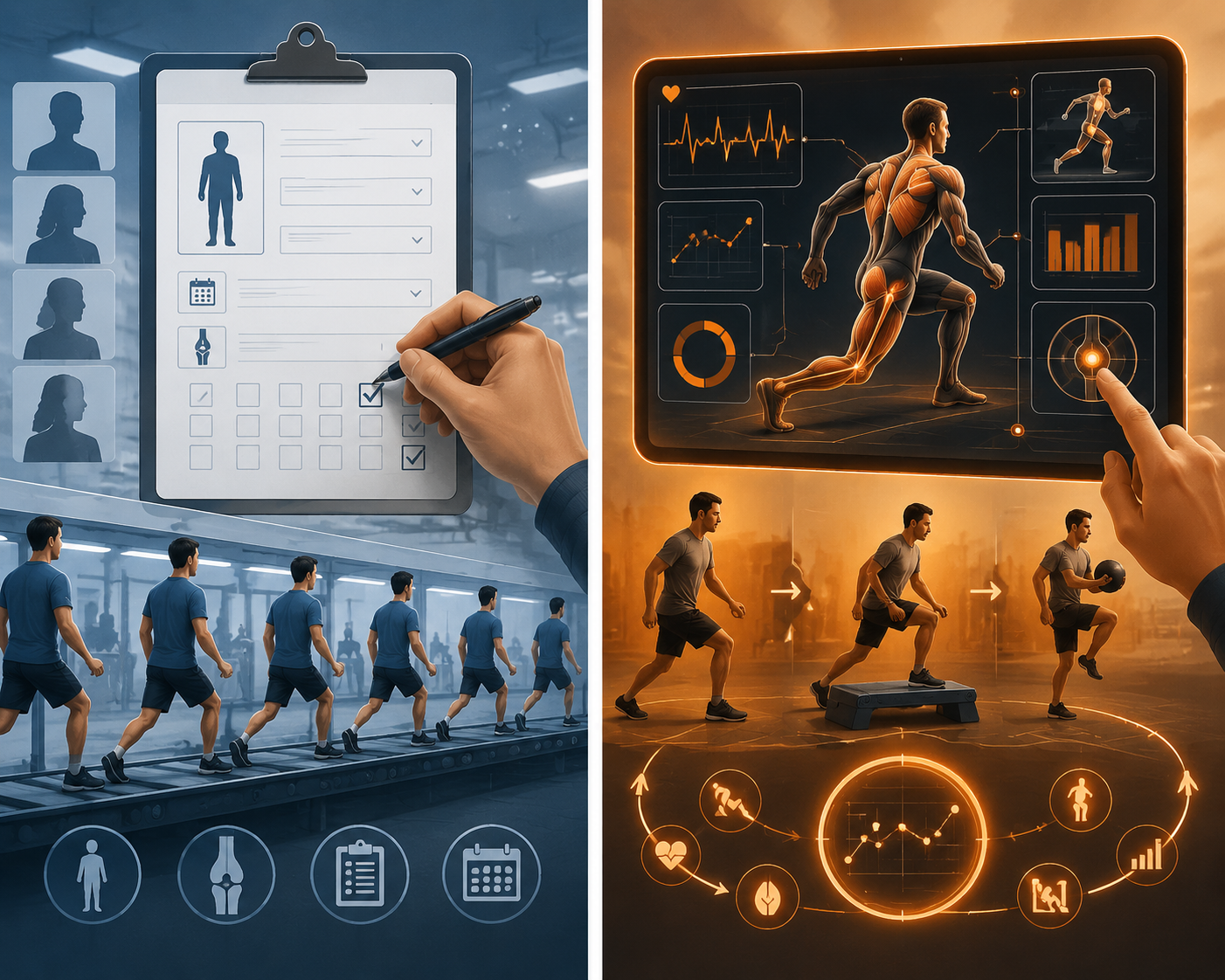
Individualization is not the same as personalization
Much of the marketing around AI rehabilitation uses “personalized” when “individualized” would be more accurate. Individualization can populate a plan with patient-specific inputs: age, sport, injury history, baseline strength, training availability, pain rating, or wearable data. Personalization requires a stronger claim. It means the system adapts intensity, exercise choice, progression, recovery, and constraints as the patient’s physiology and function change.
| Claim | What it usually demonstrates | What it does not prove |
|---|---|---|
| The plan uses injury history | The model can condition a draft on prior diagnoses or symptoms | That it understands tissue irritability, compensation, or competing limitations |
| The plan uses wearable data | The model can respond to available metrics such as load or recovery signals | That the sensor is reliable enough for a clinical progression decision |
| The plan follows FITT principles | Frequency, intensity, time, and type are represented in the prescription | That the dose is sufficient, specific, or adaptive for this patient |
| The plan is conservative | The model reduces obvious safety risk | That the plan will restore sport capacity or prevent recurrence |
This is where AI tools can look better on paper than they perform in clinical reasoning. If a patient reports anterior knee pain and the system prescribes lower-impact conditioning, hip strengthening, and gradual return-to-run volume, it may have produced a reasonable first draft. The harder question is whether it can tell when that draft should become more aggressive, when it should stop progressing, and when a clean metric should be distrusted because movement quality has not recovered.
The 2025 SWOT analysis in Frontiers in Digital Health makes this limitation explicit by identifying an over-caution bias and the conflation of individualization with personalization among barriers to clinical use. It also flags weak evidence for patients with multimorbidity, the group least served by generic exercise logic and most likely to be harmed by false confidence in a neatly structured plan.[2]
Agreement rates support a supplemental role
The 2025 rehabilitation study by Attoh-Mensah and colleagues gives a more practical calibration point. In that study, physician agreement with ChatGPT-generated rehabilitation content ranged from 55% to 80%, and plan generation accuracy was approximately 70%. Those figures are not trivial; they suggest that AI-generated rehabilitation plans can often land near acceptable clinical reasoning. They also do not support autonomous use.[3]
A 70% accuracy signal in plan generation means the clinician still owns the remaining uncertainty. In sports rehabilitation, the errors are not evenly distributed annoyances. They may concentrate around progression, contraindications, return-to-sport criteria, pain-response rules, or mismatched exercise selection. A physician agreement range of 55% to 80% tells procurement teams and clinical leaders that the tool may reduce drafting burden, not that it can assume responsibility for the plan.
The useful implementation model is therefore supervised assistance. AI can propose a starting plan, format a home program, summarize patient-reported changes, flag deviations from expected recovery, or generate alternative exercise options when equipment is limited. The clinician still decides whether the dose is appropriate, whether the patient’s movement matches the data, and whether the progression is clinically justified.
Wearable-driven updates depend on the weakest part of the chain
Wearables are often presented as the missing bridge between static templates and adaptive personalization. In principle, they help: load, step count, heart-rate patterns, sleep, readiness scores, and movement signals can give clinicians a richer view of what happened between visits. In practice, the clinical value of an AI update depends on the reliability of the sensor, the relevance of the metric, and the protocol that tells the system what to do with the signal.
A 2026 narrative review in the Journal of Sport Rehabilitation Science identified variable sensor reliability and the absence of standardized protocols as barriers to translating these systems into clinical practice. That finding should temper any claim that wearable integration, by itself, makes a rehabilitation plan truly personalized.[4]
The concern is not that wearable data are useless. It is that clean data can still be clinically incomplete. A runner may reduce ground contact asymmetry while increasing next-day irritability. A basketball player may meet total workload targets while avoiding deceleration. A post-injury athlete may show improving volume but poor confidence in cutting. If the protocol only sees the metric it was designed to see, the plan may adapt in the wrong direction or fail to adapt when the clinician would.
This is also why unvalidated injury-reduction claims deserve caution. The frequently cited 69% injury-reduction figure comes from industry-linked media rather than independent peer-reviewed validation. It may be a hypothesis worth testing, but it should not be treated as evidence that AI-generated training prescriptions prevent injuries in clinical populations.
Diagnostic performance does not transfer automatically to rehab prescription
Diagnostic AI evidence can create a halo effect around rehabilitation tools. Lancet Digital Health data cited in this area report AI sports injury diagnostic performance of about 90% accuracy for knee injuries compared with about 75% for traditional methods. That is relevant context, but it answers a different question.[5]
Diagnosis is often a classification problem: given the available inputs, what condition or risk category is most likely? Rehabilitation prescription is a control problem over time: what dose should be applied, how should it change, what response should trigger modification, and what trade-off is acceptable for this athlete? A model that classifies an injury well may still prescribe a generic progression after the diagnosis is made.
For clinicians, this means the evidence for AI-assisted detection should not be used as a proxy for evidence of AI-guided rehabilitation. The second task requires validation against functional outcomes, recurrence, adherence, progression quality, and safety in patients with real-world complexity.
Regulatory status should shape procurement, not substitute for validation
The regulatory environment adds another layer of confusion. FDA-cleared AI/ML medical devices have grown rapidly, with 882 total AI/ML-enabled devices and roughly 70 orthopedic-relevant devices identified in recent analyses. Those counts show that AI is now part of the medical device landscape, but they do not establish that a specific athletic rehabilitation planner is clinically validated for adaptive exercise prescription.[6]
This is especially important for tools that sit between wellness coaching and clinical decision support. A consumer-facing training app that suggests recovery workouts is not the same as software that guides rehabilitation decisions for a patient recovering from injury. Clinical leaders evaluating these products should separate general wellness features from regulated software functions and should review how the product fits current decision-support expectations. For broader context, see the evidence gap in FDA-cleared AI medical devices and the FDA 2026 CDS guidance discussion.
Clearance, if present, should prompt the next questions rather than end the evaluation. What indication was reviewed? What population was studied? Does the software generate recommendations, merely display information, or automate progression? Is the clinician expected to independently verify the output? Are updates driven by validated protocols or by opaque model behavior? Those answers matter more than whether the dashboard uses the language of personalization.
Where AI can help now
The defensible use case is not glamorous, but it is clinically useful. AI can make rehabilitation planning easier to start, easier to document, and easier to update under supervision. It can reduce the blank-page burden after an evaluation, produce patient-friendly instructions, translate a clinician’s constraints into a home program, or organize wearable and symptom data before a follow-up visit.
- Drafting: generating an initial FITT-compliant plan that a clinician edits before use.
- Documentation: converting clinical goals, restrictions, and progressions into clearer patient-facing instructions.
- Monitoring: organizing patient-reported symptoms, adherence, and wearable signals between visits.
- Second-checking: flagging missing contraindication language, abrupt volume changes, or inconsistent progression logic.
Those uses respect the current evidence because they keep the clinician in the loop. They also preserve the part of rehabilitation that is difficult to encode: deciding whether the patient’s response represents expected adaptation, underloading, compensation, fear, irritability, or an unrelated medical constraint.
Adoption conditions for clinical teams
A clinical team considering AI-generated athletic rehabilitation plans should ask for evidence that matches the intended use. A product used to draft general exercise options does not need the same validation as a product that recommends return-to-sport progression after injury. The closer the tool gets to directing care, the more the team should require transparent protocols, population-specific validation, and documented clinician oversight.
- Require clinician review before an AI-generated rehabilitation plan reaches the patient.
- Do not rely on unvalidated injury-reduction claims, especially when they come from industry-linked media rather than independent studies.
- Be cautious with complex multimorbidity patients, where the published evidence is weakest and generic exercise logic is least adequate.
- Distinguish wellness recommendations from clinical decision support or software-as-a-medical-device functions.
- Treat wearable-driven changes as only as reliable as the sensor data, clinical protocol, and escalation rules behind them.
The practical standard is straightforward: if the tool cannot explain how it adapts beyond a conservative template, it is not yet truly personalizing rehabilitation. It may still be useful. It just should not be allowed to impersonate clinical judgment.
References
- Evaluation of GPT-4 exercise prescription by international experts, Biology of Sport, 2024.
- Artificial intelligence in personalized sports training: a SWOT analysis, Frontiers in Digital Health, 2025.
- ChatGPT rehabilitation study, Frontiers in Digital Health, 2025.
- Narrative review on sensors and AI in sport rehabilitation, Journal of Sport Rehabilitation Science, 2026.
- AI sports injury diagnostics data, The Lancet Digital Health.
- Orthopedic artificial intelligence and machine learning-enabled medical devices, 2025.
Comments
Join the discussion with an anonymous comment.