
 Multiple (Harvard, MIT, Johns Hopkins, Stanford, Cornell, Udacity, UIUC, AMA, AAFP, Mayo Clinic, Oxford, Imperial College)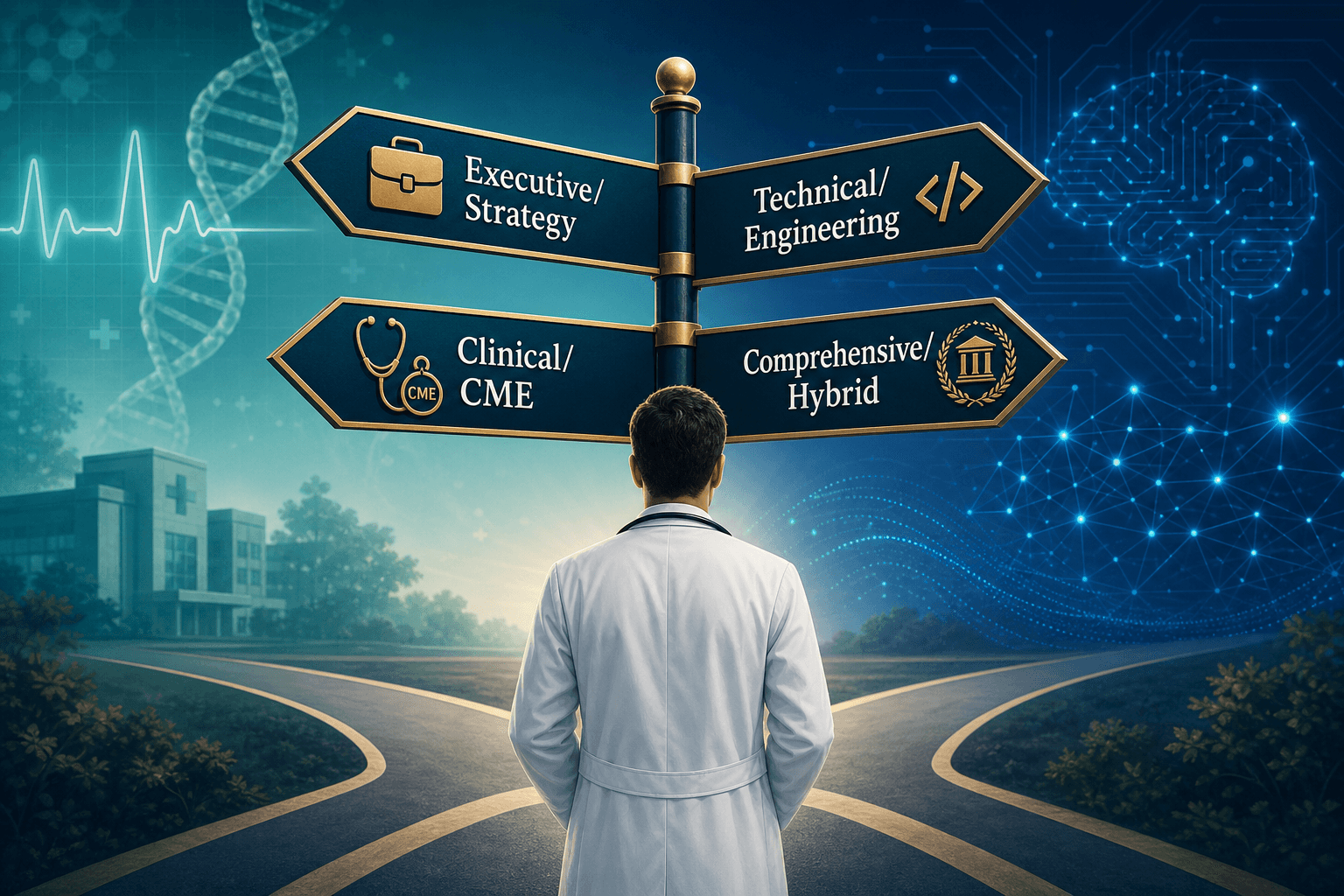
Why Choosing the Right AI Course Matters Now
The healthcare AI market is no longer a speculative frontier. By mid-2026, the global market has reached an estimated $50.7 billion, with projections ranging from $431 billion to over $1 trillion by 2032–2034 depending on the research firm (MarketsandMarkets, Grand View Research). This growth is not abstract. Deloitte reports that 80% of hospitals now use AI to enhance patient care and operational efficiency. Meanwhile, the World Economic Forum has found that nearly 46% of clinicians report a shortage of AI talent in their organizations.
The response from the workforce has been decisive. A Deloitte survey indicates that 60% of healthcare executives plan to upskill their staff in AI by the end of 2026. A separate report from Johns Hopkins University and EP estimates that 85% of healthcare leaders are already adopting generative AI at scale. For the individual professional, the stakes are equally high. LinkedIn data cited in industry analyses shows that AI-enabled healthcare roles rank among the top ten fastest-growing jobs, with salaries ranging from $120,000 to over $250,000 depending on role and experience.
The problem is that the course market has not kept pace with this demand in a coherent way. A healthcare professional searching for an AI course today encounters a fragmented landscape: university certificate programs costing $3,000–$4,000, free CME modules from medical societies, technical bootcamps requiring Python fluency, and executive programs that assume no coding background. Choosing poorly means wasting time and money on a program that either assumes too much technical knowledge or too little clinical context.
This article provides a structured decision framework — five diagnostic questions and a role-based decision matrix — to match your professional profile, technical background, and career goals with the right course category. The goal is not to rank courses but to help you identify which category of offering fits your specific situation.
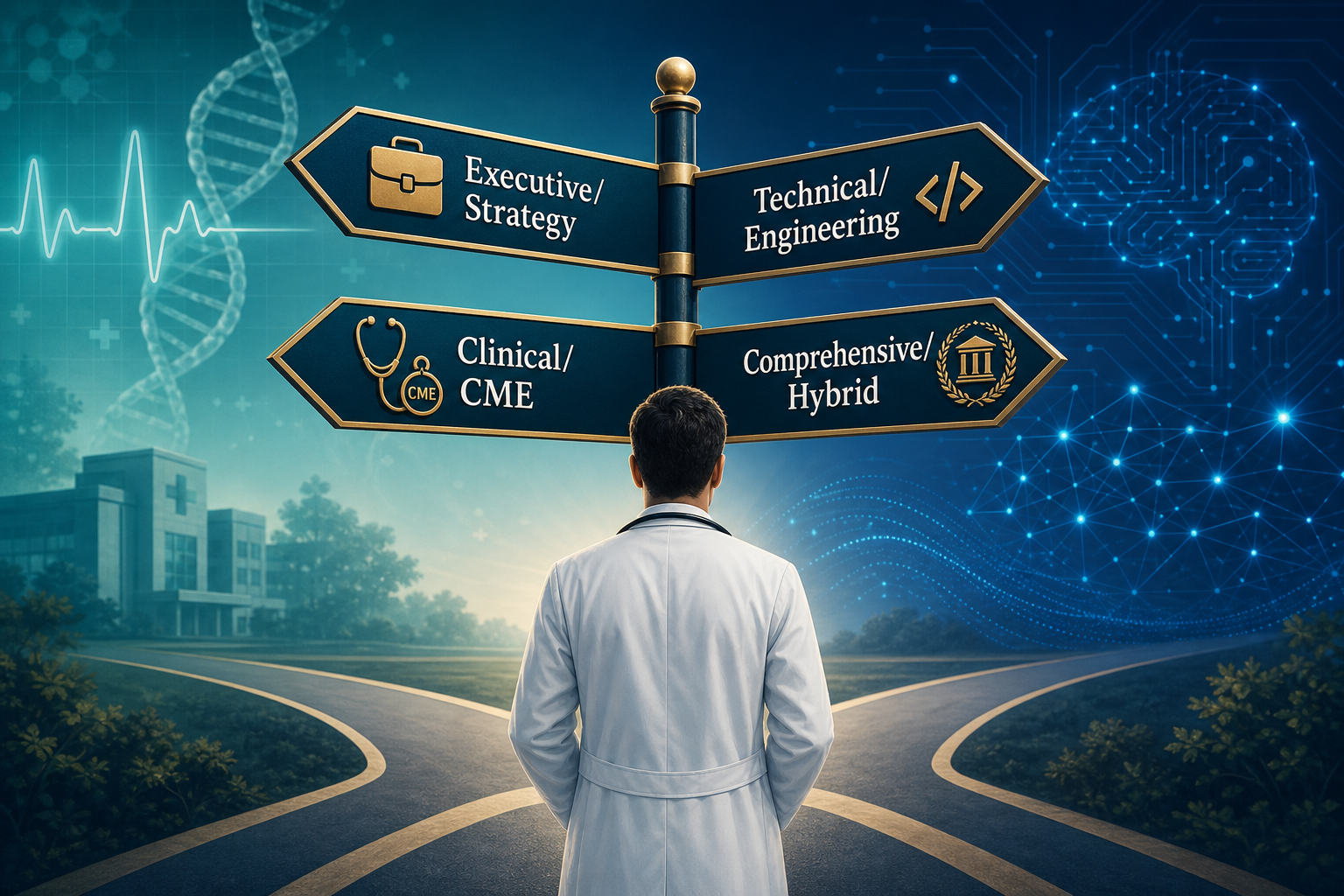
The Four Categories of AI in Healthcare Courses
After reviewing the current landscape of offerings from major universities, medical societies, and online platforms, four distinct categories emerge. Each serves a different professional need, requires different prerequisites, and delivers a different type of credential.
A. Executive / Strategy (No-Code, Leadership Focus)
These programs are designed for healthcare leaders, administrators, and clinicians who need to make strategic decisions about AI adoption — not build models themselves. They assume no programming background and focus on AI literacy, governance, implementation strategy, and ethical considerations.
Representative examples include:
- Harvard Medical School — AI in Health Care: From Strategies to Implementation ($3,100, 8 weeks, digital certificate). Faculty include Andrew Beam (CTO of Lila Sciences), Marzyeh Ghassemi, and Karandeep Singh. Covers the AI development pipeline, risk prediction models, ethics, and a capstone project to pitch an AI-first healthcare solution.
- MIT Sloan — AI in Healthcare ($3,250, 6 weeks, no coding required). Strategic focus on AI adoption and organizational change.
- Imperial College Business School — AI in Healthcare: Leading Responsible Adoption at Scale (6 weeks, online, part-time, associate alumni status). Focuses on governance, regulation, and responsible scaling.
B. Technical / Engineering (Requires Python and ML Foundation)
These programs are for data scientists, software engineers, and technical professionals who want to build, deploy, or evaluate AI models in healthcare contexts. They require existing proficiency in Python, statistics, and machine learning fundamentals.
Representative examples include:
- MIT xPRO — Artificial Intelligence in Healthcare: Fundamentals and Applications ($2,650, 8 weeks, 4.9 CEUs). Requires calculus, linear algebra, statistics, probability, and basic Python. Covers ML algorithms, NLP, biomechatronics, and generative AI. Includes hands-on projects like ideating an ingestible robot and developing a strategic AI product proposal.
- Cornell eCornell — AI in Healthcare Certificate ($3,750, 2 months, 5.6 CEUs). Requires intermediate Python and ML proficiency. Covers FAVES principles (fairness, appropriateness, validity, effectiveness, safety), FHIR interoperability, and NLP with spaCy and BERT.
- Udacity — AI for Healthcare Nanodegree ($399/month, ~$1,200 total). Requires ML and Python. Includes four real-world projects, including drafting an FDA submission plan.
C. Clinical / CME (Accredited for Practicing Clinicians)
These programs are specifically designed for physicians, nurses, and allied health professionals who need continuing medical education (CME) credits. They focus on clinical applications, workflow integration, and practical decision-making at the point of care.
Representative examples include:
- University of Illinois (UIUC) — AI in Medicine Certificate ($750, 6 modules, CME credits). Covers selection, purchase, and deployment criteria for AI medical software.
- AMA EdHub — AI in Health Care (free). A series of modules designed for practicing physicians.
- AAFP — AI in Family Medicine: Transforming Your Practice (free, 3-part series). Focused on primary care applications.
- Mayo Clinic — Current Applications and Future of Artificial Intelligence in Cardiology ($675–$825). Specialty-specific CME.
D. Comprehensive / Hybrid (Broad, Beginner-Friendly)
These programs aim to cover the full spectrum — from fundamentals to applications — without requiring a technical background. They are ideal for professionals making a career transition into healthcare AI or seeking a broad overview before specializing.
Representative examples include:
- Johns Hopkins University — AI in Healthcare Program ($2,990, 10 weeks, 6 CEUs, no programming required). Delivered with Great Learning. Covers six ML algorithms, clinical decision support, population health modeling, ethics, and change management. Includes 8+ healthcare case studies (COVID-19 chest X-rays, sepsis prediction, readmission risk, AI scribes). Application closes 18 June 2026.
- Stanford (Coursera) — AI in Healthcare Specialization ($49/month, beginner-friendly, 5 courses, capstone). Rated 4.7/5 from over 2,560 reviews. Covers fundamentals, clinical applications, and ethical considerations.
- Oxford Home Study Centre — AI in Healthcare Essentials (200 hours, self-paced, free/open access, optional CPD certification). A low-cost entry point for global learners.
| Category | Best For | Prerequisites | Cost Range | Credential | Example Programs |
|---|---|---|---|---|---|
| Executive / Strategy | Leaders, administrators, clinicians making adoption decisions | None (no coding required) | $3,100–$3,250 | Digital certificate | Harvard HMS, MIT Sloan, Imperial College |
| Technical / Engineering | Data scientists, engineers building AI models | Python, calculus, ML fundamentals | $2,650–$3,750 | CEUs, certificate | MIT xPRO, Cornell eCornell, Udacity |
| Clinical / CME | Practicing clinicians needing CME credits | Clinical background | $0–$825 | CME credits, certificate | UIUC, AMA EdHub, AAFP, Mayo Clinic |
| Comprehensive / Hybrid | Career changers, broad overview seekers | None (beginner-friendly) | $0–$2,990 | CEUs, certificate, specialization | JHU, Stanford Coursera, Oxford |
Five Diagnostic Questions to Find Your Fit
Before browsing course catalogs, work through these five questions. Your answers will map directly to one of the four categories above.
1. What is your current professional role and primary responsibility?
A hospital CEO evaluating AI vendors has different needs than a radiologist integrating an AI triage tool or a data scientist building a sepsis prediction model. If your daily work involves strategic decisions about AI procurement and policy, the Executive/Strategy category is your starting point. If you are a clinician who needs to understand AI tools at the point of care, Clinical/CME programs are more relevant. If you are building or deploying models, you need the Technical/Engineering track.
2. What is your technical background and comfort with coding and math?
This is the single most important filter. If you have never written a line of Python and have no intention of doing so, do not enroll in MIT xPRO ($2,650, requires calculus and Python) or Cornell eCornell ($3,750, requires intermediate Python and ML). You will struggle and the material will not serve your goals. Conversely, if you are a data scientist, a no-code executive program will feel shallow. Be honest about your current skill level — not where you hope to be after the course.
3. What is your primary goal — strategic leadership, technical skill-building, clinical application, or career transition?
Each category optimizes for a different outcome. Executive programs teach you to lead AI adoption and ask the right questions of technical teams. Technical programs build hands-on skills for model development and deployment. Clinical CME programs focus on practical application at the bedside. Comprehensive/hybrid programs are designed for professionals making a significant career shift into healthcare AI from another domain.
4. What is your budget and time commitment?
Costs range from free (AMA EdHub, AAFP) to $3,750 (Cornell eCornell). Executive and technical programs cluster in the $2,600–$3,750 range. Clinical CME programs are often the most affordable, with UIUC at $750 and many free options from medical societies. Time commitments range from 6 weeks (MIT Sloan, Imperial) to 10 weeks (JHU) to self-paced (Oxford, Stanford Coursera). Factor in weekly hours: most programs require 5–7 hours per week.
5. What credential do you need — CEU, certificate, CME, or academic credit?
For practicing clinicians, CME credits are often non-negotiable for license maintenance. UIUC ($750 with CME credits) and Mayo Clinic ($675–$825) are strong options. For professionals seeking a credential for career advancement, a university-issued certificate (Harvard, MIT, JHU) carries more weight than a platform completion badge. For those exploring the field without immediate credential needs, free options from AMA EdHub or the low-cost Stanford Coursera specialization ($49/month) provide excellent value.
Decision Matrix: Matching Your Profile to the Right Course Category
The following matrix maps common reader profiles to the four course categories. Use it as a starting point, then verify details on individual program pages.
| Your Profile | Executive / Strategy | Technical / Engineering | Clinical / CME | Comprehensive / Hybrid |
|---|---|---|---|---|
| Clinician seeking CME credits | Possible Fit (if leadership role) | Not Recommended | Best Fit | Possible Fit (if career change) |
| Hospital executive / administrator | Best Fit | Not Recommended | Possible Fit (if clinical background) | Possible Fit (if new to AI) |
| Data scientist / ML engineer | Not Recommended | Best Fit | Not Recommended | Possible Fit (if new to healthcare) |
| Healthcare IT / informatics professional | Possible Fit (if strategy-focused) | Best Fit (if building tools) | Possible Fit (if clinical liaison) | Possible Fit (if broad overview needed) |
| Medical student / resident | Not Recommended | Not Recommended | Best Fit (CME-eligible) | Best Fit (foundational) |
| Researcher (non-clinical) | Possible Fit (if policy-focused) | Best Fit (if modeling) | Not Recommended | Possible Fit (if new to healthcare) |
| Career changer (non-healthcare) | Not Recommended | Not Recommended | Not Recommended | Best Fit |
| Policy / regulatory professional | Best Fit | Not Recommended | Possible Fit (if clinical context needed) | Possible Fit (if broad overview needed) |
The matrix is a guide, not a prescription. A clinician who also serves as a CMIO may benefit from both the Executive/Strategy and Clinical/CME categories. A data scientist who wants to understand clinical workflow may find value in a comprehensive program. The key is to identify your primary need and start there.
Red Flags and What to Avoid When Choosing a Course
The AI education market is still immature, and not every program delivers on its promises. Watch for these warning signs.
- Courses that overpromise without prerequisites. If a program claims to teach deep learning in 6 weeks with no coding background, it is either superficial or will leave you behind. Technical programs like MIT xPRO and Cornell eCornell are transparent about requiring Python, calculus, and ML fundamentals. If a program does not list prerequisites, be skeptical.
- Programs lacking clinical relevance. A generic AI course from a non-healthcare institution may teach you ML algorithms but not how they apply to clinical workflows, regulatory constraints, or patient safety. Look for programs with faculty who have healthcare domain expertise and case studies drawn from real clinical settings.
- Inflated claims about job placement. No certificate guarantees a job. Be wary of programs that promise specific salary outcomes or job placements without transparent data. The salary ranges cited for AI healthcare roles ($120K–$250K+) reflect market conditions for experienced professionals, not entry-level certificate holders.
- Outdated curricula. The field moves fast. A course created before 2023 likely does not cover generative AI, large language models, or the latest FDA guidance on AI/ML SaMD. Check when the curriculum was last updated and whether it covers current topics like transformer models, hallucination risks, and predetermined change control plans.
- Confusing certificate with accreditation. A university-issued certificate of completion is not the same as CME accreditation or a formal degree. For clinicians, CME credits are essential for license maintenance. For professionals seeking academic credit, verify whether the program offers transferable credits or is part of a degree pathway.
Actionable Next Steps
The decision process can be summarized in a repeatable workflow:
- Work through the five diagnostic questions above. Write down your role, technical background, primary goal, budget, and required credential.
- Use the decision matrix to identify which course category (or categories) aligns with your profile.
- Review the representative programs listed in that category. Visit the official program pages to verify current pricing, dates, and prerequisites.
- Check for red flags: outdated curricula, missing prerequisites, vague faculty credentials, or inflated job placement claims.
- If you are considering a broader, self-guided learning path after your course, our structured Medical AI learning path provides a curated curriculum for clinicians and students.
The organizations driving this market include major players spanning diagnostics, clinical decision support, and operational AI. For a broader view of the industry landscape, see our analysis of top AI healthcare companies in 2026.
The right AI in healthcare course is not the one with the most prestigious university name — it is the one that matches your professional role, technical background, career goals, and budget. Use this framework to make an informed decision, and invest your time and money where it will have the greatest impact on your career.
Comments
Join the discussion with an anonymous comment.