
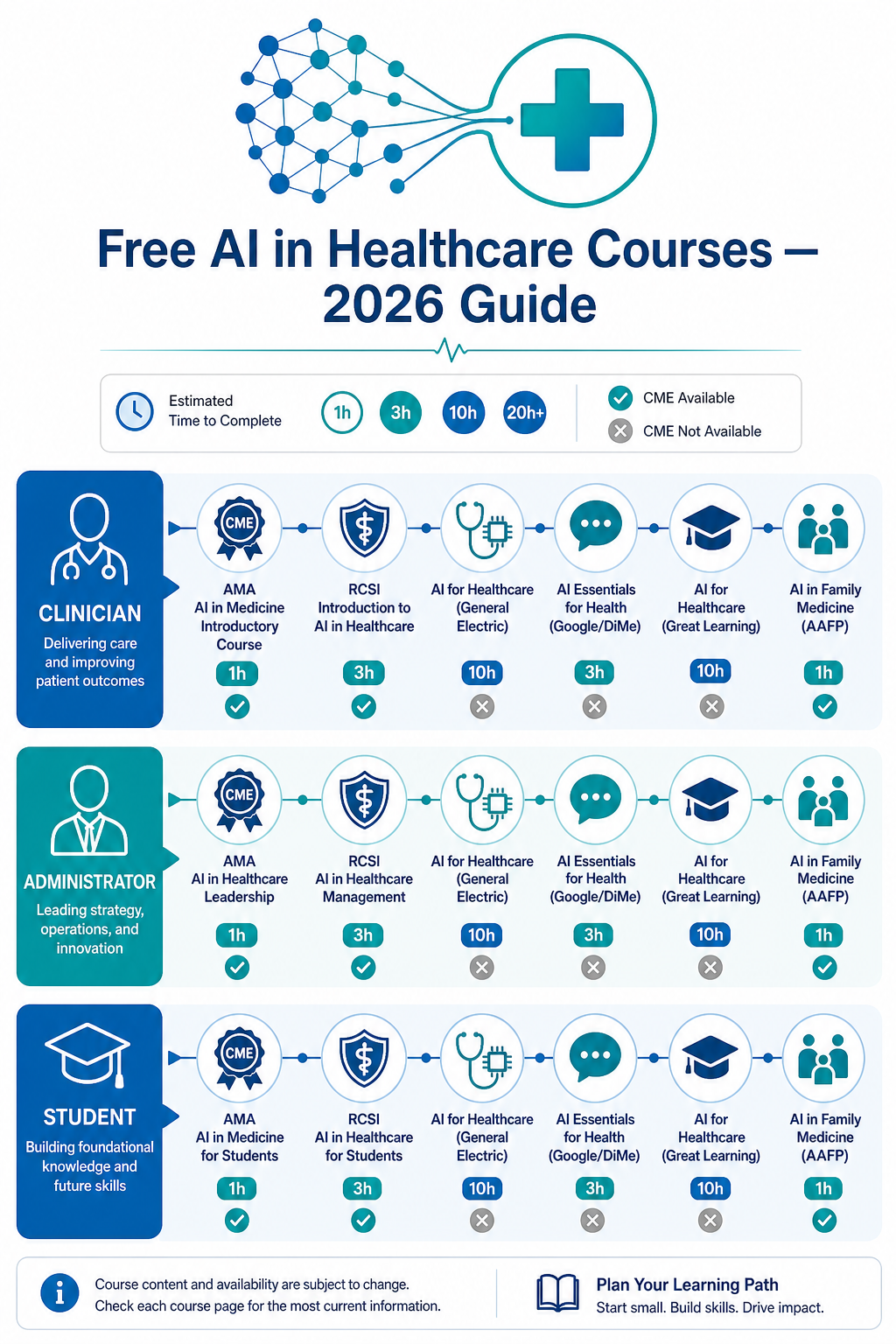
 Multiple (GE HealthCare, Google/DiMe, RCSI/Microsoft, AMA, Stanford, AAFP, Great Learning Academy, CME Meeting)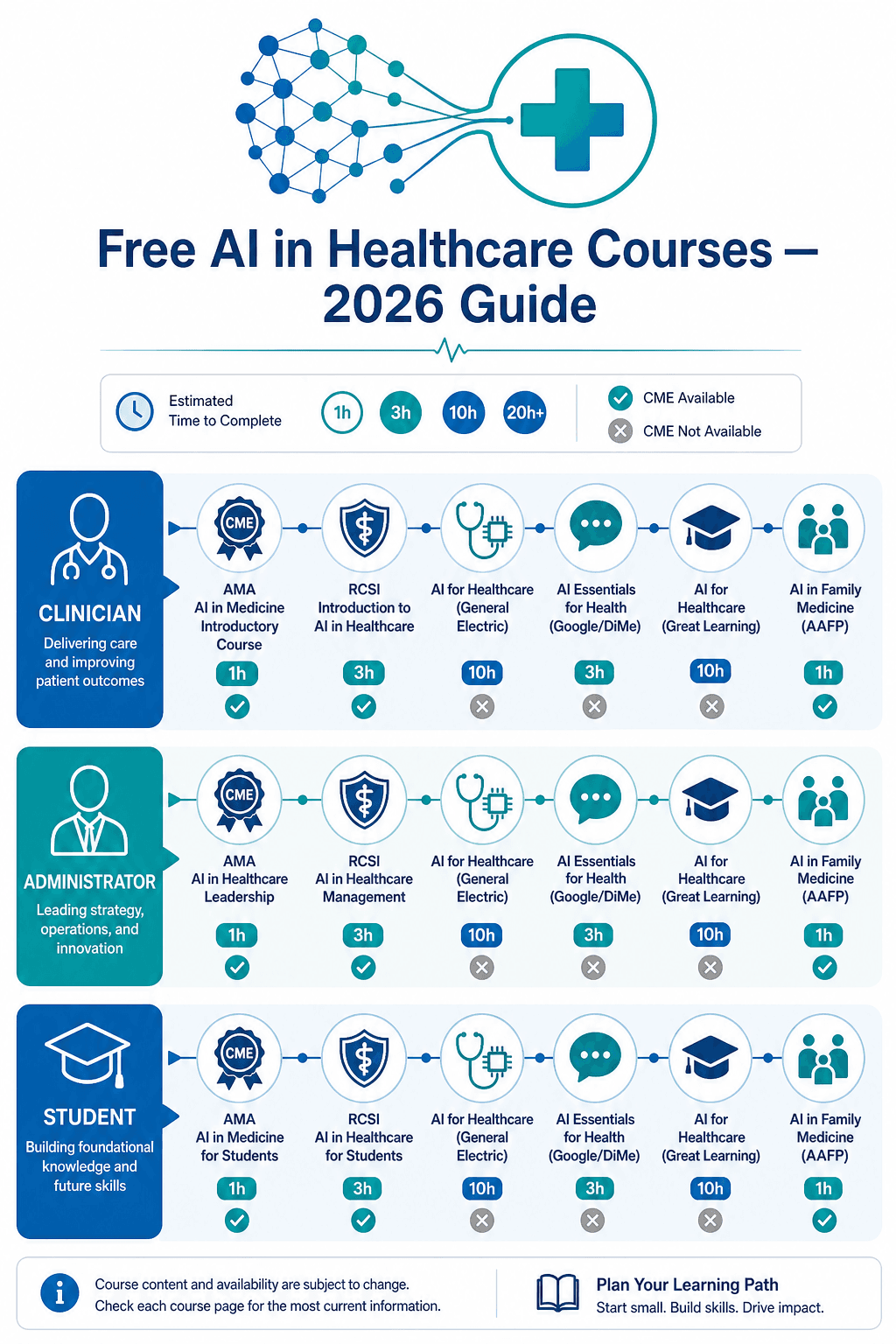
The Two Paths Into Free Healthcare AI Education
The number of free, high-quality courses on artificial intelligence in healthcare has expanded rapidly, but the landscape is not uniform. A clear divide has emerged between courses developed and delivered by technology vendors — GE HealthCare, Google, Microsoft — and those produced by academic institutions and professional medical societies such as the Royal College of Surgeons in Ireland (RCSI), the American Medical Association (AMA), and the American Academy of Family Physicians (AAFP).
For a clinician, administrator, or researcher trying to build AI literacy without spending money, this split presents a genuine decision problem. Vendor-led courses often provide hands-on exposure to real tools and platforms, but they carry an implicit product or ecosystem bias. Academic and society courses typically offer broader, vendor-independent frameworks and are more likely to carry CME accreditation, but they may lack practical tooling exercises.
This article profiles the major free offerings in each category, compares them across the dimensions that matter most to healthcare professionals — depth, bias, accreditation, and practical relevance — and provides a framework for layering courses from both sides to build balanced, actionable AI literacy.
Vendor-Led Courses: What Tech Companies Offer for Free
Technology companies with a stake in healthcare AI have invested in free educational content that naturally aligns with their product ecosystems. Three offerings stand out for their scale, reach, and quality.
GE HealthCare HelloAI Professional
GE HealthCare's HelloAI Professional program is the most extensive free healthcare AI course currently available. It offers more than 20 hours of video material across 11 online modules, supplemented by optional live webinar sessions with healthcare experts. The curriculum is broad: it begins with a global overview of AI in healthcare and operationalization strategies, then moves into technical modules covering Python, Google Colab, traditional image processing, machine learning, deep learning, convolutional neural networks, and foundation models including transformers and large language models. Later modules address advanced data management, patient perception of AI, and scaling solutions in provider organizations.
The course is designed for healthcare professionals, students, and researchers. According to a May 2026 report in DAIC, GE HealthCare cited AMA data showing that physician use of AI has more than doubled since 2023 to 81%, positioning HelloAI as a response to growing demand for AI training.
Google Generative AI for Healthcare (via DiMe)
Google, in partnership with the Digital Medicine Society (DiMe), offers a free, self-paced course titled Generative AI for Healthcare. It is designed to be completed in approximately one hour and uses animated explainer videos to demystify generative AI and large language models for healthcare professionals, administrators, medical researchers, and technology innovators.
Learning outcomes include understanding the fundamentals of generative AI, describing supervised and unsupervised learning and deep learning, an overview of LLMs for clinical decision-making and patient care, and practical prompt engineering skills. The course's brevity and focus on prompt engineering reflect Google's product strengths in generative AI and LLMs.
RCSI / Microsoft Ireland Co-Developed Course
The RCSI AI in Healthcare course is a notable hybrid: it is offered by a respected medical university (RCSI) but was co-developed with Microsoft Ireland. Announced in November 2025, the course is fully online, self-paced, and free to access. It is led by consultant radiologist Dr. John Sheehan and covers four modules: Core Concepts, Ethics/Safety/Governance, Clinical Applications, and Administrative Applications. The total duration is approximately 10 hours, and it awards 10 CPD points. A certificate of completion is available for a fee of €50 after passing the MCQ knowledge check.
Kevin Marshall, Microsoft Ireland Head of Skilling, described the course as a "public–private model" using an avatar-led format that enables quick content updates. The course is open to all healthcare workers with no prior AI knowledge required. As of June 2026, the course was undergoing scheduled updates until June 22, 2026.
| Course | Provider | Duration | Format | Key Content Focus | Cost for Certificate |
|---|---|---|---|---|---|
| HelloAI Professional | GE HealthCare | 20+ hours | 11 modules + live webinars | AI fundamentals, Python, deep learning, foundation models, operationalization | Not specified |
| Generative AI for Healthcare | Google / DiMe | 1 hour | Self-paced, animated videos | Generative AI, LLMs, prompt engineering | Not specified |
| AI in Healthcare | RCSI / Microsoft | 10 hours | 4 modules, self-paced | Core concepts, ethics, clinical & admin applications | €50 |
Academic and Professional Society Courses: Independent Frameworks
For professionals who prioritize independence from commercial interests, academic institutions and medical societies offer free courses that emphasize clinical frameworks, ethics, and evidence evaluation rather than tool-specific skills.
AMA Ed Hub AI Series
The American Medical Association's Ed Hub offers a free, multi-module series on AI in healthcare. Based on available secondary sources, the series includes approximately seven modules, each offering between 0.5 and 1 AMA PRA Category 1 CME credit. The content is designed to be vendor-independent, focusing on the clinical implications, ethical considerations, and regulatory landscape of AI rather than on any specific product or platform.
Stanford Online Free Content
Stanford Online provides free AI-related content including webinars and articles. Relevant healthcare AI webinars include "Bringing AI into Healthcare" and "How Artificial Intelligence Can Improve Healthcare." These are individual resources rather than a structured, multi-module course, and no free comprehensive AI in healthcare certificate program is offered. However, for learners seeking high-quality, university-affiliated perspectives without a product angle, these webinars are valuable supplements.
AAFP AI in Family Medicine Course
The American Academy of Family Physicians offers a free, three-part CME course titled "AI in Family Medicine: Transforming Your Practice" as part of its Practice Management and Leadership CME. The course is designed specifically for family medicine practitioners and covers using AI to reduce administrative task burdens, improve patient care, and enhance practice efficiency.
Other Notable Free Offerings
Several other free courses are worth noting. Great Learning Academy offers a beginner-level course (3 hours, rated 4.62 by 38.4K+ learners) covering foundations of AI, GenAI/LLMs/ChatGPT, AI for healthcare applications, a case study on pneumonia detection from medical images, and risks/challenges/ethics. A certificate is available for a fee. The CME Meeting provides a free recorded video lecture worth 1 CME credit, led by Dr. Mark Mabus, a board-certified clinical informaticist, covering AI tools in clinical practice, EHRs, and workflow optimization.
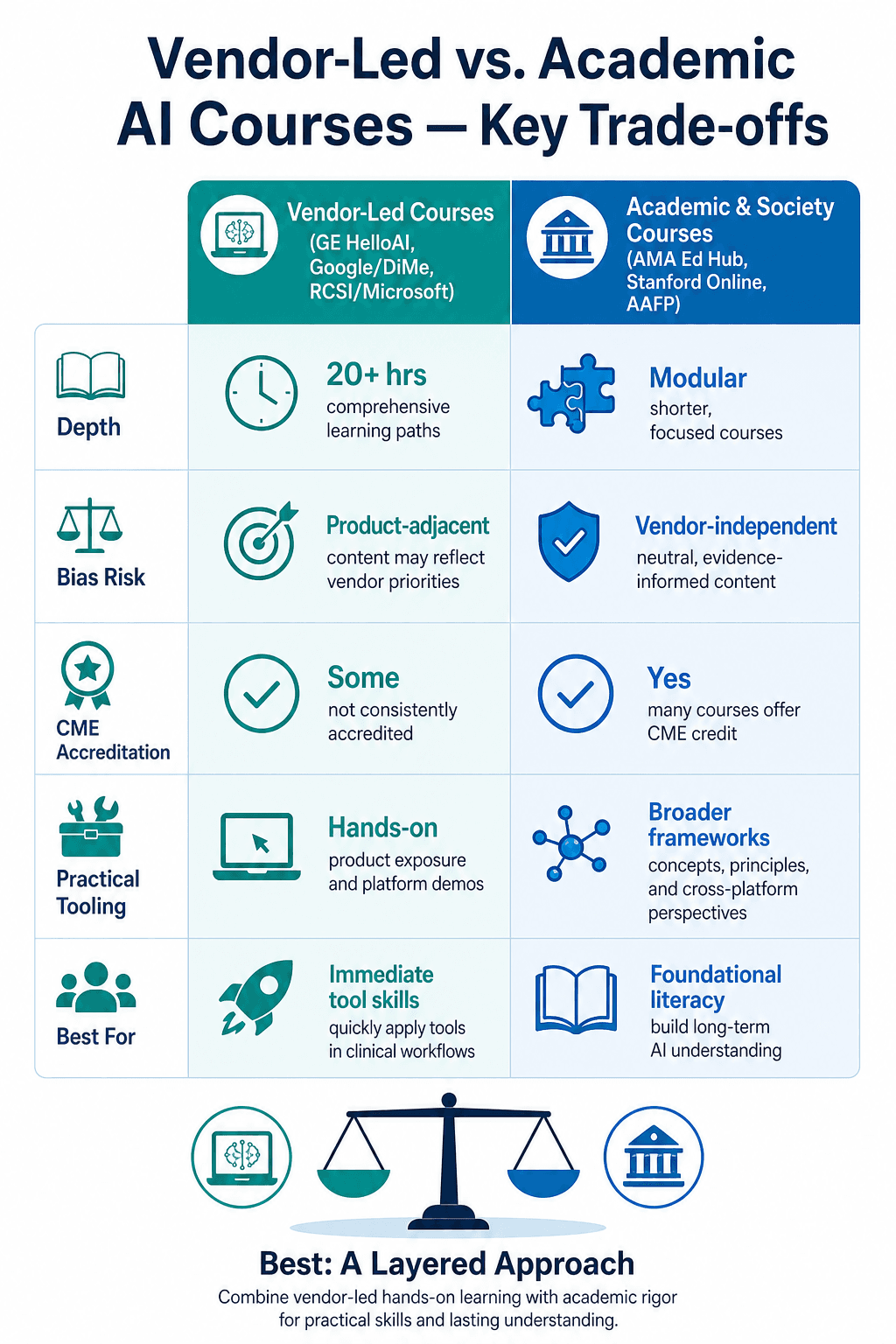
Comparison: Depth, Bias, Accreditation, and Practical Skills
The following table provides a structured comparison across the decision dimensions that matter most to healthcare professionals evaluating these courses.
| Dimension | Vendor-Led Courses | Academic / Society Courses |
|---|---|---|
| Content Depth | Variable: GE HelloAI (20+ hrs, deep technical), Google/DiMe (1 hr, narrow focus), RCSI/Microsoft (10 hrs, balanced) | Variable: AMA Ed Hub (multi-module, CME), Stanford (individual webinars), AAFP (3-part, specialty-specific) |
| Risk of Vendor Bias | Moderate to high: content may emphasize vendor's product ecosystem or technology stack | Low: designed to be vendor-independent, focused on clinical frameworks and ethics |
| CME / CPD Accreditation | RCSI offers 10 CPD points; GE HelloAI and Google/DiMe do not offer CME | AMA Ed Hub offers CME; AAFP offers CME; Stanford webinars may not offer CME |
| Practical Tool Exposure | High: GE HelloAI includes Python, Colab, deep learning frameworks; Google/DiMe covers prompt engineering | Low to moderate: focus on concepts, ethics, and clinical integration rather than specific tools |
| Best For | Learners who want hands-on skills and are comfortable with product-adjacent content | Clinicians seeking CME, learners prioritizing unbiased frameworks, and those new to AI |
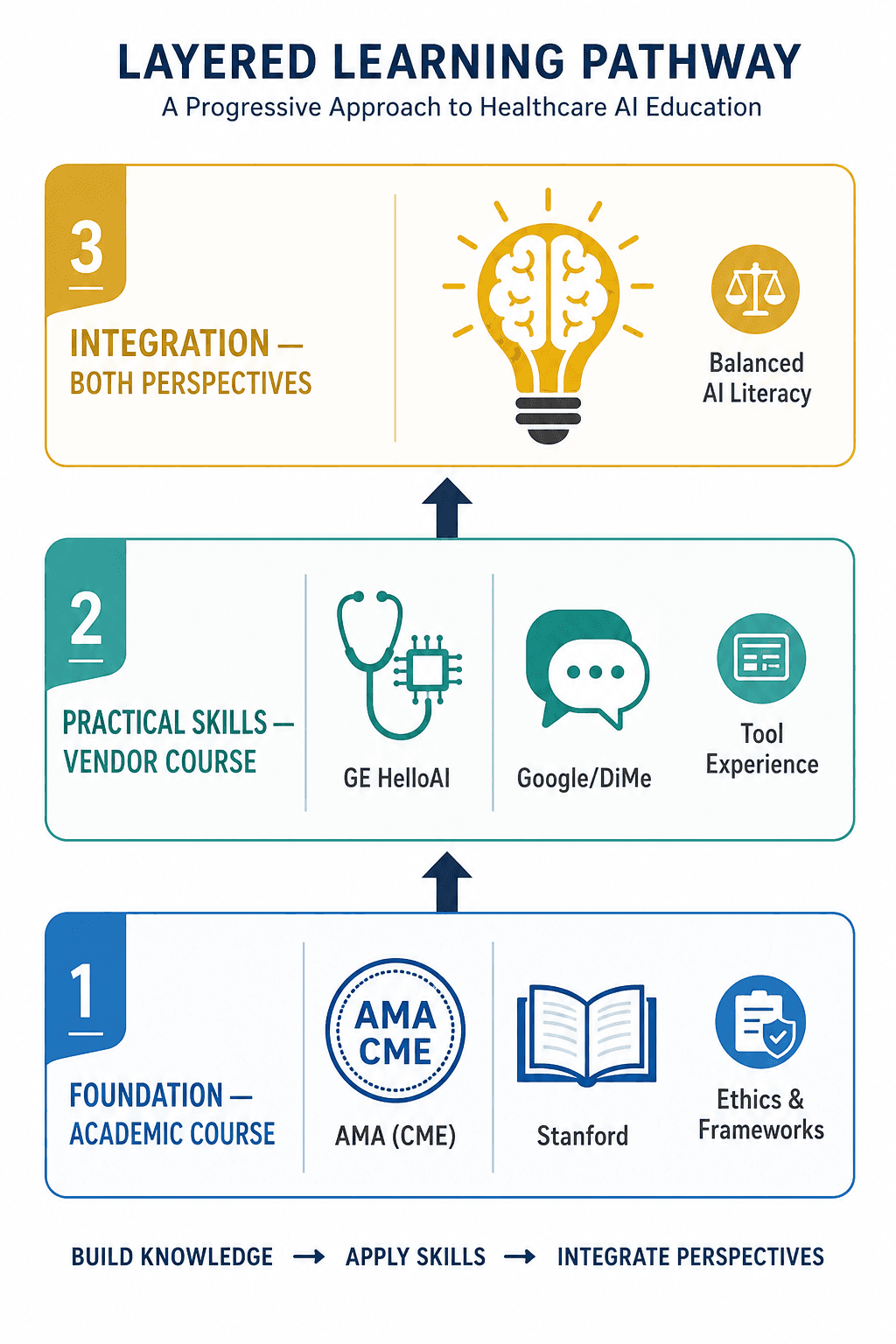
How to Layer Courses for Balanced AI Literacy
The strongest AI education for healthcare professionals comes from engaging with both vendor-led and academic perspectives. Each fills gaps left by the other. A practical approach is to layer courses in a structured sequence.
Example Learning Pathways
- For clinicians seeking CME: Start with the AMA Ed Hub AI series (vendor-independent, CME-accredited) to build a solid ethical and clinical framework. Then add the RCSI/Microsoft course (10 CPD points) for a deeper dive into clinical and administrative applications. Optionally, take the Google/DiMe course (1 hour) for a quick primer on generative AI and prompt engineering.
- For administrators and operational leaders: Begin with the RCSI/Microsoft course for a broad overview of both clinical and administrative AI applications. Follow with GE HealthCare's HelloAI Professional for hands-on exposure to operationalizing AI and understanding data management and scaling solutions.
- For students and researchers: Start with Great Learning Academy's free course (3 hours) for a quick, beginner-friendly foundation. Then progress to GE HelloAI Professional for technical depth in Python, deep learning, and foundation models. Supplement with Stanford Online webinars for academic perspectives on AI in healthcare.
- For family medicine practitioners: Take the AAFP AI in Family Medicine course (free, CME) for specialty-specific guidance. Then add the AMA Ed Hub series for a broader clinical AI framework, and the Google/DiMe course for practical prompt engineering skills.
Caveats and Considerations Before Enrolling
Before committing time to any course, consider the following practical factors.
- Optional paid certificates: Several free courses offer certificates of completion only for a fee. RCSI charges €50, Great Learning Academy charges a fee, and other providers may have similar models. The free access is to the learning content, not necessarily to a credential.
- Account creation and data use: Vendor-led courses may require creating an account, which could involve sharing personal or professional information. Be aware of the provider's data use and privacy policies, especially for courses from technology companies.
- Course availability changes: Free courses can be withdrawn, updated, or moved behind paywalls without notice. The details in this article were verified as of June 2026. Always check the provider's page for current availability, pricing, and module content before enrolling.
- CME accreditation verification: While AMA Ed Hub and AAFP courses are described as CME-accredited, the specific number of credits and the accreditation status for individual modules should be verified on the provider's site before assuming eligibility.
- Bias awareness: Vendor-led courses are valuable for practical skills but may present AI capabilities in a way that aligns with the vendor's product roadmap. Cross-reference claims with independent sources and academic literature.
Comments
Join the discussion with an anonymous comment.