
AI Is Now Infrastructure, Not a Pilot
For the better part of a decade, artificial intelligence in healthcare lived in a perpetual pilot phase. A radiology department here, a sepsis prediction model there, a handful of ambient scribe trials — each project isolated, each evaluation bespoke, each business case starting from scratch. That era has ended.
The February 2026 survey by Eliciting Insights, based on responses from 120 U.S. health systems, captured the inflection point: 75% of health systems have now deployed at least one AI solution, up from 59% in 2025. Nearly 60% run three or more AI tools simultaneously — a 67% year-over-year increase in multi-solution adoption. The share of systems with zero AI deployment nearly halved, dropping from 41% to 25%.
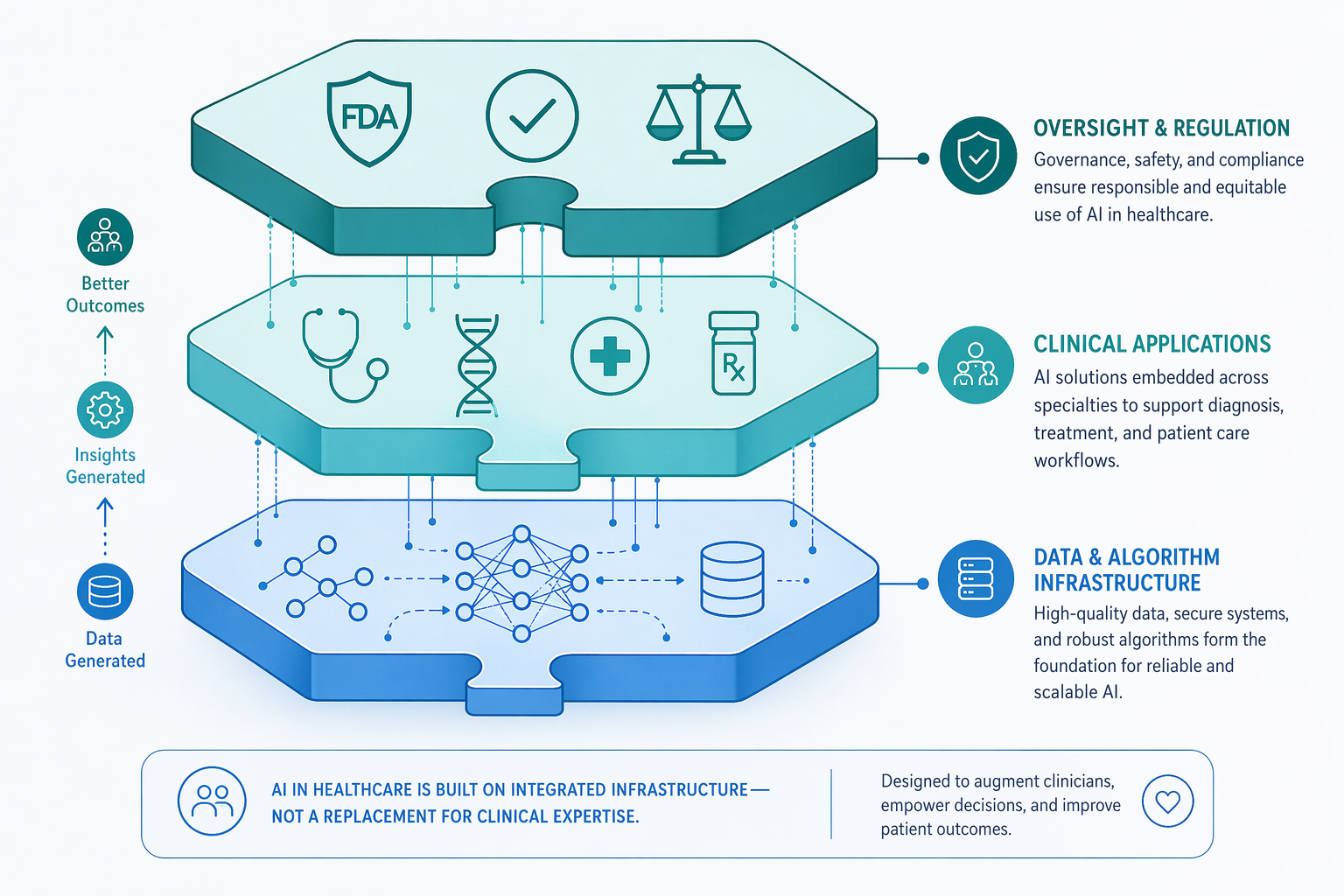
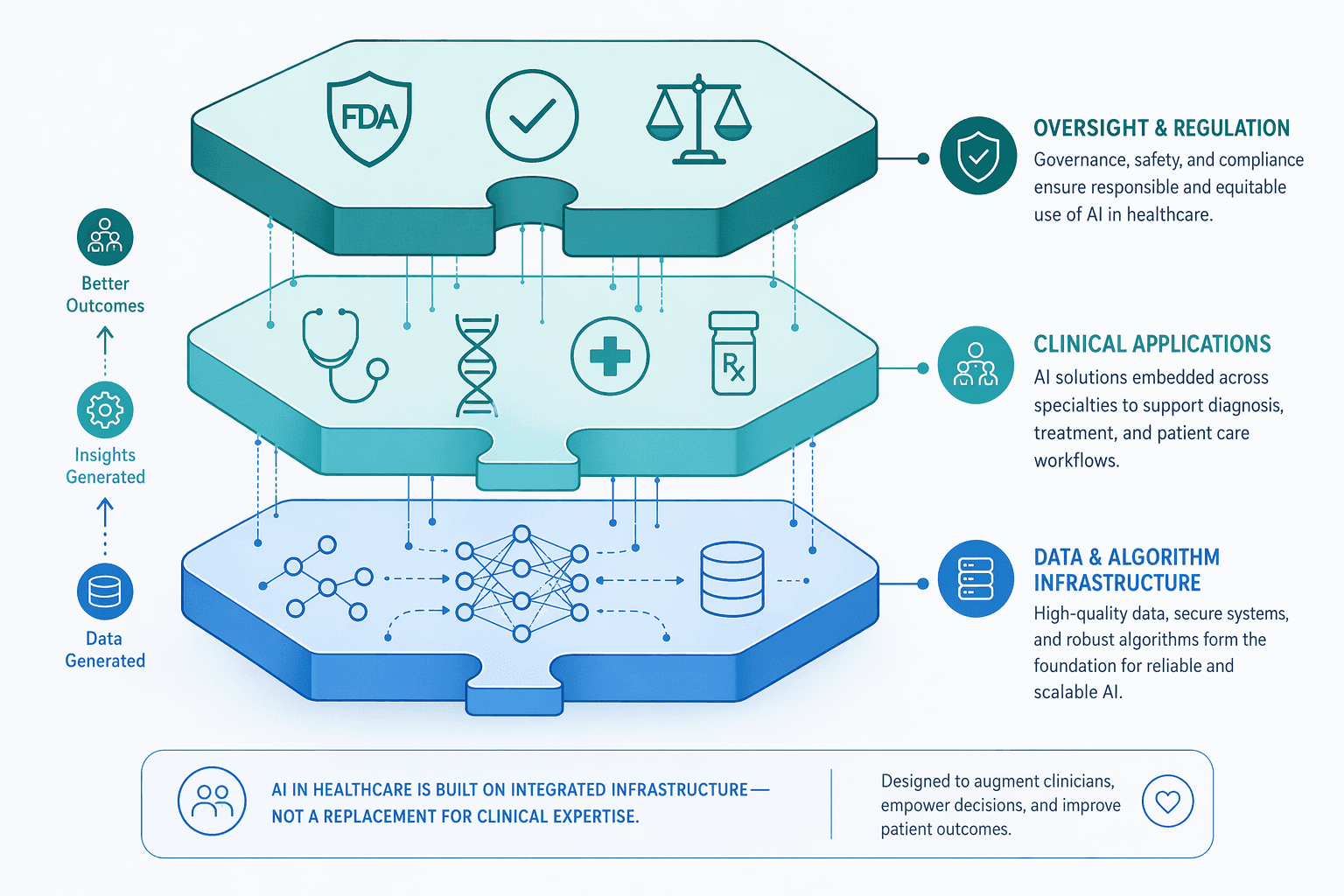
These numbers signal a structural shift. AI is no longer a discretionary innovation line item; it is becoming embedded infrastructure — as foundational to health system operations as the EHR or the revenue cycle platform. Yet the data also reveals a striking asymmetry. The same survey that documents 75% overall adoption shows that revenue cycle management (RCM) AI categories remain stubbornly below 30% implementation, despite active consideration rates of 34% to 45%. That gap — between what health systems are evaluating and what they have actually deployed — represents the largest near-term whitespace in the healthcare AI market.
This article unpacks that tension. Drawing primarily on the Eliciting Insights survey data and supplementary market context, it examines where AI adoption has accelerated, where the ROI evidence is strongest, and — most importantly — where the combination of high consideration and low implementation creates a clear strategic opportunity for health system leaders and the vendors who serve them.
Adoption Acceleration: From 59% to 75% in One Year
The pace of AI adoption across U.S. health systems over the past year has been anything but incremental. The Eliciting Insights data documents a 16-percentage-point increase in overall deployment — from 59% of health systems in early 2025 to 75% by February 2026. But the headline number understates the more significant shift happening beneath the surface.
The real story is the surge in multi-solution adoption. In 2025, roughly 30% of health systems reported running three or more AI tools. By early 2026, that figure had nearly doubled to 59%. That 67% year-over-year growth rate signals that early adopters are not stopping at one use case — they are building portfolios. A health system that deployed an AI radiology triage tool in 2024 is now adding ambient documentation, clinical decision support, and revenue cycle automation in parallel.
The contraction at the bottom of the adoption curve is equally telling. The proportion of health systems reporting zero AI deployment fell from 41% to 25% — a reduction of nearly 40% in the non-adopter segment. If this trajectory holds, the remaining holdouts will represent a shrinking minority by early 2027.
- 75% of health systems have deployed at least one AI solution (up from 59% in 2025)
- 59% run three or more AI tools simultaneously (up from ~30% in 2025, a 67% YoY increase)
- 25% report zero AI adoption (down from 41% in 2025)
- By end of May 2025, the FDA had authorized 1,247 AI/ML-enabled medical devices, with 956 in radiology and 116 in cardiovascular applications (Ventionteams, compiled from 28 sources)
- 70% of healthcare payers and providers were actively pursuing generative AI implementation as of early 2025 (Ventionteams)
The broader market context reinforces this acceleration narrative. The AI in drug discovery market nearly doubled from $0.9 billion in 2023 to $1.86 billion in 2024, representing a compound annual growth rate of 29.9%. And while the FDA's device authorization count is not a direct proxy for deployment, the growing stock of cleared tools — 1,247 as of May 2025 — provides the regulatory substrate for health systems to expand their AI portfolios with confidence.
For a broader look at the market forces driving and constraining this growth, see our companion analysis on the AI healthcare market in 2026.
Where AI Delivers: ROI Evidence Across Categories
Adoption numbers alone do not tell the full story. The durability of AI as health system infrastructure depends on whether the tools deliver measurable return on investment. The Eliciting Insights survey provides category-level ROI data that helps explain why certain AI applications have achieved higher penetration — and which ones are likely to drive the next wave of deployment.
Across all AI categories, 59% to 71% of implementers report achieving at least 2x return on their investment. The leaders are revealing: AI-based clinical documentation integrity (CDI) tops the list at 71%, followed closely by denial prediction at 70%. Both are revenue-cycle-adjacent functions — CDI directly impacts coding accuracy and reimbursement, while denial prediction targets a persistent source of revenue leakage.
| AI Category | Implementers Reporting 2x+ ROI |
|---|---|
| AI-based clinical documentation integrity (CDI) | 71% |
| Denial prediction | 70% |
| Overall across all categories | 59–71% |
These figures align with broader industry data. The Ventionteams compilation, drawing on 28 sources, reports that 82% of U.S. healthcare organizations describe their AI ROI as moderate or high, and 30% of those actively tracking outcomes characterize their return as high or very high. Among organizations using generative AI specifically, 45% achieved measurable return within 12 months of deployment.
The pattern is clear: the strongest ROI cases cluster in operational and revenue-related categories — not in the high-profile clinical applications that dominate conference keynotes. This is not to diminish the clinical value of AI in radiology or pathology, where evidence of improved diagnostic accuracy is substantial. Rather, it reflects a practical reality for health system CFOs: the business case for an AI tool that directly improves reimbursement or reduces denials is easier to quantify and defend than one that improves diagnostic sensitivity by a few percentage points.
For a deeper look at the evidence behind one specific high-ROI category, see our analysis of conversational AI in healthcare.
The Revenue Cycle Whitespace: High Consideration, Low Implementation
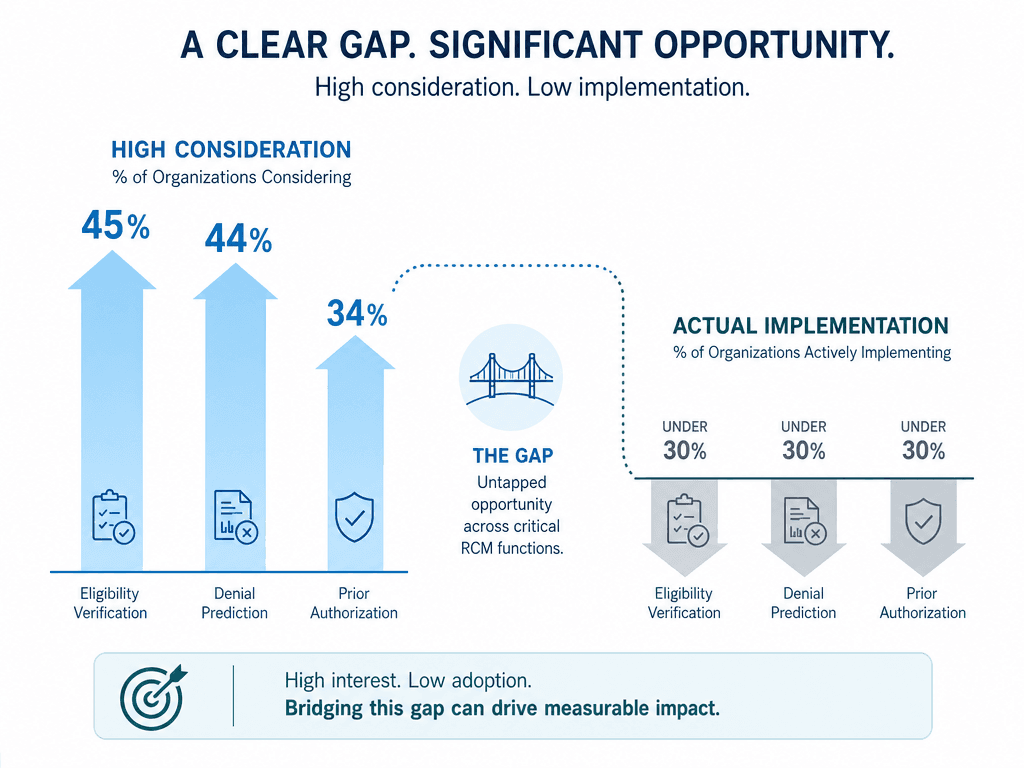
If the overall adoption data tells a story of rapid progress, the RCM data tells a story of untapped potential. Across three key revenue cycle categories, the gap between active consideration and actual implementation is the widest in the entire AI landscape.
| RCM AI Category | Actively Considering | Implemented | Gap |
|---|---|---|---|
| Eligibility verification | 45% | 29% | 16 percentage points |
| Denial prediction | 44% | 25% | 19 percentage points |
| Prior authorization | 34% | 28% | 6 percentage points |
Eligibility verification shows the widest absolute gap: 45% of health systems are actively evaluating AI solutions, but only 29% have deployed them. Denial prediction follows a similar pattern — 44% considering versus 25% implemented. Even prior authorization, with a narrower gap, shows a 6-percentage-point delta between intent and action.
Why does this gap exist? Three factors appear to be at play:
- Integration complexity. RCM AI tools must interface with existing revenue cycle platforms, clearinghouses, and payer systems — a heterogeneous technical environment that makes deployment harder than plugging an AI tool into a PACS or an EHR module.
- Vendor focus on clinical AI. The majority of well-funded healthcare AI startups have targeted clinical applications (imaging, diagnostics, ambient documentation) where the narrative is more compelling and the regulatory path is clearer. RCM AI has historically been the domain of legacy revenue cycle vendors, not AI-native companies.
- Regulatory uncertainty. While the FDA has clarified its framework for clinical AI devices through guidance documents and PCCP mechanisms, the regulatory status of AI tools that automate administrative and revenue cycle functions is less defined. Health systems may be waiting for clearer guardrails before committing to deployment.
The regulatory dimension is worth watching closely. Recent CMS policy signals — including the proposed rule CMS-0057 — create a forcing function for RCM AI adoption by tying reimbursement accuracy requirements to the use of automated tools. For a detailed analysis of how regulatory developments are shaping commercial prospects, see our article on the AI healthcare market's regulatory crossroads.
For a deeper dive into the evidence and regulatory landscape of one specific RCM category, see our analysis of prior authorization AI.
The Underserved Majority: Sub-500 Bed Systems and Non-Epic EMRs
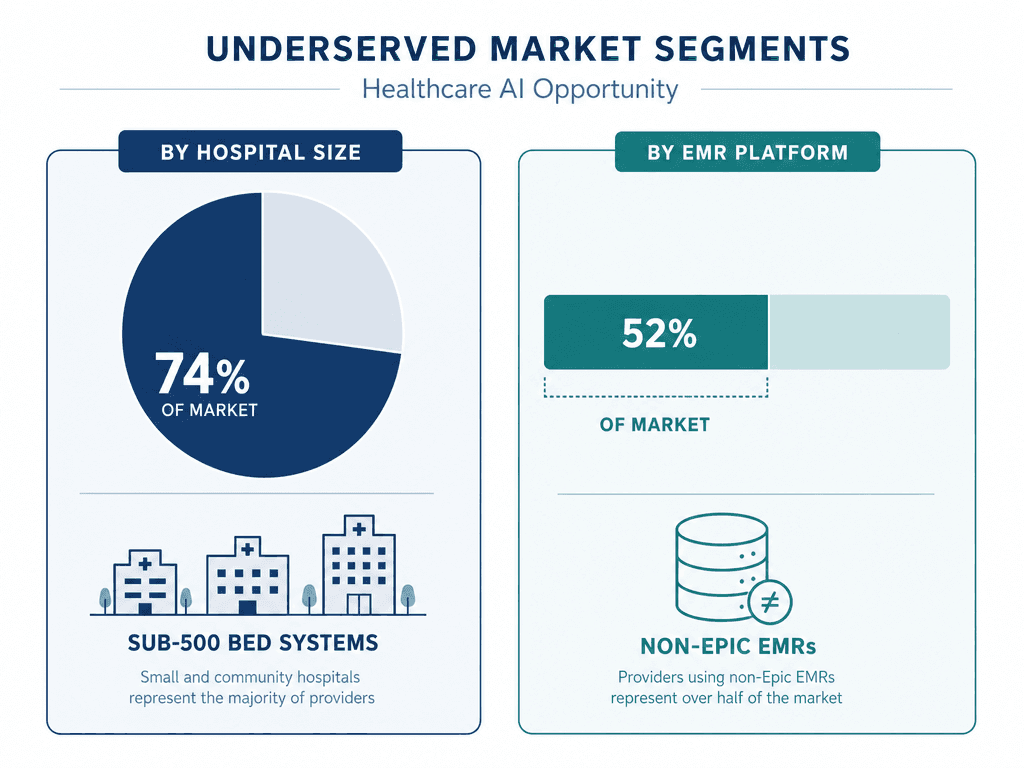
The aggregate adoption figures mask a structural divide that has significant implications for both health system strategy and vendor market positioning. The Eliciting Insights data reveals two overlapping underserved populations: smaller health systems and organizations running non-Epic electronic medical records.
Sub-500 bed systems represent 74% of all U.S. health systems, yet they show near-zero RCM AI adoption. These organizations face a double disadvantage: they have fewer internal resources to evaluate and deploy AI tools, and the vendor ecosystem has historically prioritized large academic medical centers and multi-hospital enterprises where contract values are higher and implementation complexity is offset by dedicated IT teams.
The EMR divide is equally stark. Epic holds approximately 48% of the acute care EMR market share, with Oracle/Cerner at 16%, Meditech at 8%, CPSI at 7%, and AthenaHealth at 4%. The remaining 52% of health systems run non-Epic EMRs — and they are systematically underserved by AI vendors whose products are optimized for Epic's architecture and data model.
The data bears this out. Ambient listening AI adoption on CPSI systems is just 25%, compared to 72% on Epic. Similar disparities exist across other AI categories. For health systems running Oracle/Cerner, Meditech, or CPSI, the AI vendor marketplace offers fewer options, less mature integrations, and higher implementation friction.
This creates both a market opportunity and an equity concern. The market opportunity is straightforward: any vendor that can deliver RCM AI tools that integrate cleanly with non-Epic EMRs will face dramatically less competition than those targeting the Epic ecosystem. The equity concern is that the health systems most in need of AI-driven revenue cycle improvements — smaller community hospitals and rural facilities running older EMRs — are the least likely to have access to them.
For an in-depth look at the governance obligations that arise when AI is deployed within the Epic ecosystem, see our analysis of governing Epic's AI ecosystem.
Key Takeaways and Strategic Implications
The data from the Eliciting Insights survey and supporting sources paints a clear picture of where healthcare AI stands in mid-2026 — and where it is headed. For health system leaders and AI vendors alike, the strategic implications are actionable.
- The RCM whitespace is the largest near-term opportunity. With 34–45% of health systems actively considering RCM AI tools but fewer than 30% having deployed them, the gap represents hundreds of potential implementations. The ROI evidence — 70% of denial prediction implementers reporting 2x+ returns — provides a strong business case for health system CFOs.
- The sub-500 bed segment is structurally underserved. These 74% of health systems have near-zero RCM AI adoption, not because they lack need, but because the vendor ecosystem has not built for their scale, budget, or technical environment. Vendors that can deliver lightweight, lower-cost, easier-to-deploy RCM AI solutions for this segment will find a largely uncontested market.
- Non-Epic EMRs represent a vendor blind spot. With 52% of health systems running non-Epic platforms, the current vendor strategy of optimizing for Epic leaves a majority of the market with suboptimal options. Vendors that invest in Oracle/Cerner, Meditech, and CPSI integrations will differentiate themselves in a crowded field.
- The ROI evidence supports operational AI investment. The strongest returns are in CDI and denial prediction — both operational and revenue-cycle-adjacent categories. Health systems building their AI portfolios should prioritize tools with clear, quantifiable financial impact before expanding into more speculative clinical applications.
- Regulatory tailwinds are building. CMS policy signals and the growing body of FDA guidance for AI/ML-enabled devices are reducing the regulatory uncertainty that has slowed RCM AI adoption. Health systems that delay investment may find themselves playing catch-up as reimbursement requirements increasingly assume automated tools.
The central insight from the 2026 adoption data is that healthcare AI has crossed a threshold. It is no longer a question of whether AI will be part of health system operations, but of which applications will be deployed first, for which patients, and with what return. The revenue cycle whitespace — high consideration, low implementation, strong ROI evidence — is where the next wave of deployment will likely concentrate. Health systems that recognize this and act on it will be better positioned than those that wait for the market to consolidate around a narrower set of clinical applications.
For a broader perspective on how the industry conversation around AI is shifting from hype to governance and real-world outcomes, see our coverage of 2026 AI in healthcare summits.
Comments
Join the discussion with an anonymous comment.