
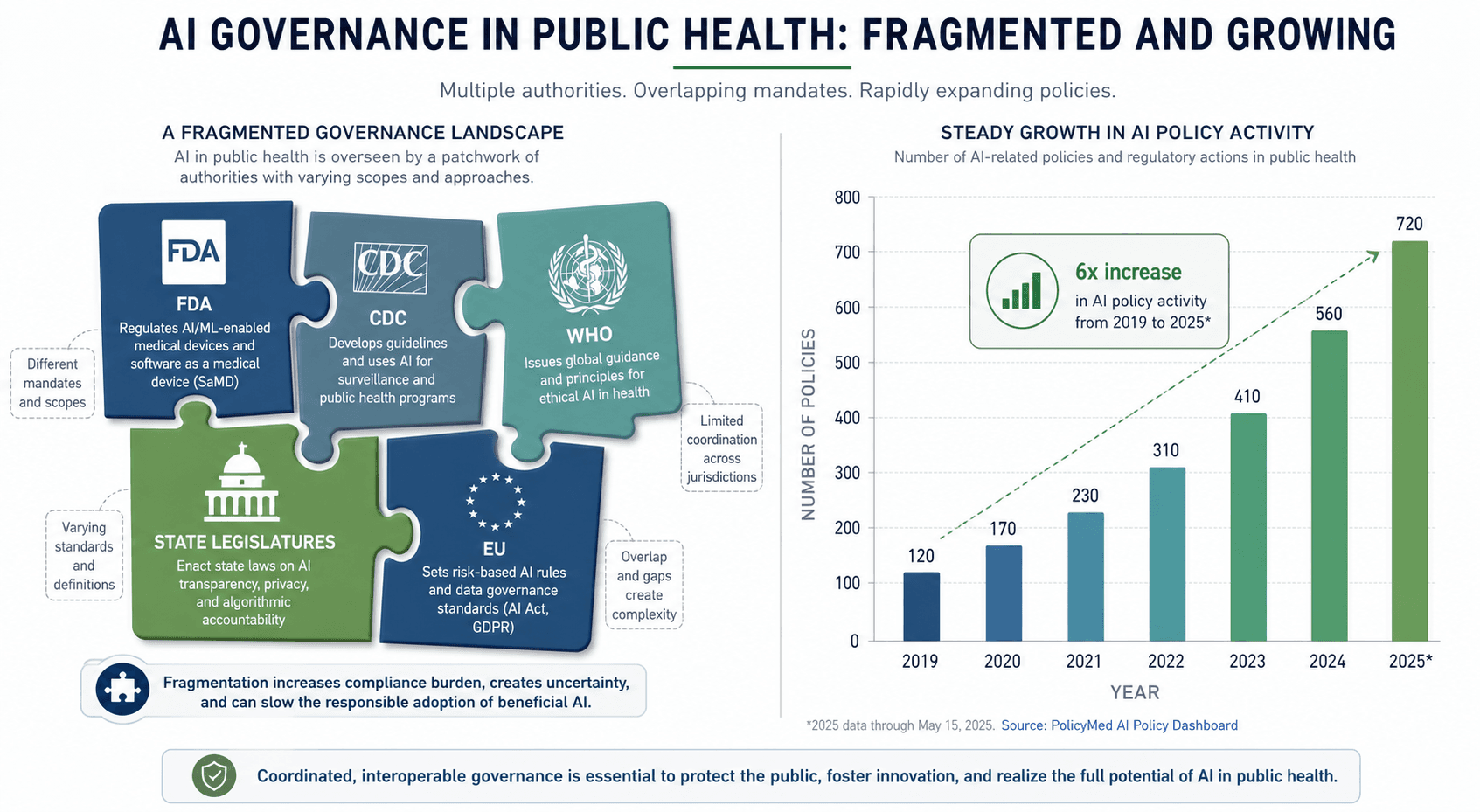
The promise of artificial intelligence in public health — faster disease surveillance, optimized resource allocation, personalized risk prediction — carries a documented countercurrent. A growing body of evidence shows that the same algorithms designed to improve population health outcomes can systematically disadvantage the populations they are meant to serve. The regulatory response to this tension, however, is neither unified nor settled. It is a contested patchwork of federal deregulation, state-level algorithmic discrimination laws, and international governance frameworks, each pulling in different directions.
This article examines the documented evidence of algorithmic bias in public health AI, maps the fragmented regulatory landscape that has emerged in response, and offers actionable guidance for policy professionals, health equity officers, and compliance teams navigating this shifting terrain. It is written for readers who already understand the basic taxonomy of algorithmic bias — for those who need a primer, the site's existing glossary entry on algorithmic bias covers definitions and mitigation frameworks comprehensively.
The Evidence Base for AI-Driven Disparities in Public Health
The harms are not hypothetical. A 2024 systematic review of 30 studies published between 2013 and 2023 found a significant association between AI utilization and the exacerbation of racial disparities in health outcomes, including longer wait times, lower prediction accuracy, and underdiagnosis for Black and Hispanic populations. The review, cited in an April 2026 analysis by KFF, consolidates evidence across multiple public health AI applications and provides a baseline for understanding the scale of the problem.
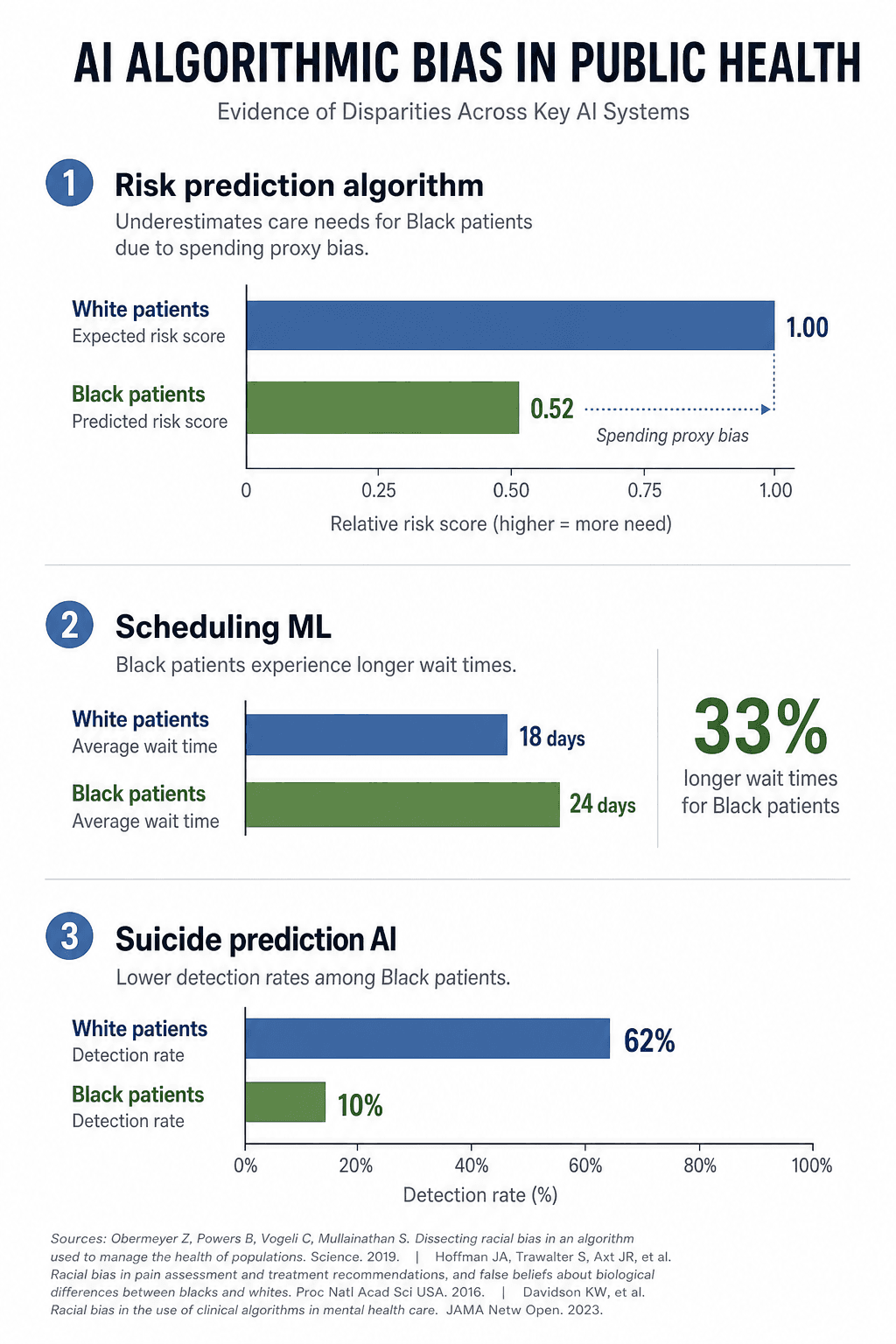
Three cases from that evidence base illustrate the pattern clearly:
- Risk prediction and the spending proxy. A widely used U.S. risk prediction algorithm, designed to identify patients with complex health needs for care management programs, systematically underestimated the needs of Black patients. The algorithm used healthcare spending as a proxy for illness — but because Black patients with equivalent disease burden had lower spending due to historical access inequities, the model assigned them lower risk scores. The result: fewer Black patients were referred to the programs that could help them.
- Scheduling ML and wait-time disparities. A machine learning algorithm used to schedule patient appointments led to Black patients experiencing 33% longer wait times than White patients. The model optimized for operational efficiency but encoded patterns from historical scheduling data that reflected systemic inequities in access and resource allocation.
- Suicide prediction and differential detection. An AI suicide prediction model detected 62% of suicides among White patients but only 10% among Black patients. The model's training data, drawn predominantly from populations with higher healthcare engagement, failed to capture the patterns of suicidal ideation and behavior in populations with different care-seeking histories and social determinants.
Sources of Algorithmic Bias in Population-Level AI
Understanding why these disparities emerge requires examining the specific bias types that are most consequential for public health AI. A July 2025 article in PMC by Joseph and colleagues identifies five bias categories that are particularly relevant to population-level applications: historic bias, representation bias, measurement bias, aggregation bias, and deployment bias. Each manifests differently in public health contexts than in clinical settings, and each has distinct implications for regulatory intervention.
| Bias Type | Definition | Public Health AI Example |
|---|---|---|
| Historic bias | Prior injustices embedded in training data | A U.S. risk prediction algorithm using prior healthcare expenditure as a proxy for illness, encoding historical access inequities |
| Representation bias | Training samples dominated by urban or wealthy populations | Sepsis prediction models from high-income settings showing reduced accuracy among Hispanic patients due to underrepresentation in training data |
| Measurement bias | Proxy variables that differ across socioeconomic environments | Using hospital attendance or smartphone usage as health indicators, which systematically undercounts populations with limited access |
| Aggregation bias | Assuming homogeneity across heterogeneous groups | Applying a single disease surveillance model across diverse geographic regions with different epidemiological profiles |
| Deployment bias | Tools from high-resource environments used without modification in low-resource settings | India's Aarogya Setu contact tracing app failing to reach populations without smartphones, limiting its effectiveness for disease surveillance |
The deployment bias category is especially salient for public health. Unlike clinical AI tools that are deployed within controlled healthcare environments, public health AI applications — contact tracing apps, syndromic surveillance systems, resource allocation algorithms — must function across heterogeneous populations with varying levels of digital access, health literacy, and trust in institutions. When a tool designed for a high-resource urban setting is deployed in a rural or low-income community without modification, the bias is not in the algorithm but in the implementation.
The Regulatory Landscape: How Many Policies Actually Address Equity?
The gap between documented harm and regulatory response is measurable. The Health & AI Policy Index (HAPI), published in npj Digital Medicine in May 2026, provides the most comprehensive snapshot available of the health-AI policy landscape. As of January 1, 2026, the HAPI index catalogs 240 policies from over 100 distinct issuing bodies. The findings on equity coverage are striking.
| Policy Tag | Number of Policies | Percentage of Total |
|---|---|---|
| Transparency & Governance | 144 | 60% |
| Safety & Risk | 115 | 48% |
| Clinical Quality & Efficacy | 84 | 35% |
| Privacy & Data | 60 | 25% |
| Equity & Bias | 63 | 26% |
Only 63 of 240 policies — 26% — are tagged as addressing equity and bias. Among those 63, 50 (79%) also carry a Transparency & Governance tag, indicating that equity concerns are usually embedded within broader transparency requirements rather than treated as standalone policy objectives. This co-tagging pattern suggests that equity is often an afterthought, addressed through disclosure and documentation requirements rather than through substantive use conditions or performance standards.
The impact distribution is equally concerning. Only 22 policies (9%) are rated as high-impact. The remaining 91% are medium or low impact. State policies make up most of the high-impact instruments — 9 of the 10 policies that set substantive use conditions come from state legislatures, not federal agencies. This finding is critical for understanding the regulatory dynamic: the most meaningful equity protections are emerging at the state level, even as federal policy moves in the opposite direction.
Federal Policy Shift: Deregulation and the Retreat from Equity Mandates
The federal regulatory trajectory under the Trump administration represents a sharp departure from the equity-focused approach of the preceding years. Three actions, all documented in the KFF analysis, define this shift.
- Executive Order 4148 (January 2025). This order rescinded Biden-era executive orders that had established equity as a cross-cutting priority for federal AI policy, including requirements for agencies to assess and mitigate algorithmic bias in federally funded programs. The rescission removed the formal mandate for equity review in AI procurement and deployment across federal health agencies.
- Executive Order 14179. This order reframed federal AI policy around the principle of "minimally burdensome" innovation, prioritizing industry growth and reducing regulatory friction. The language signals a shift away from proactive equity governance and toward a posture that treats algorithmic discrimination as a market problem to be solved by voluntary industry standards rather than regulatory mandates.
- DOJ AI Litigation Task Force (January 2026). The Department of Justice created a dedicated task force to identify and challenge state laws that impose algorithmic discrimination requirements on AI systems. The task force's creation signals an active federal posture against state-level equity mandates, framing them as barriers to innovation that preempt federal authority.
These actions do not eliminate all federal engagement with AI in health. The FDA continues to refine its approach to AI-enabled device regulation, including through the Predetermined Change Control Plan (PCCP) guidance, which addresses how manufacturers can update AI/ML models after market authorization. But the equity-specific infrastructure — the mandates, review requirements, and accountability mechanisms that were designed to prevent algorithmic discrimination — has been systematically dismantled.
State-Level Activity: 47 States, 250+ Bills, and a Legal Showdown
While the federal government retreats from equity mandates, state legislatures have moved aggressively into the regulatory vacuum. In 2025, 47 states introduced more than 250 health AI bills, according to the KFF analysis. This surge represents the most significant period of state-level health AI legislation in U.S. history, and it has created a direct conflict with federal policy.
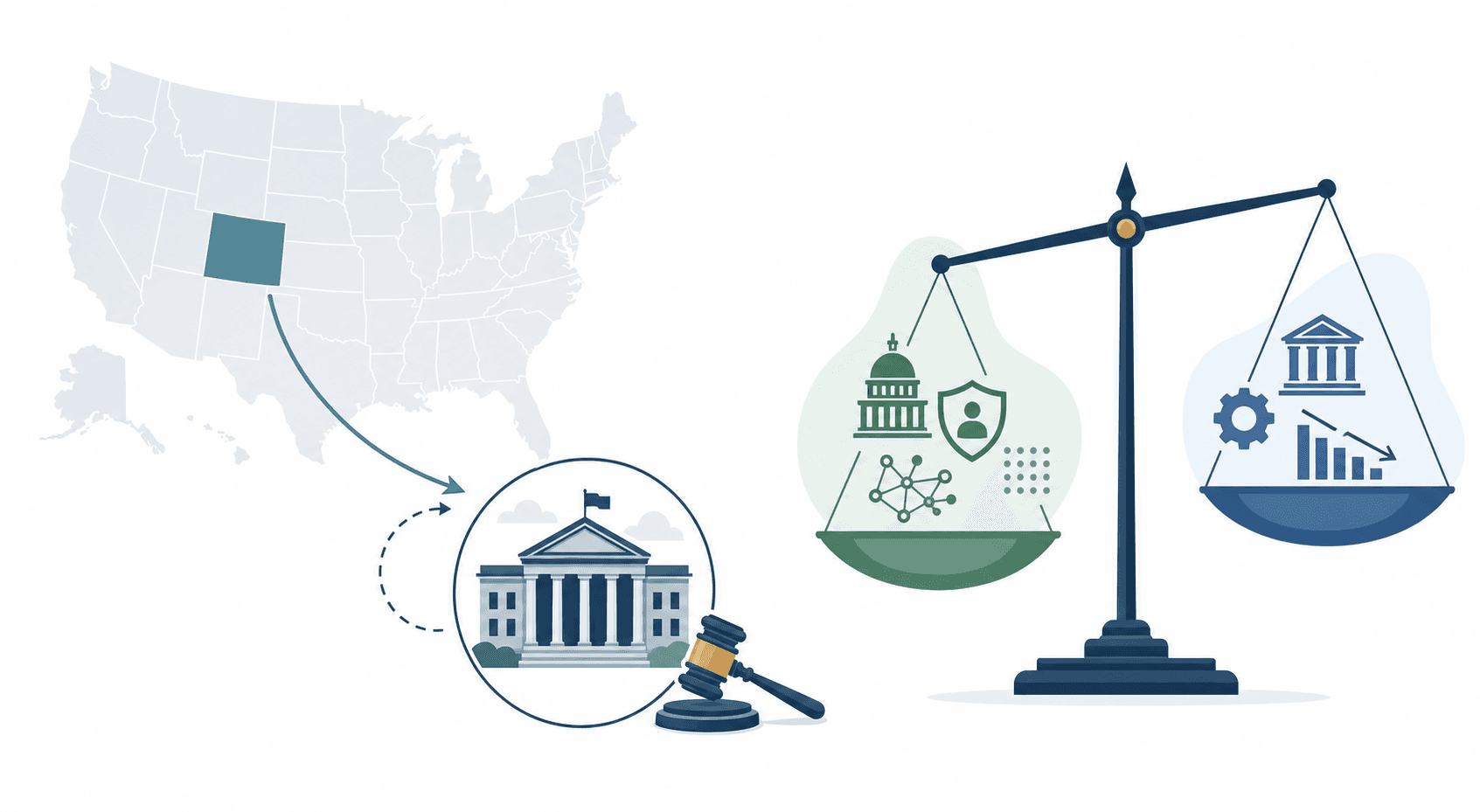
The most consequential example is Colorado's SB24-205, which includes algorithmic discrimination provisions that require developers and deployers of AI systems to take reasonable care to avoid algorithmic discrimination in high-risk use cases, including healthcare. The law's provisions are among the most specific in the nation, establishing a duty of care that goes beyond transparency and disclosure to impose substantive obligations on AI developers.
Colorado SB24-205 now faces legal challenges from the DOJ AI Litigation Task Force, which argues that the state law is preempted by federal authority and imposes burdens that conflict with the federal policy of minimally burdensome innovation. The outcome of this challenge will have significant implications for the broader state-level regulatory landscape. If the DOJ succeeds in invalidating Colorado's algorithmic discrimination provisions, it could chill similar efforts in other states. If Colorado's law survives, it could become a template for a wave of state-level equity mandates.
Mitigation Frameworks and Governance Approaches
In the absence of a unified regulatory mandate, several governance frameworks and mitigation strategies have emerged to address algorithmic bias in public health AI. These frameworks are not substitutes for regulation, but they provide actionable guidance for organizations that choose to address equity proactively — whether or not the law requires it.
The CDC's commentary on health equity and ethical considerations in AI, published in Preventing Chronic Disease in August 2024, identifies multiple sources of bias — including experience/expertise bias, exclusion bias, environment bias, empathy bias, and evidence bias — and recommends a set of mitigation strategies that are directly applicable to public health AI deployments.
- Inclusive data collection. Ensuring that training data includes diverse population groups across race, ethnicity, geography, socioeconomic status, and digital access levels. This is the foundational mitigation — without representative data, no amount of algorithmic adjustment can fully correct for representation bias.
- Explainable AI systems. Building AI systems with interpretable outputs that allow public health officials to understand why a model made a particular prediction or recommendation. Explainability is a prerequisite for detecting and correcting biased outcomes.
- Continuous monitoring for biased outcomes. Implementing post-deployment surveillance systems that track model performance across demographic subgroups and flag disparities in accuracy, wait times, or resource allocation.
- Diverse expert teams. Including clinicians, community representatives, and equity experts in the AI development lifecycle to identify potential sources of bias that technical teams alone may miss.
- Integration of social determinants. Incorporating social determinants of health — housing, food security, transportation access, digital literacy — into AI models to avoid relying solely on clinical or claims data that encode systemic inequities.
- Community engagement. Involving affected communities in the design, deployment, and evaluation of public health AI tools to ensure that the tools serve population needs rather than operational convenience.
At the international level, the WHO-led Global Initiative on AI for Health (GI-AI4H), described in an April 2025 npj Digital Medicine article by Muralidharan and colleagues, has established four strategic priorities that provide a governance framework for member states: Ethics, Regulation, Implementation, and Operations. The Ethics priority builds on the WHO's 2024 ethics guidance for large multimodal models, which has already been accessed by over 25,000 people across 178 countries. The Regulation priority references the WHO's 2023 Regulatory Considerations on AI for Health and the International Medical Device Regulators Forum's 2022 Good Machine Learning Practice guidance.
Recommendations for Policy Professionals Navigating the Shifting Landscape
The fragmented and contested regulatory landscape creates both risk and opportunity for organizations committed to equity in public health AI. The following recommendations are designed for policy professionals, health equity officers, and compliance teams who need to navigate this environment while maintaining effective equity governance.
- Monitor both federal and state regulatory developments simultaneously. The federal-state conflict over algorithmic discrimination is not a temporary dispute — it is a structural tension that will shape the regulatory environment for years. Organizations operating across multiple states must track both the DOJ's legal challenges to state laws and the evolving state-level legislative landscape. The HAPI index provides a useful baseline, but it must be supplemented with real-time tracking of state bill activity and legal proceedings.
- Build equity audits into AI procurement and deployment regardless of regulatory mandates. The retreat from federal equity mandates does not eliminate the underlying risk of algorithmic harm. Organizations that proactively implement equity audits — testing AI tools for differential performance across demographic subgroups before and after deployment — reduce their legal, reputational, and operational exposure. The CDC's mitigation framework provides a practical starting point for designing these audits.
- Engage with international frameworks as potential benchmarks. The WHO's GI-AI4H framework and the EU AI Act's risk-based classification system offer governance models that may influence future U.S. regulation, particularly if the political landscape shifts again. Organizations that align their internal governance with these international standards position themselves for regulatory convergence rather than regulatory whiplash.
- Document and report bias findings to build the evidence base for future regulation. The current regulatory vacuum is partly a function of insufficient evidence. The systematic review of 30 studies that underpins much of the current understanding of AI-driven disparities is a start, but it is not enough. Organizations that systematically document and publish bias findings — including null findings where AI tools perform equitably — contribute to the evidence base that will inform future regulation, whether at the federal, state, or international level.
The tension between documented bias harms and a contested regulatory response is not likely to resolve quickly. The federal government has signaled a preference for voluntary industry standards over regulatory mandates. States are moving in the opposite direction, imposing substantive equity requirements that face legal challenges. International bodies are developing governance frameworks that lack enforcement mechanisms. In this environment, the organizations that fare best will be those that treat equity governance not as a compliance obligation to be met at the minimum level required by law, but as an operational necessity that protects both the populations they serve and their own institutional integrity.
Comments
Join the discussion with an anonymous comment.