
The privacy controversy over audio surveillance AI in hospitals is not really about whether physicians should get help with notes. It is about whether a health system can place an always-listening documentation tool into an exam room, send the encounter audio through a vendor workflow, and later defend the deployment by saying the tool was “administrative” and HIPAA-reviewed. The Sharp HealthCare lawsuit makes that defense look incomplete before anyone reaches the broader AI ethics debate.
In November 2025, plaintiffs filed a proposed class action against Sharp HealthCare and Abridge, alleging that Sharp used an AI scribe to record patient encounters without adequate consent from all parties under California law.[1] The complaint reportedly involves more than 100,000 patient encounters, and the legal theory includes claims under California’s Invasion of Privacy Act, where statutory damages can reach $5,000 per violation.[2] Those two facts belong in the same sentence. A recording practice that may have been purchased as a documentation aid can become material litigation exposure when multiplied across routine visits.

Nothing about that math decides the case. The Sharp matter is active litigation, and the allegations have not been adjudicated. But compliance risk does not wait for a final judgment. The case is already useful because it identifies the operational act that health systems too often blur: the act of listening and recording is not the same legal event as the later handling of protected health information.
The Sharp Allegations Turn Consent Into a Balance-Sheet Issue
The plaintiffs’ theory is direct. They allege that Sharp deployed Abridge’s AI scribe in clinical encounters without obtaining consent sufficient for California’s all-party consent requirement.[1][2] They also contend that language in Sharp’s patient portal was too general to establish consent under CIPA, and that Sharp refused to delete recordings after patient requests, citing a 30-day retention policy.[2]
That portal allegation matters because many health systems treat notice architecture as if it were consent architecture. A privacy notice, a terms-of-use update, a registration packet acknowledgment, and a patient portal banner may all be useful pieces of evidence. They are not automatically the same thing as all-party consent to an audio recording. If the statute triggered by the encounter is a wiretap or eavesdropping law, the question becomes narrower: did every legally required participant agree to the recording before it happened?
The plaintiffs also reportedly assert claims involving California medical privacy law and false documentation, but the CIPA theory is the one that should command the first compliance meeting.[2] Medical privacy claims are familiar terrain for hospital lawyers. False documentation claims fit into existing health-record risk categories. Wiretap statutory damages attached to a routine documentation workflow are different. They turn a seemingly small consent mismatch into a repeatable violation theory.
The 30-day retention allegation adds a second layer. Retention is often sold internally as a control: the vendor does not keep raw audio indefinitely; the health system can describe a defined deletion window; the privacy team can point to a policy. But a retention policy does not cure an unlawful recording if consent was required at the front end. Nor does it resolve the patient-facing problem when a person asks for deletion and is told the system has a standard retention period. In a courtroom, that fact pattern may be read less like a technical safeguard and more like evidence that patients lacked practical control over recordings of their own visits.
For administrators, the uncomfortable point is that none of this requires a finding that an AI scribe produced a bad clinical note. The alleged harm is not primarily diagnostic. It is the claimed interception or recording of a confidential clinical conversation without the consent state law demands. That is why a procurement file focused on accuracy, clinician satisfaction, and HIPAA security may still be missing the decisive legal question.
Why HIPAA Review Is Not the End of the Inquiry
HIPAA is a privacy and security baseline for protected health information. It governs uses and disclosures, safeguards, business associate obligations, and patient rights. It does not, by itself, answer whether a hospital may record a conversation in an all-party consent state without a separate, legally adequate agreement from everyone whose consent is required. Treating a HIPAA pass as a consent pass is how a privacy/security review becomes overconfident.
The distinction is not academic. A health system could execute a business associate agreement, require encryption, restrict vendor access, and still face a claim that the original audio capture violated a state wiretap statute. Conversely, a recording may be consented to under state law and still raise HIPAA concerns if the vendor contract, data flow, access controls, or patient-rights process is poorly designed. These are separate regimes, with separate questions and separate remedies.
De-identified data use creates another area where HIPAA comfort can outrun patient expectations. Legal analysis of 2026 state healthcare AI activity notes that HIPAA provides no restrictions on the use of de-identified data by AI vendors.[3] That does not mean every vendor reuse of de-identified data is unlawful, or that every de-identified dataset is readily re-identifiable. It means the legal permission structure and the trust problem are not the same thing. Scholarly discussion of AI scribes has separately warned that re-identification risk remains part of the clinical-practice risk landscape even when data are treated as de-identified.[4]
Patients who object to recording may not be making a HIPAA argument at all. They may be objecting to the capture of the conversation, the possibility that audio was retained, the use of transcripts to improve models, or the feeling that a private medical visit acquired a silent third participant. A compliance program that responds only with “the vendor is a business associate” is answering a narrower question than the one patients and plaintiffs may ask.
FDA Non-Review Leaves a Different Gap
FDA oversight is also a poor substitute for consent analysis. AI scribes are generally classified as administrative documentation tools rather than medical devices, so they do not require FDA premarket review or post-market surveillance on that basis.[3] That classification may be sensible for tools that transcribe and draft notes without making diagnostic or treatment recommendations. But it also means federal device review is not where the recording practice is tested.
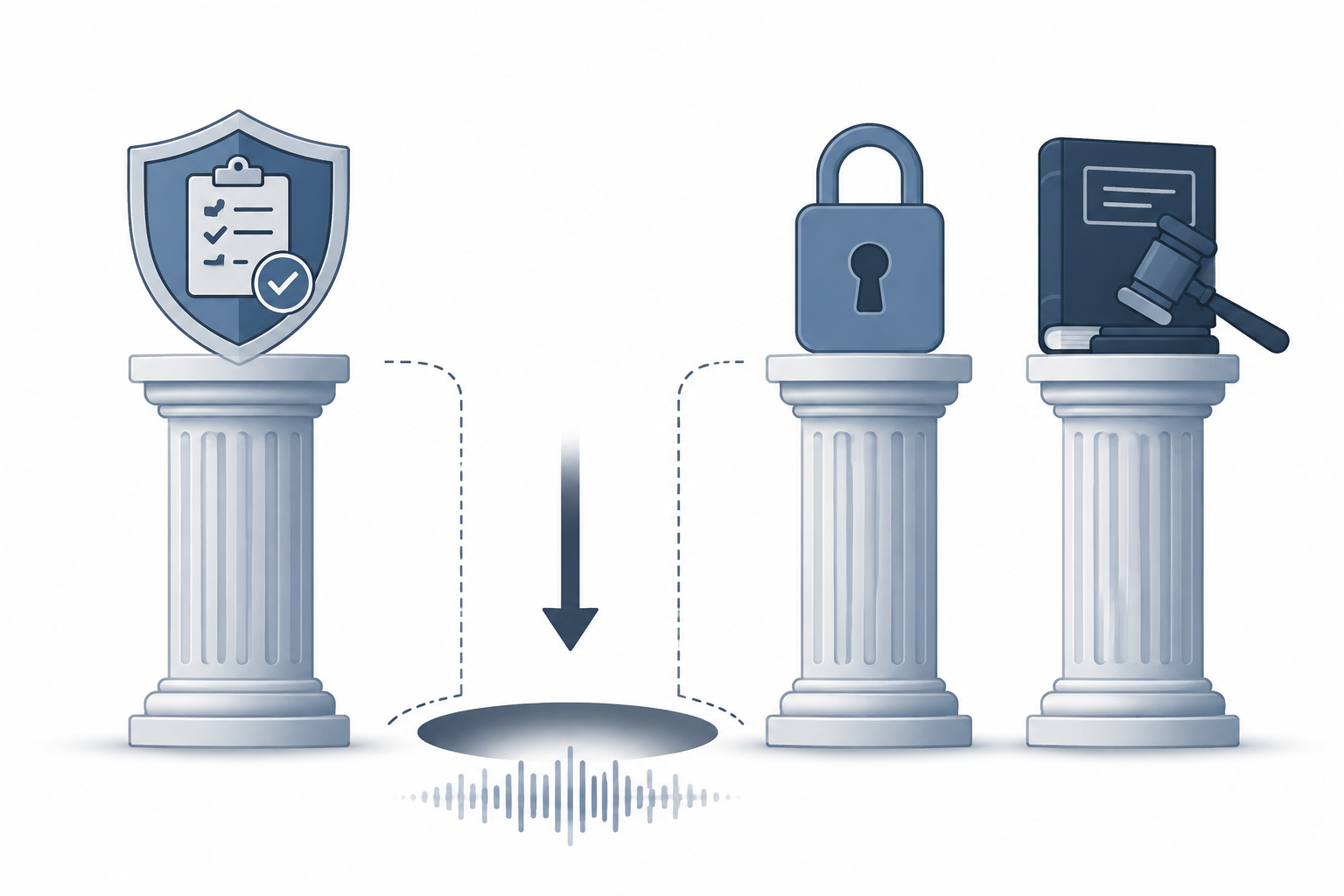
This is where the regulatory gap becomes precise enough to be useful. FDA non-review does not bless the deployment. HIPAA compliance does not supply all-party recording consent. State wiretap law does not evaluate model accuracy or clinical note quality. Each framework is looking at a different object. The operational object in the exam room, however, is one continuous workflow: microphone on, encounter captured, data transmitted, note generated, audio or transcript retained for some period, and sometimes vendor data rights triggered.
Health systems have seen this kind of fragmentation before, but ambient AI makes it harder to paper over. The tool is attractive precisely because it disappears into the visit. The physician can face the patient rather than the keyboard. The note draft appears with less manual typing. The workflow rationale is real, and broader adoption of clinical AI is no longer a fringe issue, as discussed in ClinicalMind’s overview of how AI is being used in healthcare in 2026. But the very smoothness of ambient documentation can make the consent event too easy to bury.
That is the point procurement decks tend to understate. The tool is not merely a note assistant. It changes who or what is listening during the visit. If the patient’s legal right is to agree before that listening occurs, a later assurance about documentation quality arrives too late.
All-Party Consent States Are the Hardest Test
The Sharp complaint lands in California, but the theory is not inherently confined to California. Fisher Phillips has noted that similar claims could be asserted under federal wiretap law and analogous state statutes in other all-party consent jurisdictions.[2] Holland & Knight’s 2026 analysis describes 11 all-party consent states as creating the widest consent gap, while cautioning that some sources list up to 13 depending on how current statutes and case law are counted.[3]
That count should not be treated as a shortcut. A multistate health system needs current state-by-state analysis before deployment, not a map copied from a vendor appendix. Some states focus on recording. Some distinguish between confidential communications and other conversations. Some case law matters. Some clinical settings create different expectations of privacy than others. The operational answer may differ by service line, facility, modality, and who is physically or virtually present.
Maine’s 2026 law is a useful signal because it names the ambient-listening problem more directly than broad AI governance statutes. Holland & Knight identifies Maine HB 2082, enacted in April 2026, as the first state law explicitly requiring mental health professionals to obtain patient consent before using ambient-listening or AI-powered recording tools.[3] The mental-health limitation matters. It is not a general national rule for every hospital department. Still, it shows that legislatures are beginning to separate clinical ambient recording from the larger basket of AI companion, chatbot, and decision-support regulation.
That separation is healthy. An AI chatbot that gives a patient general wellness information presents different legal issues from a microphone in a psychiatric visit. A clinical decision-support model raises different FDA and malpractice questions from a scribe that drafts a note. Treating all of them as “healthcare AI” can obscure the one issue that matters here: whether a real conversation was captured with legally sufficient consent.
What a Health System Must Be Able to Prove
The practical question is not whether ambient AI scribes are good or bad. Many clinicians want relief from documentation burden, and the promise of restoring attention in the exam room is not trivial; ClinicalMind has explored that promise in its discussion of whether deep medicine has made healthcare more human. The practical question is narrower: before turning on an ambient scribe in an all-party consent jurisdiction, what can the health system prove?
| Issue | What the file should show |
|---|---|
| State consent law | A current legal determination of whether the encounter requires one-party consent, all-party consent, or a setting-specific rule. |
| Consent language | A clear statement that audio may be recorded or processed by an AI documentation tool, presented before recording begins. |
| Consent mechanics | Evidence of affirmative agreement where required, not merely passive awareness or buried portal language. |
| Vendor data terms | Contractual limits on audio, transcript, note, metadata, model-improvement use, subcontractors, and de-identified data handling. |
| Retention and deletion | A policy that distinguishes legal retention duties from patient deletion requests and explains what can actually be deleted. |
| Deployment scope | A record of which clinics, specialties, encounter types, languages, and telehealth workflows use the tool. |
The consent language deserves special attention because it is often drafted too gently. “Your provider may use technology to assist with documentation” is not the same as “this visit may be recorded and processed by an AI scribe.” A patient cannot meaningfully agree to a recording if the recording is described only as a background documentation feature. The more sensitive the encounter, the less persuasive euphemism becomes.
The consent mechanics matter just as much as the words. In an all-party consent state, a health system should be cautious about relying on generalized portal boilerplate, especially if the patient completed it days or months before the visit. The Sharp plaintiffs are reportedly challenging that kind of boilerplate as insufficient under CIPA.[2] Whether that argument succeeds will depend on the litigation record and the court’s analysis, but the compliance lesson does not require waiting: make the consent event visible, specific, and tied to the recording.
Vendor terms are where many deployments become harder to defend than they needed to be. The hospital may care primarily about the note. The vendor may care about service improvement, model performance, benchmarking, support review, or de-identified data use. If the contract does not say plainly what happens to raw audio, transcripts, derived notes, metadata, and de-identified outputs, the health system will struggle to explain the data path after a patient objects.
Retention and deletion should be tested before go-live, not when the first complaint arrives. If audio is retained for a defined period, who can access it? If a patient asks for deletion, is the request handled under HIPAA, state privacy law, contract policy, medical-record retention rules, or some combination? If the answer is that the audio cannot be deleted until a standard retention period expires, the patient-facing script should not imply immediate control. The Sharp allegations show how quickly a retention detail can become part of the consent narrative.[2]
The Wrong Deployment Record Will Not Age Well
The weakest record is the one that treats ambient AI as ordinary software. It contains a business associate agreement, a security questionnaire, a clinician pilot summary, and perhaps a patient-experience paragraph. It does not contain a state wiretap analysis. It does not preserve the exact consent text shown to patients at the time of recording. It does not show how refusals were honored. It does not explain whether the same workflow was used in behavioral health, pediatrics, interpreter-assisted visits, group visits, or telehealth encounters.
A stronger record is less elegant but more useful. It identifies where recording law was analyzed separately from HIPAA. It describes when recording starts and stops. It preserves screenshots or scripts. It documents opt-out handling and what happens when a clinician forgets to ask. It includes vendor restrictions that match what patients were told. It gives compliance staff a way to answer a deletion request without discovering the workflow for the first time.
This record also needs to distinguish ambient scribes from adjacent AI tools. Evidence on conversational AI, summarized elsewhere by ClinicalMind in its review of 2025–2026 conversational AI in healthcare, may be relevant to adoption and clinical usefulness. It does not replace a consent analysis for a microphone in an exam room. Similarly, comparative frameworks such as the EU AI Act for high-risk AI in healthcare may help boards understand governance maturity, but a U.S. hospital still has to answer the state-law recording question facility by facility.
The same discipline applies to de-identified or synthetic data assurances. A vendor’s statement that it uses only de-identified data for certain purposes may reduce one category of HIPAA risk, but it does not automatically resolve patient concerns about reuse or re-identification. ClinicalMind’s discussion of why synthetic health data alone will not protect patient privacy is relevant for that narrower point. Privacy engineering and consent law are related, but one does not swallow the other.
Sharp Crystallizes the Consent Crisis
The Sharp litigation should not be treated as proof that every ambient AI scribe deployment is unlawful. It should be treated as a warning that the legal theory is no longer theoretical. Plaintiffs have identified a health system, a vendor, a large alleged class, a state all-party consent statute, a portal-consent challenge, a retention-policy fact, and statutory damages large enough to force board-level attention.[1][2]
That is the consent crisis. Ambient AI scribes sit between administrative convenience, medical privacy, and wiretap law. FDA non-review leaves them outside device oversight when they function as documentation tools.[3] HIPAA review addresses protected health information but does not itself supply consent to record in all-party consent jurisdictions. State consent law may attach at the moment the microphone begins listening, before the note exists and before the vendor’s security controls become the main issue.
A health system that wants the benefits of ambient documentation needs more than enthusiasm, a business associate agreement, and a clinician pilot. It needs to verify state consent law, write consent language that actually describes recording, preserve proof of agreement where required, audit vendor data terms, test retention and deletion procedures, and define exactly where the tool is deployed. Until those pieces are in place, ambient documentation should not be treated as routine infrastructure.
References
- Sharp HealthCare Sued Over AI Scribe, Patient Consent, Medscape.
- New Class Action Targets Healthcare AI Recordings, Fisher Phillips.
- States Continue Efforts to Regulate AI in Healthcare: A Review of Legislation Passed in 2026, Holland & Knight, May 2026.
- Beyond human ears: navigating the uncharted risks of AI scribes in clinical practice, npj Digital Medicine.
Comments
Join the discussion with an anonymous comment.