
As of Q3 2026, there are no federal health transparency requirements for Congress members that compel a senator or representative to disclose a medical condition, diagnosis, prognosis, or course of treatment to the public. The absence is not a technicality buried in an obscure rule. It is the baseline: no federal statute creates such a duty, the House ethics rules do not require health disclosure, and the Constitution supplies no congressional equivalent to a health-capacity mechanism for individual lawmakers.[1]

That answer is unsatisfying precisely because it is so simple. Congress writes documentation demands into the daily life of agencies, hospitals, insurers, and health systems. Yet when the question is whether a member of Congress is absent, incapacitated, unreachable, or unable to vote, the public often receives less structured notice than it would expect from the regulated institutions Congress oversees.
The missing rule should not be confused with a public entitlement to private medical facts. A diagnosis can be deeply personal, especially when it involves cancer, dementia, depression, substance use, neurological disease, or terminal illness. The harder and more useful question is narrower: what must an elected federal lawmaker tell constituents when health affects the ability to perform public duties? At present, the answer is still mostly a matter of voluntary disclosure, office judgment, and political pressure.
The Legal Baseline Is Silence
The existing legal framework regulates many forms of congressional disclosure, but health status is not one of them. The House Ethics Manual’s disclosure architecture is centered on financial interests and related conflicts, not medical capacity or health-related absence.[1] A member may decide to make a public statement, may allow staff to confirm a hospitalization, or may provide no meaningful explanation at all. Those choices may carry political consequences, but they are not currently governed by a federal health-disclosure mandate.
Nor does the 25th Amendment fill the gap. It is frequently invoked in public arguments about official fitness, but it addresses presidential inability and succession. It does not create a process for determining whether a senator or representative is medically able to vote, conduct oversight, respond to constituents, or remain in office.[1]
That distinction matters. A constitutional mechanism for the presidency cannot be casually repurposed into a congressional health rule. Members of Congress hold individual seats, represent separate constituencies, and are governed by a combination of chamber rules, ethics processes, election law, and constitutional qualifications. None of those sources currently requires public disclosure of a medical diagnosis or prognosis.
| Source of obligation | Does it require public health disclosure by members of Congress? |
|---|---|
| Federal statute | No current federal statute requires a member to disclose a health condition, diagnosis, or prognosis. |
| House ethics rules | No health-disclosure rule comparable to financial disclosure requirements is identified in the House Ethics Manual. |
| Constitution | No provision creates a congressional health-capacity disclosure process for individual members. |
| 25th Amendment | No. It applies to presidential inability, not congressional health disclosure. |
| Public expectation | Yes as a political norm for some voters and officials, but not as an enforceable legal duty. |
The result is a procedural vacuum rather than a privacy rule carefully balanced against representation. Offices may be prudent, candid, evasive, or silent. Constituents may learn enough to understand why votes are being missed, or they may learn only after a family member, reporter, opponent, or outside political figure supplies the information first.
Recent Cases Made the Gap Harder to Ignore
The recent attention to congressional health transparency did not arise because one lawmaker became ill. Illness is not rare in a large, aging institution. The issue became more visible because several episodes involved absence, delayed explanation, missed votes, or disclosure by someone other than the member.
Sen. Mitch McConnell, then 82, was hospitalized in June 2026 for an undisclosed condition and was absent for weeks with limited public detail, according to NPR reporting.[2] The central problem for constituents was not that they lacked a diagnostic label. It was that the public had little structured information about the expected duration of the absence, functional capacity, and how official responsibilities were being handled.
Rep. Tom Kean Jr. was absent for roughly four months, from March through June 2026, while receiving treatment for depression, and disclosed the diagnosis only when he returned, according to Straight Arrow News. During that period, he missed more than 100 votes, including votes on Iran war powers resolutions.[3] Depression treatment should not be treated as spectacle. But a months-long absence from votes is not a private event in the same way a diagnosis is private. It changes representation in real time.
Rep. Kay Granger’s case exposed another version of the same gap. POLITICO reported in December 2024 that Granger had been living in an assisted-living facility with dementia while still in office, and that her son disclosed the condition. She missed 279 of 517 votes.[4] Again, the key public issue is not a demand for intimate medical detail. It is the absence of an orderly notice process when a member’s capacity and participation have materially changed.
Rep. Neal Dunn’s terminal heart diagnosis entered public view when President Trump revealed it, not through Dunn’s own office, according to NPR.[2] That sequence is a poor substitute for accountable communication. When a third party becomes the first public source of basic information about a sitting member’s serious illness, the member’s office loses control of both privacy and public notice.
There are counterexamples. Sen. John Fetterman checked into Walter Reed in February 2023 for depression treatment and disclosed the hospitalization within days through public reporting.[5] Rep. Jamie Raskin publicly disclosed a cancer diagnosis in December 2022 through a statement from his office.[6] Those choices show that voluntary transparency can work. They do not show that the public has a reliable process when an office chooses a different approach.
Observed symptoms are a more dangerous category. The American Prospect reported in 2025 that questions about Rep. Paul Gosar’s hand tremors had persisted for years without a confirmed neurological explanation.[7] Visible symptoms may prompt legitimate questions about public performance, but they can also invite speculation. A serious transparency rule would have to avoid turning observation into diagnosis by rumor.
What the Duty of Transparency Act Would Actually Require
The first formal policy response in the current record is the Duty of Transparency Act, introduced by Reps. Ritchie Torres and Seth Moulton on July 16, 2026.[8] Its design is important because it does not try to create a general congressional health-transparency requirement. It creates an extended-absence notice rule.
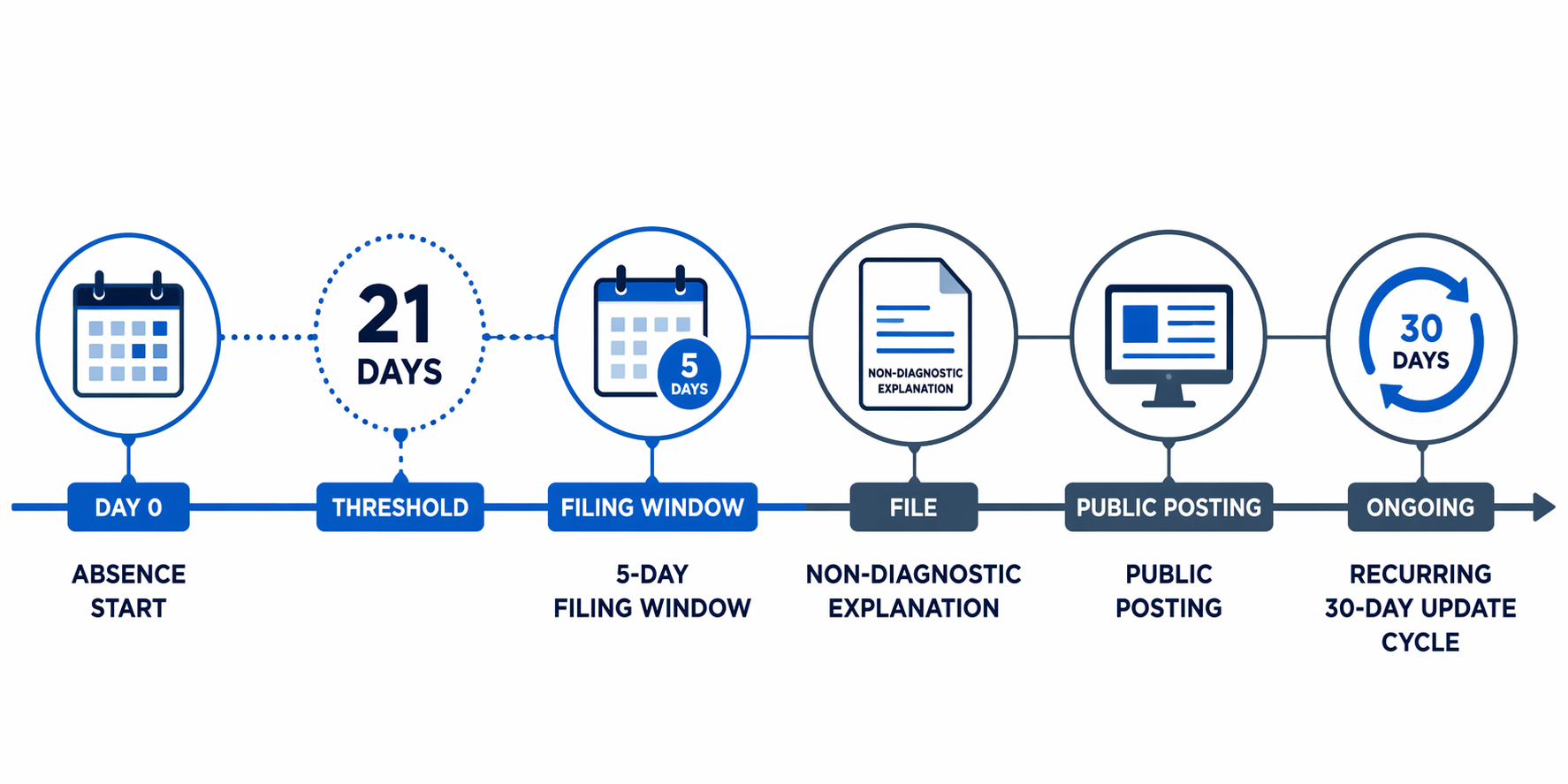
Under the bill, a member who expects to miss at least 21 consecutive days would have to file notice within five days. The filing would include expected dates of absence, an explanation that does not require a diagnosis, information about whether the member can perform duties remotely, and a staff contact. The notice would be posted publicly within two days, with updates required every 30 days. Enforcement would sit with the relevant ethics committee.[8]
| Bill component | Practical effect |
|---|---|
| 21 consecutive-day threshold | Captures extended absences, not all health-related incapacity. |
| Five-day filing deadline | Prevents an office from waiting indefinitely before giving basic notice. |
| Expected dates | Gives constituents and chamber leadership a timeline rather than a rumor cycle. |
| Non-diagnostic explanation | Allows a reason for absence without forcing disclosure of a medical condition. |
| Remote-duty capacity | Separates physical absence from ability to work, communicate, or vote where permitted. |
| Staff contact | Identifies where constituents and official counterparts can direct requests. |
| 30-day updates | Prevents an initial notice from becoming stale during a long absence. |
The bill’s privacy language is not incidental. It explicitly protects diagnosis, prognosis, and treatment information from required disclosure.[8] That choice marks the boundary of the proposal. A member could be required to say, in effect, that an extended absence is expected, when it began, how long it may last, whether official duties can continue remotely, and whom to contact. The member would not be required to say whether the cause is cancer, depression, dementia, cardiac disease, surgery, or anything else.
That makes the bill meaningful but limited. It would reduce the information vacuum around long absences. It would not answer every voter’s question about fitness to serve, and it would not create a medical-disclosure regime for Congress. It also would not reach shorter periods of incapacity if they fall below the 21-consecutive-day threshold, even when those periods coincide with consequential votes.
The Public Expectation Is Broader Than the Proposed Rule
Sen. Alex Padilla said in July 2026 that transparency about lawmakers’ health is a “reasonable expectation” of voters.[9] As a statement of democratic expectation, that is easy to understand. Voters do not elect a diagnosis; they elect someone to vote, deliberate, oversee, negotiate, and respond. If the member cannot do those things for an extended period, constituents have a reason to know what the office can and cannot do.
But a reasonable expectation is not the same as an administrable legal standard. “Tell us everything” is not a workable rule. It collapses medical privacy, political curiosity, opposition research, and legitimate capacity concerns into one demand. A better standard has to identify the public function at stake: attendance, voting, committee work, remote availability, constituent service, delegation to staff, and expected duration.
The demographic context makes the issue harder to dismiss. Pew Research Center reported that the median age of senators was 64.7 in January 2025, and roughly 36 senators were age 70 or older.[10] Age alone proves nothing about capacity. It does, however, increase the practical likelihood that serious health events will intersect with public duties in a chamber where one absence can alter legislative strategy.
Opacity also has predictable side effects. Straight Arrow News reported that political scientist Adam Enders of the University of Louisville linked secrecy around lawmakers’ health to erosion of public trust and the growth of conspiracy theories.[3] That is not a reason to publish medical charts. It is a reason to avoid leaving constituents, staff, reporters, and ethics offices to infer official capacity from fragments.
The Remaining Gap
The current policy state is therefore narrower than the public debate often suggests. No federal disclosure mandate exists for the health of members of Congress. Voluntary disclosure remains the norm. Some members disclose promptly and with dignity; others disclose late, partially, or only after the information emerges elsewhere.
The Duty of Transparency Act would change one part of that system by requiring public notice of expected absences lasting at least 21 consecutive days. It would give constituents dates, a non-diagnostic explanation, remote-duty information, and a staff contact. It would also preserve medical privacy by withholding any requirement to disclose diagnosis, prognosis, or treatment details.[8]
That leaves the core tension unresolved. Voters may reasonably want to assess whether a member is able to serve without receiving private diagnoses. Offices may reasonably protect medical information while still owing constituents a timely account of functional capacity. As of July 18, 2026, Congress has not converted that balance into a binding health transparency requirement for its own members.
References
- Analysis of the legal landscape for congressional health disclosure, NPR / Straight Arrow News, 2026.
- NPR reporting on Sen. Mitch McConnell hospitalization and congressional health disclosure, NPR, July 10, 2026.
- Straight Arrow News reporting on Rep. Tom Kean Jr. absence, missed votes, and health transparency, Straight Arrow News, 2026.
- POLITICO reporting on Rep. Kay Granger assisted-living facility disclosure, POLITICO, December 22, 2024.
- Public reporting on Sen. John Fetterman depression treatment at Walter Reed, 2023.
- Raskin Statement on Cancer Diagnosis, Raskin.house.gov, December 2022.
- American Prospect reporting on Rep. Paul Gosar hand tremors and neurological questions, The American Prospect, 2025.
- Duty of Transparency Act press release, Office of Rep. Ritchie Torres, July 16, 2026.
- NOTUS reporting on Sen. Alex Padilla health transparency comments, NOTUS, 2026.
- Pew Research Center congressional age analysis, Pew Research Center, January 16, 2025.
Comments
Join the discussion with an anonymous comment.