
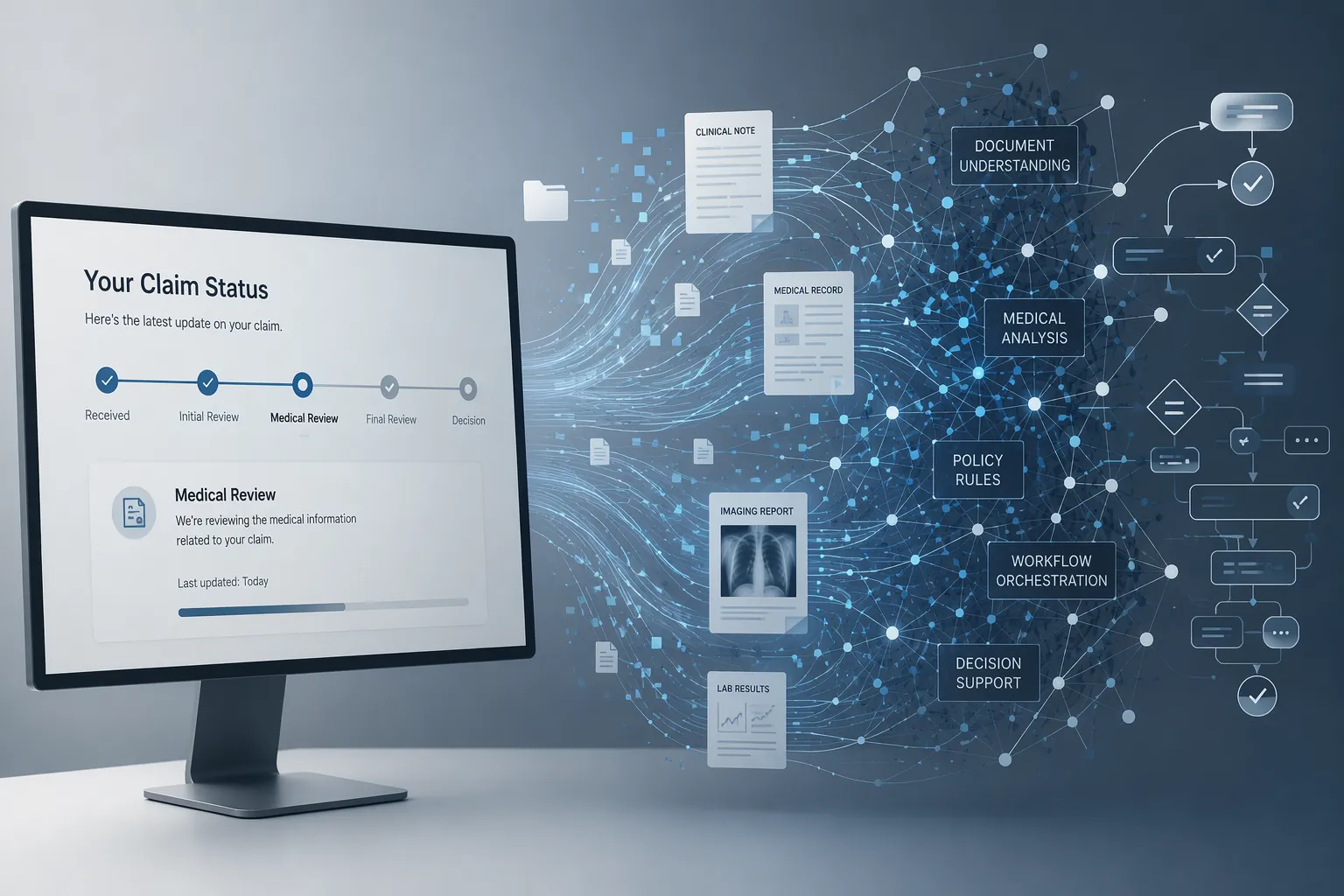
A disability claimant checking the Social Security Administration’s online status tracker in 2026 may see a simple label: “Medical Review,” “Decision Made,” a hearing update, or an appeal notice. That is the useful part of the interface. It tells someone where to look next, whether a deadline may be coming, and whether SSA has moved the file from one visible stage to another. But anyone searching for “social security disability claim status tracker how to use” also needs to know what the tracker does not show: the medical-record parsing, expedited triage, hearing-transcript production, and other machine-assisted work that may be shaping the path behind that status.
On July 21, 2026, SSA announced new Claim Status Tracker features, including real-time tracking for hearings and appeals, access to 26 additional digital notices, proffer letter access, and online submission for forms HA-4631, HA-4632, and HA-4633.[1] Because those changes are only newly announced, they should be treated as expanded visibility, not yet as proof that claimants will experience fewer missed notices, clearer decisions, or fairer outcomes.
Use the Tracker for Deadlines, Not for Certainty
The practical use of the SSA claim status tracker begins with the basics: sign in through SSA’s online status page or a my Social Security account, check whether the claim or appeal has moved, read any available notices, and respond when SSA asks for forms, medical evidence, or hearing-related material.[2] The tracker is most valuable when it helps a claimant or representative act before a deadline passes.
That is different from treating the status label as a full explanation. “Medical Review” does not tell a claimant which records have been received, which are missing, whether the file contains conflicting evidence, or whether a machine-assisted tool has helped organize the documents for an examiner. “Decision Made” does not explain whether the decision was straightforward, whether a likely allowance was accelerated, or whether the file will now require a reconsideration, hearing, or court challenge.
- Check the tracker often enough to catch new notices, especially after filing an appeal or requesting a hearing.
- Download or save digital notices when available, because the tracker’s value depends on preserving what SSA says and when it says it.
- Use hearing and appeal updates to confirm the next procedural step, not to infer the strength of the medical case.
- When a status seems inconsistent with mailed notices, representative updates, or recent submissions, treat the discrepancy as something to verify rather than something to ignore.
What Sits Behind “Medical Review”
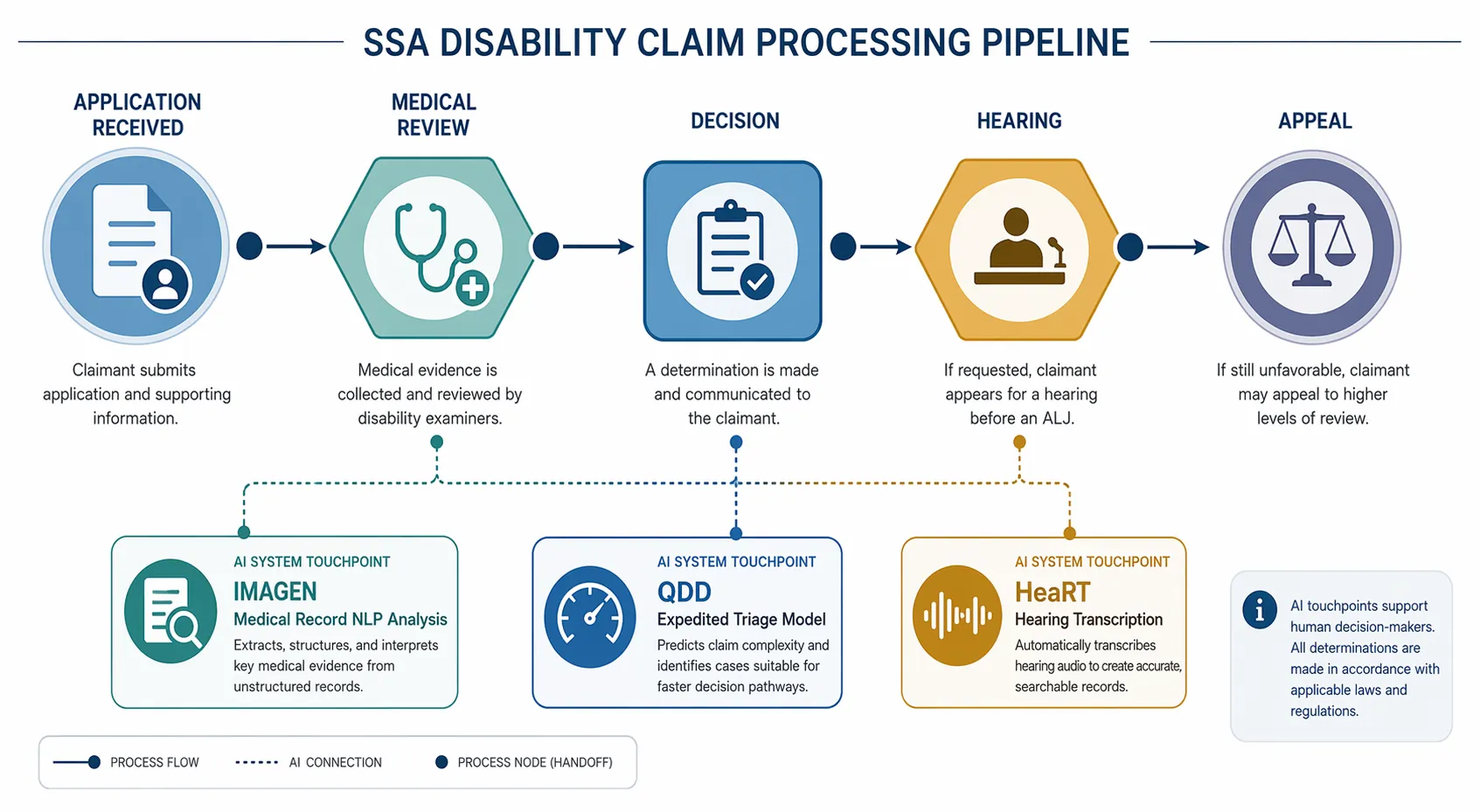
SSA’s public AI page and inventory describe active and planned artificial intelligence uses across the agency, including disability-related systems that sit much closer to adjudication than the claimant-facing tracker does.[3] The tracker itself is not the AI system. It is the front counter for a larger benefits-processing system in which AI tools may help sort, extract, transcribe, or prioritize information before a human decision is communicated.
The tool that deserves the most scrutiny in this workflow is IMAGEN, SSA’s Intelligent Medical Language Analysis Generation system. It uses natural language processing and predictive analytics to turn unstructured medical records into data that adjudicators can use.[3] In a disability claim, unstructured medical records are not a side file. They are often the case itself: specialist notes, hospital records, imaging reports, medication histories, functional observations, and gaps that may reflect access problems rather than absence of impairment.
A tool that can help adjudicators find relevant evidence inside long medical files could reduce clerical drag. It could also make a real difference in an overburdened system where a missing test result or overlooked specialist note can change the trajectory of a claim. The risk is more specific than a generic fear of automation. If the records are thin, fragmented, poorly coded, or dominated by conditions that do not present neatly in lab values, a system that organizes what is present may still fail to surface what is absent, contested, or clinically difficult to document.
That is why the status label can be misleadingly calm. A claimant sees “Medical Review.” Behind it, the system may be ingesting records, routing evidence, extracting signals, and preparing information for a disability examiner or adjudicator. The claimant cannot tell whether a treating source’s note was given proper context, whether a symptom history was reduced to a less meaningful field, or whether a missing record has quietly become a decisive weakness.
Where QDD and HeaRT Touch the Claim Path
Quick Disability Determinations, or QDD, works differently from IMAGEN. It uses predictive models to identify claims that are likely to meet disability criteria and move them into expedited review.[3] For a claimant whose file clearly supports an allowance, prioritization can be a public good: less waiting, less financial strain, and fewer months spent in administrative limbo.
The fairness question is what happens to files that do not look like likely allowances to the model. A prioritization system does not have to deny anyone to shape outcomes. It can change attention by deciding which cases move first, which cases wait, and which cases receive earlier human review. That matters in disability adjudication because delay is not neutral. Rent, medication access, caregiving, and the ability to keep medical appointments can all deteriorate while a claim waits.
HeaRT, SSA’s Hearing Recording and Transcriptions system, sits farther downstream. SSA describes it as a generative AI tool for producing hearing transcripts, and the agency reported full implementation by March 17, 2025, with annual savings of $5 million and reduced hearing delays.[3] That is a plausible operational win. Hearing offices need transcripts, representatives need records, and federal court review depends on an administrative record that can be read.
The tracker’s new hearing and appeal visibility makes HeaRT more relevant to claimants even if they never see the tool’s name. A hearing status update may now arrive in a system where transcript production is partly automated, appeal documents are more visible, and certain forms can be filed online. The useful question for a claimant is still procedural: Is there a notice to read, a form to submit, a hearing step to prepare for, or a proffered exhibit that requires response?
| Visible tracker moment | Likely backend activity | What not to assume |
|---|---|---|
| Medical Review | Medical records may be collected, organized, parsed, or summarized for adjudication. | Do not assume all records are complete or interpreted in context. |
| Decision Made | A determination has been reached and a notice should explain the result. | Do not assume the status label reveals why the claim was approved or denied. |
| Hearing update | Hearing scheduling, transcript production, exhibit handling, or other hearing-office steps may be moving. | Do not assume the appeal is stronger or weaker because the status changed. |
| Appeal or notice available | SSA may have posted a digital notice, proffer letter, or form request. | Do not assume online visibility replaces careful review of deadlines and evidence. |
Speed Has Improved. Accuracy Is a Separate Question.
The operational numbers deserve to be taken seriously. SSA performance data show the average initial disability decision time fell from 231 days in March 2025 to 189 days in March 2026, and the disability determination services backlog declined from about 1.26 million cases in June 2024 to about 831,000 in February 2026.[4] Those are not cosmetic improvements. For people waiting on disability benefits, 42 fewer days at the initial level can mean fewer missed bills, less pressure to abandon treatment, and a faster path either to benefits or to the next appeal.
But the numbers do not prove that AI caused the improvement. Processing times can change because of staffing, workload shifts, policy decisions, backlog initiatives, technology, or some combination of those factors. It would be too easy to look at faster decisions, point to AI systems in the background, and declare success. The harder question is whether faster movement through the pipeline produces decisions that withstand review.
The outcome data keep that question open. In FY2025, SSA processed more than 3.2 million disability decisions; 64% of 2.2 million initial applications were denied, and 65% of 13,587 federal court decisions were remanded.[5] Those figures measure different points in the system and should not be collapsed into one simple error rate. Still, they make one conclusion hard to avoid: faster initial processing does not, by itself, tell us whether the right claims are being allowed, denied, or sent into years of appeal.
A high initial denial rate may reflect statutory standards, medical eligibility rules, incomplete applications, weak evidence, or adjudicative error. A high federal court remand rate reflects a later, narrower slice of cases that reached judicial review. The combination does not prove that AI is harming claimants. It does show why speed metrics need outcome metrics beside them before anyone treats an improved status timeline as evidence of a fairer system.
The Governance Standard Is Not Optional
The National Academy of Social Insurance Task Force on AI, Emerging Technology, and Disability Benefits warned in its April 2025 Phase One report that AI tools in disability benefits require meaningful human review, bias prevention, and strong governance.[6] Those phrases can sound abstract until they are placed inside a claim file. Meaningful human review means someone with authority must be able to notice when a tool’s output does not fit the person’s medical reality. Bias prevention means testing whether the system disadvantages claimants whose impairments are invisible, episodic, poorly documented, or less likely to be captured in standardized records. Governance means SSA can explain what the tool did, who reviewed it, and how errors are corrected.
This is where a clean tracker interface can create false comfort. A status system can be accurate about process while silent about judgment. It can tell a claimant that a case moved from one stage to another without showing whether the medical evidence was interpreted correctly, whether an expedited model passed over a deserving file, or whether a transcript error affected the record used on appeal.
The new digital-notice features may help claimants and representatives respond faster. They may also shift more monitoring work onto people who are already ill, disabled, or navigating unstable housing, limited internet access, or inconsistent mail delivery. A notice that is easier to post is not automatically easier to understand. A form that is easier to submit is not automatically enough to correct a missing medical source, a mistaken inference, or a poorly summarized impairment history.
How to Read a Status Update in 2026
The safest way to use the tracker is to separate procedural information from substantive meaning. Procedural information tells you what SSA says has happened or what it is asking you to do. Substantive meaning concerns the strength of the evidence, the legal reasoning, and whether the decision can survive review. The tracker is better at the first task than the second.
- If the tracker shows a new notice, read the notice itself rather than relying on the status label.
- If the case is in medical review, confirm that SSA has the treating sources, dates of care, hospital records, specialist notes, and functional evidence that matter most.
- If a hearing or appeal update appears, check whether the update creates a response deadline or requires review of a proffered exhibit.
- If a decision is unfavorable, use the written explanation and the administrative record to evaluate appeal options; the tracker status alone will not show the defect.
- If online information conflicts with mailed notices or representative communications, document the conflict and contact SSA or the representative promptly.
For advocates and policy readers, the same distinction applies at system level. A lower backlog is meaningful. A faster initial decision is meaningful. More online notices are meaningful. None of those measures answers whether IMAGEN handles complex medical narratives fairly, whether QDD systematically favors certain kinds of well-documented impairments, or whether HeaRT transcripts are accurate enough for the appeals record. Those questions require auditing, disclosure, correction pathways, and human accountability.
What the Tracker Can Do, and What SSA Still Must Prove
The enhanced Claim Status Tracker is worth using actively in 2026, especially for hearing and appeal visibility, digital notices, proffer letters, and online submission of the newly supported hearing-related forms.[1] Claimants should not have to depend on guesswork about whether SSA has posted a document or moved an appeal forward. If the tracker reduces missed communications and helps people respond on time, that is a concrete improvement.
The limit is just as concrete. Visibility into status is not visibility into adjudication. A progress label can tell a claimant where the file appears to be; it cannot show how an AI-assisted workflow weighed the evidence, whether a human reviewer meaningfully challenged a machine output, or whether an error was caught before a denial letter went out.
Use the tracker because deadlines matter. Use it because notices matter. Use it because hearings and appeals can turn on whether someone sees and answers a request in time. But judge SSA’s AI era by a stricter standard than faster movement through opaque statuses: accountable review, visible correction of errors, and decisions that remain fair when the case is complicated, poorly documented, or difficult to reduce to a data field.
References
- SSA Expands Online Claim Status Tracker — Social Security Administration, July 21, 2026
- Check application or appeal status — Social Security Administration
- Artificial Intelligence at SSA — Social Security Administration
- SSA Performance — Social Security Administration
- What SSA FY 2025 Disability Data Tells You About Your Chances — Ortiz Law Firm
- Task Force on AI, Emerging Technology & Disability Benefits — National Academy of Social Insurance, April 2025
Comments
Join the discussion with an anonymous comment.