
Arkansas shows the real failure mode
For anyone analyzing Medicaid work requirements impact, Arkansas is the unavoidable starting point. In the state’s 2018 rollout, 18,000 adults lost coverage in seven months; nearly one in four of those subject to the rule lost coverage; 70% were unaware the policy applied; and employment did not measurably increase over 18 months. More than 95% of the affected adults already met the work requirement or qualified for an exemption, which means the barrier was reporting and verification rather than substantive ineligibility. The state spent $26.1 million on administration while producing a coverage-loss system that failed the people it was supposed to sort. [1]
That matters because it shifts the question. The danger is not simply that a model might misclassify someone. The deeper risk is that an eligibility architecture can turn unverifiable compliance into a denial, even when the enrollee did the substantive work or met the exemption and just could not prove it in the required channel.

Tennessee shows what brittle eligibility plumbing does to legal rights
Tennessee’s TennCare Connect system makes the same point from a different angle. In August 2024, a federal district judge ruled that the $400 million Deloitte-built system illegally denied Medicaid benefits after it failed to load data, assigned beneficiaries to the wrong households, and made incorrect eligibility determinations. Once the plumbing is wrong, the harm is not theoretical. People lose coverage because the system cannot reconcile their records with the legal rules that govern them. [2]
That is why an AI layer added under a short deadline should not be described as a harmless efficiency patch. If the underlying data feed cannot reliably tell who lives where, who is in which household, or what documentation already exists, a more confident model does not fix the administrative problem. It only makes the error look more organized.
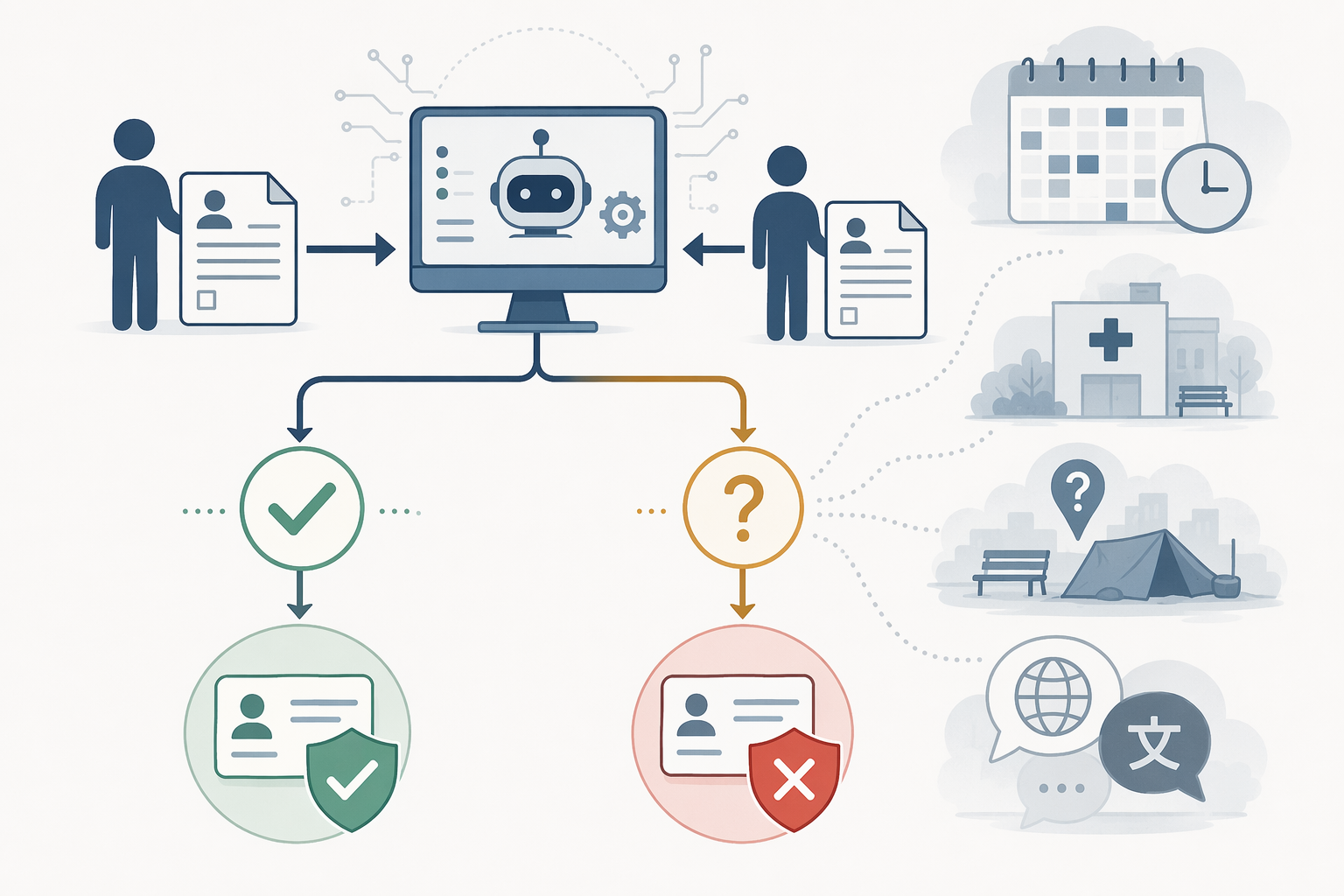
Why the 2026-2027 version is especially exposed
The 2026 KFF work-requirements material is useful here because it narrows the failure points instead of speaking in generalities. Focus-group participants and advocates said vendor AI tools are unlikely to verify gig workers, medically frail people, and people experiencing homelessness, and they estimated that data matching might verify only 60% to 80% of enrollees, leaving 20% to 40% for manual review; that is a stakeholder concern, not a measured outcome. The KFF/Georgetown survey was fielded from January to March 2026, before CMS released additional guidance in June, so state plans may have shifted. The same source also records a warning from National Health Law Program attorneys: over time, human reviewers tend to defer to AI suggestions, which is exactly how a "human in the loop" safeguard gets softened into rubber-stamping. [3]
Missouri offers a useful reality check against the fantasy that the target population is mostly detached from work. The Beacon reported in June 2026 that 67% of working-age Missouri Medicaid enrollees were already employed, while most of the remainder were disabled, caregiving, or in school. [4] That does not prove every state will see the same mix, but it does show why a work-requirement system has to separate noncompliance from unverifiable compliance. A person with irregular shifts, unstable housing, a language barrier, or caregiving duties may be reachable in theory and invisible in practice. Missouri has also moved to bar AI from making adverse eligibility decisions, which is a sign that at least one state understands the difference between automation that organizes files and automation that decides who loses coverage. [4]
Guardrails matter because they define the line, not because they erase the risk
The better guardrails are not grand AI principles; they are ordinary administrative controls. The Bipartisan Policy Center’s list is blunt about that: human oversight, transparency, a pilot before rollout, protection for vulnerable populations, and automation that helps rather than harms. [5] CHAI’s tiger team, which now includes roughly 150 organizations, is trying to do the slower work of building shared best-practice frameworks before states lock themselves into a vendor design they cannot safely unwind. [6]
The legal frame is even less forgiving than the governance language. Section 1557 nondiscrimination rules and the FAIR Act’s inherently governmental-functions test both push in the same direction: the state can automate evidence handling, but it cannot casually outsource the adverse eligibility judgment itself. Missouri’s bar on AI making adverse eligibility decisions sits comfortably inside that logic. [4]
The practical distinction is the one that matters. Automation that gathers records, flags missing documents, and helps a caseworker find the right file can reduce duplicate work without deciding anyone’s fate. Automation that recommends denial, normalizes a missing-data placeholder, or converts an unverifiable record into noncompliance is different. Arkansas showed what happens when reporting failure becomes coverage loss, though it predates H.R. 1 and the current AI deployment context. Tennessee showed what happens when eligibility software cannot keep the household and data logic straight. That record does not prove every AI deployment will disenroll eligible people, but it does show a predictable risk pattern: tight timelines, incomplete data, vendor dependence, and automation bias can make AI a coverage-loss amplifier whenever it is asked to decide too much with too little visibility.
References
- Impacts of Arkansas's Medicaid work requirement on coverage and employment — Health Affairs, 2020 — PMC full text
- Judge Rules $400 Million Algorithmic System Illegally Denied Thousands of People’s Medicaid Benefits — Gizmodo, August 2024 — gizmodo.com
- An early look at policy decisions as states get ready to implement work requirements — KFF — kff.org
- Missouri Medicaid eligibility and AI under H.R. 1 — The Beacon, June 2026 — thebeaconnews.org
- AI and Medicaid: Balancing the promise of efficiency with guardrails to ensure responsible use — Bipartisan Policy Center — bipartisanpolicy.org
- AI could be used for new Medicaid work requirements: CHAI convening tiger team — Fierce Healthcare — fiercehealthcare.com
Comments
Join the discussion with an anonymous comment.