

The legal basis for a Medicaid payment pause is still 42 CFR § 455.23: once there is a credible allegation of fraud, the suspension can begin before a hearing, notice follows within 5 days, and only limited good-cause exceptions interrupt that rule. If the suspension lasts more than 12 months, the matter has to go to the state MFCU. [1]
| Rule element | What it does |
|---|---|
| Credible allegation of fraud | Triggers mandatory Medicaid payment suspension. [1] |
| Pre-suspension process | No pre-suspension notice or hearing is required. [1] |
| Post-suspension timing | Notice follows within 5 days. [1] |
| Longer suspensions | Suspensions lasting more than 12 months require state MFCU referral. [1] |
That is the part worth keeping in view when AI enters the picture. The regulation does not say the trigger must be found by hand, but it was written for a world where investigators could explain the record they were relying on. A machine flag can fit inside that world only if someone can still show how it became a credible allegation.
Where AI Enters
CMS is now layering AI-driven anomaly detection through the Fraud Defense Operations Center, CRUSH, and Fraud Prevention System 2.0 onto the same authority. A June 2026 update said FDOC launched in March 2025 and triaged more than 340 suspect providers in its first months, with AI flags reviewed by clinicians before suspension actions. [2]
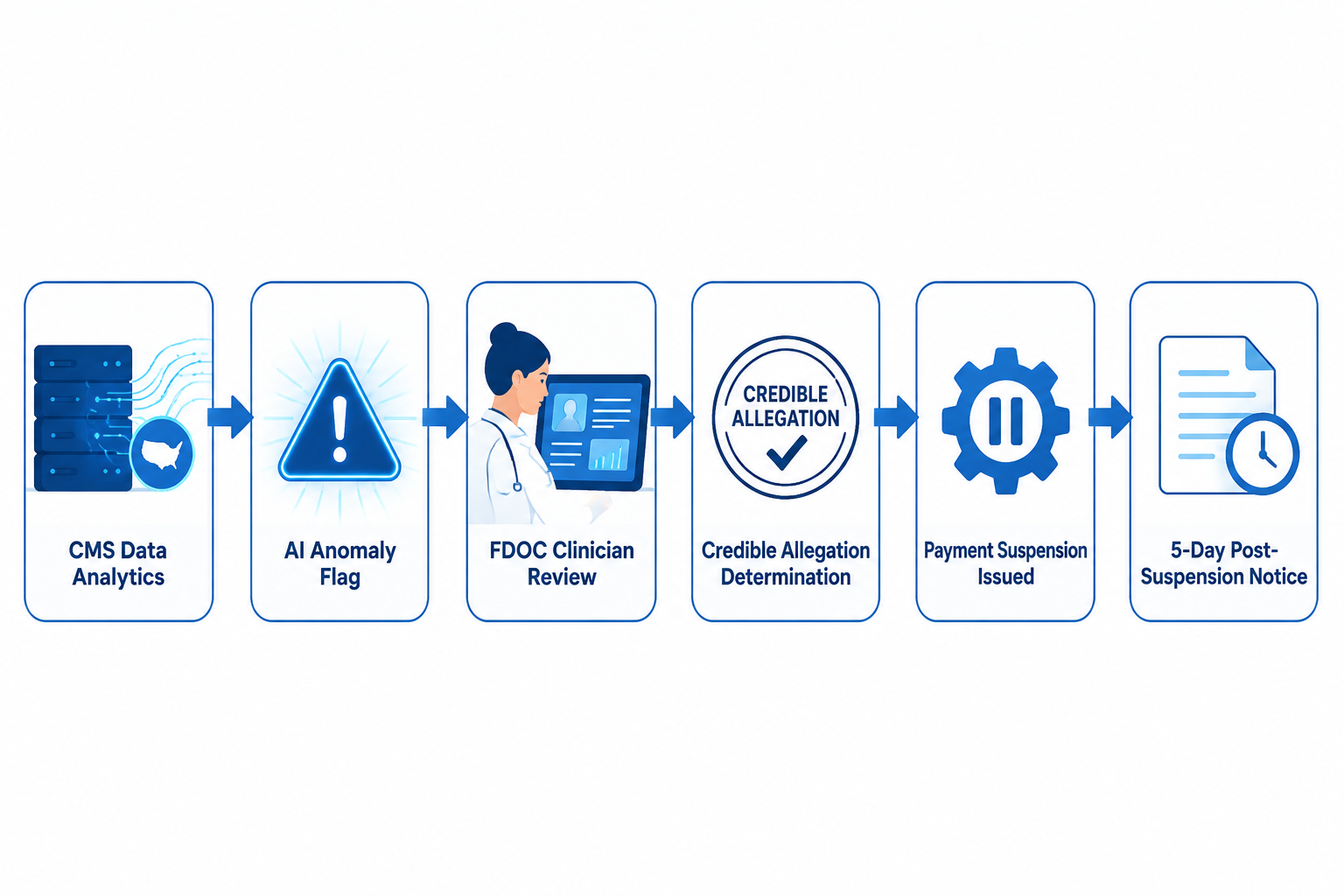
The scale matters because this is not a niche experiment. CMS says FY2025 Medicare program-integrity work produced $5.7 billion in suspended payments across 537 administrative actions, more than $2 billion halted by FDOC real-time analytics, and $41.9 billion in total program-integrity savings. [3]
Minnesota Shows the Friction
Minnesota is the clearest public stress test so far. In February 2026, a federal audit flagged $244 million in unsupported claims and CMS imposed a $259 million payment deferral. By June 11, 2026, Minnesota had resumed payments to most affected providers. [4][5]
That sequence shows the pressure point. Once payment stops, payroll, patient access, and state-federal bargaining all move faster than any later explanation. The provider is not only trying to deny wrongdoing; it is also trying to reconstruct the path from a data problem to a legal conclusion after the money is already frozen.
What CRUSH Is Testing
CMS's February 27, 2026 CRUSH request for information asked 13 topic areas, including whether the agency should extend suspension authority to Medicare Advantage and Part D plans, add enhanced identity proofing, use prepayment claim edits, and expand AI use in Medicare Advantage coding oversight. [6] Because it is an RFI, not a final rule, it signals direction more than it changes law.
What Remains Unclear
The unresolved questions are narrower than the hype and sharper than the slogans. Does a machine-generated anomaly, by itself, amount to a credible allegation? How much of the model's reasoning must the agency be able to explain back to the provider? What record exists when the payment stop comes first and the justification is assembled later? The current regulation does not answer those questions, and the legal basis has not been replaced; AI is changing how fast that rule gets invoked, how far the detection pipeline reaches, and how hard it is for a provider to know what it is being accused of.
References
- 42 CFR § 455.23 — Cornell LII
- CMS CRUSH Update: Providers Must Prepare for AI Driven Audits in 2026 — Liles Parker, June 5, 2026
- CMS.gov/fraud — CMS
- US halts some Medicaid payments to Minnesota, alleging fraud — Reuters, Feb. 25, 2026
- Minnesota resumes payments to most of the Medicaid providers it cut off — Minnesota Reformer, June 11, 2026
- CMS seeks to expand tech-driven fight against Medicaid fraud — Nextgov/FCW, March 2026
Comments
Join the discussion with an anonymous comment.