
The best way to answer how the public charge rule affects immigrant healthcare access is not to start with the doctrine. It is to follow the enrollment and avoidance signals across time. From 2016 through 2026, the evidence points in the same direction across different instruments: immigrant families reduced Medicaid, SNAP, and other safety-net participation when public charge policy became more threatening, some of that avoidance persisted after the 2022 reversal, and current projections for the 2026 final rule assume a substantial additional loss of Medicaid and CHIP coverage.
Two companion pieces on this site cover the mechanics of how the 2026 Public Charge Rule reshapes Medicaid access for immigrants and the separate question of how the Public Charge Rule could strip millions from Medicaid and SNAP under DHS’s own analysis. This piece does a narrower job: checking whether independent longitudinal evidence supports the concern that public charge policy chills healthcare access even when eligibility rules do not formally bar a family from care.

The enrollment drop began before the rule formally took effect
The strongest historical anchor is the Migration Policy Institute’s analysis of American Community Survey data from 2016 to 2019. That period matters because it captures the years before and during the Trump administration’s public charge proposal and debate, including behavior that changed before full implementation. Among low-income noncitizens, Medicaid participation fell 20% from 2016 to 2019, while SNAP participation fell 37% over the same period. MPI reported that those declines were roughly double the rate observed among citizens.[1]
That comparison with citizens is doing important work. It does not prove that every lost enrollment was caused by public charge fear; ACS participation measures are self-reported, and immigrant populations, especially undocumented people, are difficult to count accurately. But when low-income noncitizens move away from Medicaid and SNAP far faster than citizens during the same policy window, the pattern is hard to dismiss as ordinary administrative churn.
The acceleration between 2018 and 2019 is even more telling. During the year of proposal, debate, and public confusion around the 2019 rule, noncitizen SNAP participation declined 19%, and noncitizen Medicaid participation declined 12%.[1] In clinic terms, that is the period when families were hearing warnings, rumors, and partial explanations while still trying to decide whether a refill, a pediatric visit, or a renewal form could create immigration consequences later.
| Measure | Population | Reported change | Why it matters |
|---|---|---|---|
| Medicaid participation, 2016–2019 | Low-income noncitizens | Down 20% | Shows a large coverage-related decline during the policy escalation period |
| SNAP participation, 2016–2019 | Low-income noncitizens | Down 37% | Shows safety-net avoidance beyond healthcare alone |
| SNAP participation, 2018–2019 | Noncitizens | Down 19% | Suggests acceleration during proposal and debate |
| Medicaid participation, 2018–2019 | Noncitizens | Down 12% | Shows healthcare-program retreat before formal implementation |
The Medicaid decline is the central healthcare finding, but the SNAP decline helps interpret it. Families were not merely making program-specific calculations about one benefit. They were responding to a broader perceived risk attached to contact with public systems. For health systems, that distinction matters because a household that stops trusting one agency often becomes harder to reach through others.
The spillover to citizen children changes the practical reach of the rule
The public charge framework names immigrants in immigration status decisions, but the participation data show a household-level effect. MPI found that participation declined twice as fast among citizen children with noncitizen household members as among children in all-citizen households.[1] That is one of the most consequential findings in the record because it moves the issue beyond whether a noncitizen adult personally used a benefit.
A U.S.-citizen child may remain eligible for Medicaid or CHIP while a parent decides that the household cannot risk applying, renewing, or staying visible in the system. The result is not a legal exclusion written on the child’s eligibility screen. It is a missed renewal, a delayed application, or a family that waits until symptoms are harder to ignore. The administrative data see the loss later as lower participation. The clinic sees it as a gap in care.
Survey evidence captured the fear directly
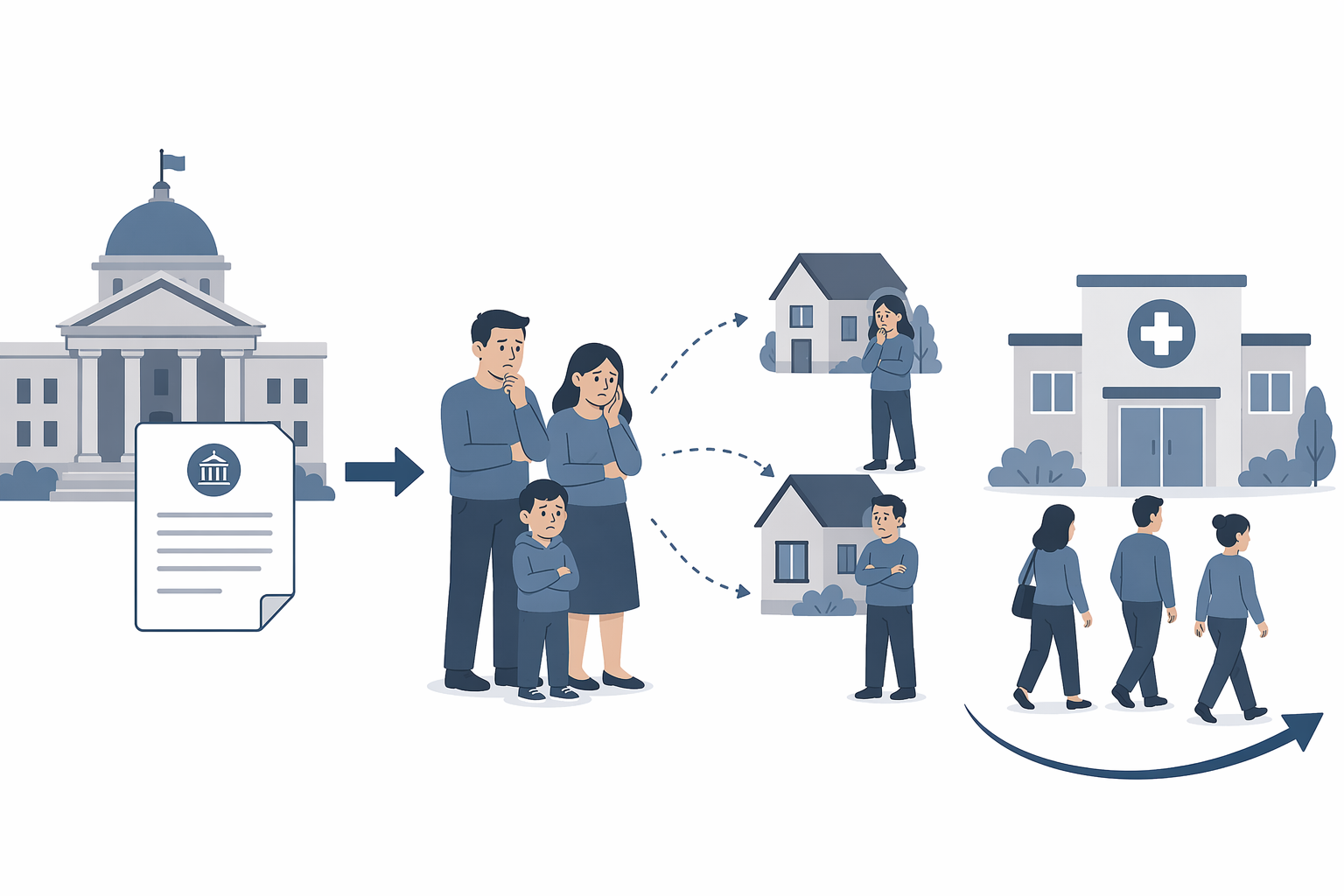
Administrative participation shifts show what changed; survey data help identify the mechanism families reported. In 2019, Urban Institute survey data found that 1 in 7 adults in immigrant families, or 16%, avoided benefits because of fears about risking a green card. Among low-income immigrant families, the share rose to 26%.[1][2]
Self-reported avoidance is not the same thing as verified disenrollment. People may misremember timing, misunderstand eligibility, or describe a general climate of fear rather than a single program decision. But that limitation cuts both ways. Families most exposed to immigration risk are also among the hardest to survey, and undocumented households are likely undercounted in many data systems. The cleaner number is not automatically the truer one.
The 2022 reversal did not erase avoidance
A narrow reading of the policy timeline would expect the chilling effect to fade after the Biden administration’s more permissive 2022 rule. The post-reversal evidence does not support a clean reset. KFF’s reporting on the KFF/LA Times 2023 Survey of Immigrants found that 8% of immigrant adults said they had avoided applying for assistance because of immigration-related fears even under the more permissive rule; among likely undocumented immigrants, the share was 27%.[2]
CHOP PolicyLab separately reported in 2023 that 14% of immigrant families avoided safety-net programs.[3] The exact estimates differ because the instruments and samples differ. The repeated signal is more important than the identical percentage: after the formal policy reversal, a meaningful share of immigrant families still behaved as if participation could carry immigration risk.
That persistence is predictable to anyone who has watched outreach workers try to rebuild trust. Eligibility can be updated in a manual faster than fear can be removed from a household’s decision-making. Once a parent has been told that enrollment might harm immigration prospects, the next official reassurance has to compete with memory, community warnings, and the possibility that rules may change again.
By 2025, avoidance was no longer limited to benefit applications
The current policy environment adds another layer: avoidance of healthcare itself. KFF’s 2025 survey reported that 11% of immigrant adults had stopped participating in assistance programs since January 2025. It also found that 29% had skipped or postponed healthcare in the past 12 months.[4]
Those healthcare delays were measured alongside broader indicators of immigration-related fear. In the same KFF survey, 22% of immigrant adults said they personally knew someone who had been arrested, detained, or deported since January 2025; 41% worried that they or a family member could be detained; and 30% said they had limited activities outside the home.[4]
These 2025 findings should be read carefully. They are current survey evidence, not peer-reviewed administrative confirmation of 2025–2026 disenrollment. They also capture public charge fears within a larger immigration enforcement climate. Still, for healthcare planning, the practical implication is immediate: a family that limits activities outside the home or postpones care is already less reachable by ordinary enrollment and care-management workflows.
The 2026 projection rests on a behavioral baseline that already exists
KFF’s December 2025 projection for the 2026 final rule estimates that 1.3 million to 4.0 million people could disenroll from Medicaid or CHIP under 10% to 30% chilling-effect scenarios among 13.4 million enrollees in households with a noncitizen.[2] That range includes an estimated 600,000 to 1.8 million citizen children.[2]
The range is wide by design. KFF modeled different assumptions about the share of affected people who would disenroll or avoid enrollment despite remaining eligible. A 10% chilling scenario is not a prediction that only 10% are legally barred; it is an assumption that 10% of people in the affected household baseline respond behaviorally by leaving or avoiding coverage. The 30% scenario applies a larger behavioral response to the same kind of exposed population.
This projection should also be kept separate from earlier modeling tied to the 2019 rule. Different policy periods use different baselines and assumptions. The December 2025 estimate is not a direct continuation of the 2019 model; it is a current projection for the 2026 final rule. What makes it credible is not that it can name the exact future count. It is that the assumed behavior has already been observed repeatedly in prior survey and participation data.
| Policy period | Evidence type | What was measured | Main signal |
|---|---|---|---|
| 2016–2019 | ACS analysis | Medicaid and SNAP participation among low-income noncitizens | Large participation declines, with sharper drops during 2018–2019 |
| 2019 | Survey evidence | Benefit avoidance due to green-card fears | Avoidance reported by immigrant families, especially low-income families |
| Post-2022 | Survey and health-policy reporting | Avoidance after the more permissive rule | Fear persisted rather than disappearing |
| 2025 | Current survey evidence | Program participation, healthcare delays, and immigration-related fear | Avoidance extended into healthcare-seeking and daily activity |
| 2026 final rule projection | Modeled disenrollment scenarios | Medicaid/CHIP disenrollment among households with a noncitizen | Projected losses of 1.3 million to 4.0 million people |
What the numbers can and cannot prove
Chilling effects are difficult to measure because the event of interest is often an absence: a renewal not submitted, a clinic visit not scheduled, a parent who never asks whether a child is still eligible. Administrative data can show participation declines, but they cannot always identify the fear behind each case. Surveys can ask about fear, but they carry the usual limits of self-reporting and sampling.
The evidence is strongest where multiple imperfect measures point in the same direction. The MPI ACS analysis shows participation changes during the policy escalation period. Urban Institute survey data show families naming immigration risk as a reason for avoidance. KFF/LA Times and CHOP PolicyLab findings show persistence after the 2022 reversal. KFF’s 2025 survey shows renewed assistance-program avoidance and delayed healthcare in the current environment. KFF’s 2026 projection then applies chilling scenarios to a defined Medicaid/CHIP household baseline.
The exact count will remain uncertain because fear-driven nonparticipation is not directly observable in the way a formal eligibility denial is. But by 2026, the direction and magnitude are no longer speculative. Across multiple independent sources and policy periods, public charge policy has reduced healthcare access not only through formal eligibility rules, but through durable behavioral avoidance among immigrant families and their U.S.-citizen children.
References
- Anticipated “Chilling Effects” of the Public-Charge Rule Are Real — Migration Policy Institute
- Estimated Impacts of Final Public Charge Inadmissibility Rule on Immigrants and Medicaid Coverage — KFF, December 2025
- Chilling Effects of Public Charge Rule Linger: How Can Health Systems Support Immigrant Families? — CHOP PolicyLab, 2023
- Potential “Chilling Effects” of Public Charge and Other Immigration Policies on Medicaid and CHIP Enrollment — KFF
Comments
Join the discussion with an anonymous comment.