
The green-card worry that changes behavior before it changes eligibility
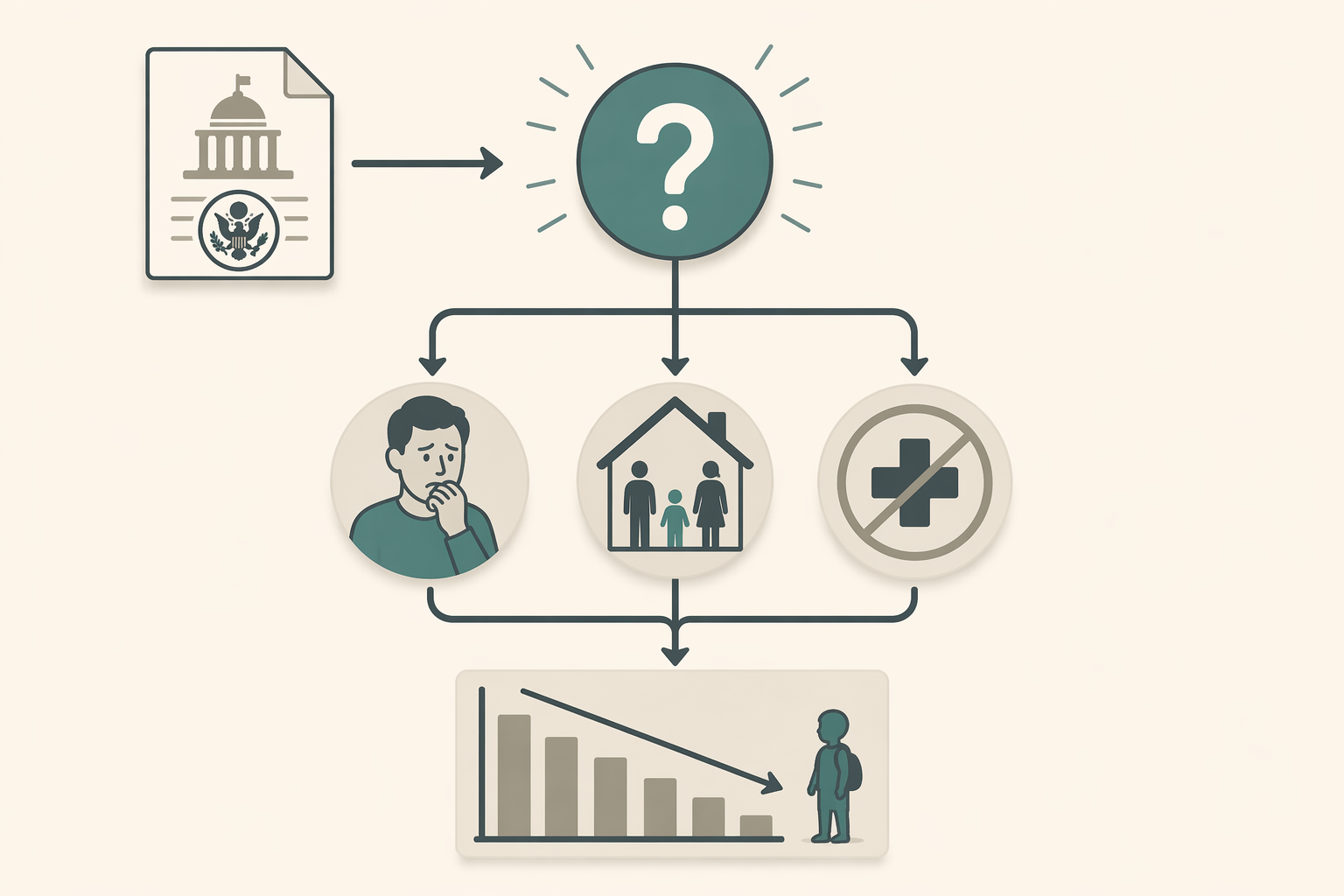
The practical answer to the public benefits and green card impact on healthcare is narrower than many families fear: using Medicaid or CHIP does not automatically bar someone from a green card, but the 2025 public charge proposal can still push eligible people out of coverage through confusion, fear, and household-level caution. That matters because the proposed rule is not final, litigation could still change its path, and the earliest possible effective date is September 18, 2026 [1].

What would change under the 2025 proposal is not a tidy new checklist. DHS would eliminate bright-line definitions for which benefits count, restore broad officer discretion, and rescind the 2022 primary-dependence standard. In its own analysis, the agency estimated $8.97 billion in annual federal and state transfer-payment reductions [1].
Why the biggest losses are expected among people who stay eligible
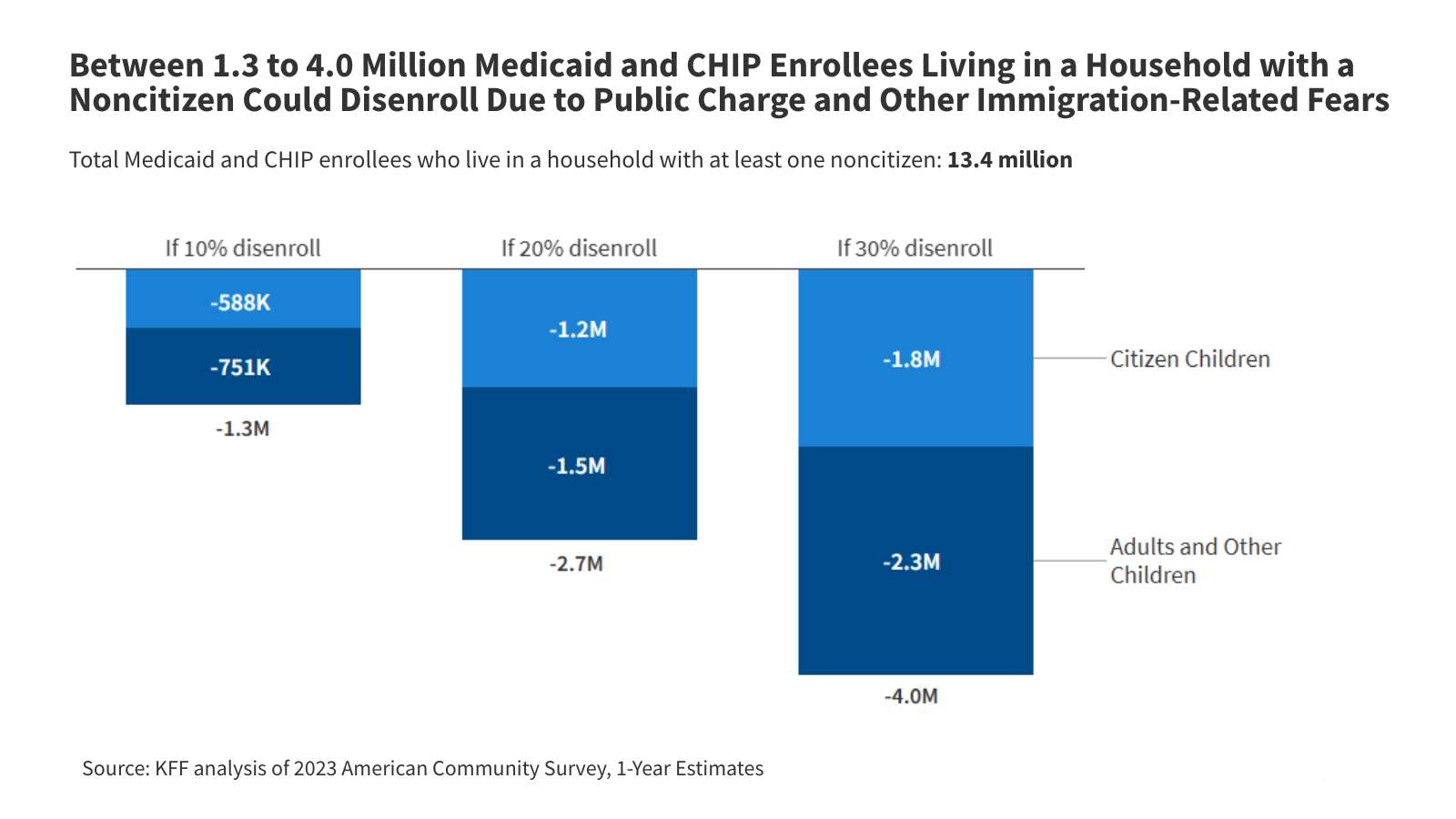
KFF’s modeled estimate is the load-bearing number here. Applying disenrollment rates of 10% to 30% to the 13.4 million Medicaid and CHIP enrollees living in noncitizen households yields a projected loss of 1.3 million to 4.0 million enrollees. Within that range, 600,000 to 1.8 million are citizen children who remain legally eligible but are likely to lose coverage anyway [2].
That concentration among children is not incidental. The Migration Policy Institute estimates that 5.3 million citizen children live in mixed-status households where at least one family member is a noncitizen, so the fear created by an immigration rule can travel through a family even when the child is not the person directly exposed to immigration review [3].
The 2019 public charge expansion already showed the mechanism. During that period, Medicaid and CHIP participation fell 18% among citizen children in noncitizen households, compared with 8% among citizen children in citizen-only households [4]. The difference is the story: confusion does not spread evenly; it hits the households where immigration status is already part of the family’s daily calculations.
Why the 2025 rule can depress enrollment before anyone is denied a green card
A benefit rule can change behavior even if few people are ever formally found inadmissible. If the government stops naming a narrow set of countable benefits and gives officers more room to weigh the facts, families lose the ability to sort safe from unsafe with any confidence. In a clinic waiting room, that uncertainty is enough to make Medicaid renewal packets look like immigration forms and to turn routine re-enrollment into a risk calculation [1].
CMS’s 2025 decision to share Medicaid enrollment data with ICE strengthens that fear. It is the first systematic federal data linkage between health coverage and immigration enforcement, which means the coverage question is no longer just about whether a benefit counts in a public charge review; it also becomes a question of whether enrolling creates a paper trail a family would rather avoid [7].
That distrust is already visible. In the KFF/New York Times survey cited by KFF, 29% of immigrant adults said they skipped or postponed healthcare, and 11% said they stopped participating in assistance programs because of immigration-related fears [8]. Those are not direct eligibility findings. They are a record of how policy signals reach care-seeking long before an immigration officer makes a decision.
H.R. 1 narrows the safety net while the public charge rule is still pending
The public charge proposal is not the only change moving through the system. H.R. 1 independently removes Medicaid eligibility from asylees, refugees, TPS holders, and survivors of domestic violence or trafficking, with coverage losses beginning in October 2026 and more than 1 million lawfully present immigrants affected over time [5][6].
That timing matters for hospitals and state agencies because the changes do not arrive all at once. Some losses begin before the full public charge rule could take effect, and some states will blunt the hit better than others. The national picture is therefore less a single drop-off than a staggered contraction in who feels safe enrolling, who still qualifies, and who assumes they should stay out of the system entirely [5][6][8].
State policy already shapes the size of that gap. KFF reports that 14 states plus D.C. use state-only funds to cover immigrant children regardless of status, while 7 states plus D.C. cover immigrant adults. Those programs do not cancel the federal risk, but they do create a two-tier geography of coverage and a two-tier forecast for uncompensated care [8].
What health systems should expect next
The likely operational result is not a neat eligibility shift but a slower leak: more eligible families dropping Medicaid or CHIP, more citizen children losing coverage inside mixed-status households, more delayed care, and more visits pushed toward emergency departments and uncompensated settings. Families USA argues that this kind of rule weakens the health system by increasing uncompensated care and straining community health centers, which is the downstream cost of treating coverage as a trust problem instead of a paperwork problem [9].
For policy teams and enrollment staff, the main forecast is already visible in the sequence of events: ambiguous proposed rule language, enforcement-linked data sharing, a documented history of eligible children disenrolling when immigration fears rise, and parallel statutory cuts that further narrow the safety net. The result is likely to be more attrition among families who still qualify, a disproportionate hit to citizen children in mixed-status households, and a heavier burden on clinics and hospitals trying to repair lost coverage after the fact.
References
- Public Charge Ground of Inadmissibility — Federal Register — Nov. 19, 2025 — https://www.federalregister.gov/documents/2025/11/19/2025-20728/public-charge-ground-of-inadmissibility
- Potential “Chilling Effects” of Public Charge and Other Immigration Policies on Medicaid and CHIP Enrollment — KFF — https://www.kff.org/
- Trump Administration Public-Charge Rule Would Amplify Harms to Immigrant Families — Migration Policy Institute — https://www.migrationpolicy.org/
- KFF analysis of the 2019 public charge expansion and Medicaid/CHIP participation among citizen children in mixed-status households — KFF — https://www.kff.org/
- What Recent Policy Changes Mean for Immigrant Health Coverage — Commonwealth Fund — https://www.commonwealthfund.org/
- New Law Limits Health Care & Food Aid for Immigrants — National Immigration Law Center — https://www.nilc.org/
- CMS-ICE data-sharing explainer on Medicaid enrollment data and immigration enforcement — Commonwealth Fund — https://www.commonwealthfund.org/
- Key Facts on Health Coverage of Immigrants — KFF — https://www.kff.org/
- Health Access on The Line — Families USA — https://familiesusa.org/
Comments
Join the discussion with an anonymous comment.