
For a patient who ate recalled eggs, the first clinical question is ordinary but important: does the illness fit Salmonella? Typical symptoms include diarrhea, fever, abdominal cramps, vomiting, and sometimes bloody diarrhea. CDC describes onset as 6 hours to 6 days after exposure, while FDA commonly uses a 12- to 72-hour window in outbreak advisories; most illnesses last 4 to 7 days and resolve without specific treatment. Medical attention is warranted for fever above 102°F, bloody diarrhea, diarrhea lasting more than 3 days, or signs of dehydration, with children under 5, adults 65 and older, and immunocompromised patients at higher risk for severe disease.[1]
As of July 24, 2026, the 2025 egg-associated Salmonella outbreaks discussed here are over. They are useful now not as an active consumer alert, but as a case study in how a breakfast exposure becomes a reportable public health signal: a patient develops a compatible syndrome, clinicians and laboratories generate an isolate, epidemiologists look for shared exposures, and federal investigators test whether recalled product, facility samples, and patient isolates tell the same genomic story.[1][2]
For recalled eggs, the label work is not cosmetic. FDA recall notices direct consumers, retailers, and distributors to check details such as plant codes, Julian dates, UPCs, and sell-by or best-by ranges. Those identifiers are how a carton in a refrigerator, a kitchen, or a supply chain becomes tied to a specific firm and recall lot rather than to eggs in general.
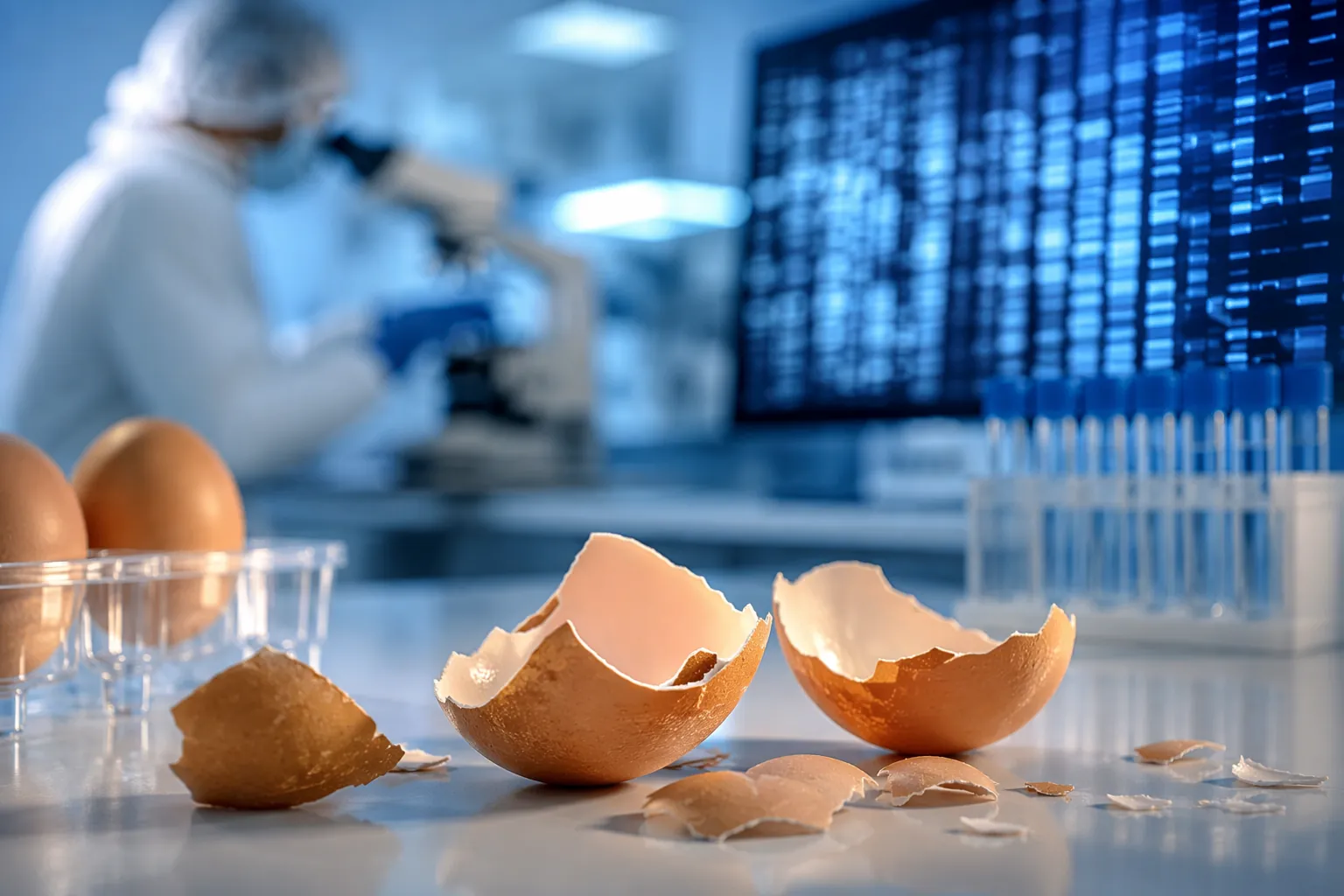
The 2025 Egg Recalls Were Three Separate Investigations
The 2025 egg recalls are easy to flatten into one story because the commodity and pathogen were similar. That would be a mistake. August Egg Company, Country Eggs LLC, and Black Sheep Egg Company involved different producers, different evidence trails, and different Salmonella findings. The common thread was not a single mega-outbreak; it was the modern investigation pattern: clinical illness, exposure histories, traceback, facility sampling, sequencing, and recall action.
| Investigation | Reported scope | Key evidence described in federal materials | Operational significance |
|---|---|---|---|
| August Egg Company, June 2025 | 134 cases across 10 states; 38 hospitalizations; 1 death | Whole genome sequencing linked clinical cases to environmental samples from a cage-free laying house | A severe outbreak with a death, where environmental sampling and WGS helped connect illnesses to a facility source |
| Country Eggs LLC, August 2025 | 105 cases across 14 states; 19 hospitalizations | Three WGS-matched environmental samples were linked to clinical cases | A separate multistate investigation where multiple environmental matches strengthened the product-facility link |
| Black Sheep Egg Company, August 2025 | More than 6 million eggs recalled | More than 40 positive environmental samples across multiple sites; 7 distinct Salmonella strains identified | A recall driven by extensive environmental findings, with strain diversity that should not be collapsed into the other events |
In the August Egg Company investigation, the human consequences were substantial: 134 reported illnesses in 10 states, 38 hospitalizations, and 1 death. FDA reported that whole genome sequencing linked the outbreak strain to environmental samples from a cage-free laying house. That is the kind of evidence trail that matters because it moves the investigation beyond a food history pattern and toward a facility-associated microbiologic match.[3]
Country Eggs LLC was also a multistate outbreak, but it was not the same one. FDA reported 105 illnesses across 14 states and 19 hospitalizations. In that investigation, three environmental samples were WGS-matched to clinical cases. Multiple matched environmental samples do not make field interviews unnecessary; they make the interviews, traceback, and sampling more interpretable because the same pathogen fingerprint appears on both sides of the clinical-environmental divide.[4]
Black Sheep Egg Company reads differently again. FDA’s advisory described more than 6 million recalled eggs, more than 40 positive environmental samples across multiple sites, and 7 distinct Salmonella strains. Those facts point to a broad environmental contamination problem, but they also warn against imprecision. “Salmonella in eggs” is not a single analytic unit when the facility findings include multiple strains and when the other 2025 investigations had their own producers and genomic evidence.[5]
From Diarrhea After Breakfast to an Outbreak Signal
Most individual gastrointestinal illnesses never become federal outbreak narratives. A patient may recover before testing. A clinician may treat supportively without obtaining a stool culture. A food history may be vague, especially when eggs are an ingredient rather than a visible item on the plate. The recall becomes clinically meaningful when the symptom pattern, timing, laboratory result, and product exposure can be tied to a defined investigation.
- Clinical fit: diarrhea, fever, cramps, vomiting, or bloody diarrhea in the expected post-exposure window.
- Exposure fit: recalled eggs or foods made with recalled eggs, identified through recall-specific label details.
- Laboratory fit: a patient isolate that can be compared with isolates from food or the production environment.
- Epidemiologic fit: interviews and traceback that make the shared exposure plausible rather than incidental.
That sequence is also why hospitalization and death counts should not disappear behind methods. In the August Egg Company outbreak, 38 people were hospitalized and 1 person died; in the Country Eggs LLC outbreak, 19 people were hospitalized.[3][4] Those outcomes are not proof that every exposed person needs emergency care. They are reminders that Salmonella enteritis is usually self-limited at the population level while still being consequential for specific patients, especially those in higher-risk groups.
What Whole Genome Sequencing Actually Adds
Whole genome sequencing does not discover a patient’s diarrhea. It compares isolates with enough resolution to help investigators determine whether clinical, food, and environmental samples are closely related. In foodborne outbreaks, that distinction is central. A suspected product can look plausible from interviews, but WGS can show whether the Salmonella from patients and the Salmonella from a facility or product are genetically linked closely enough to support a common-source investigation.
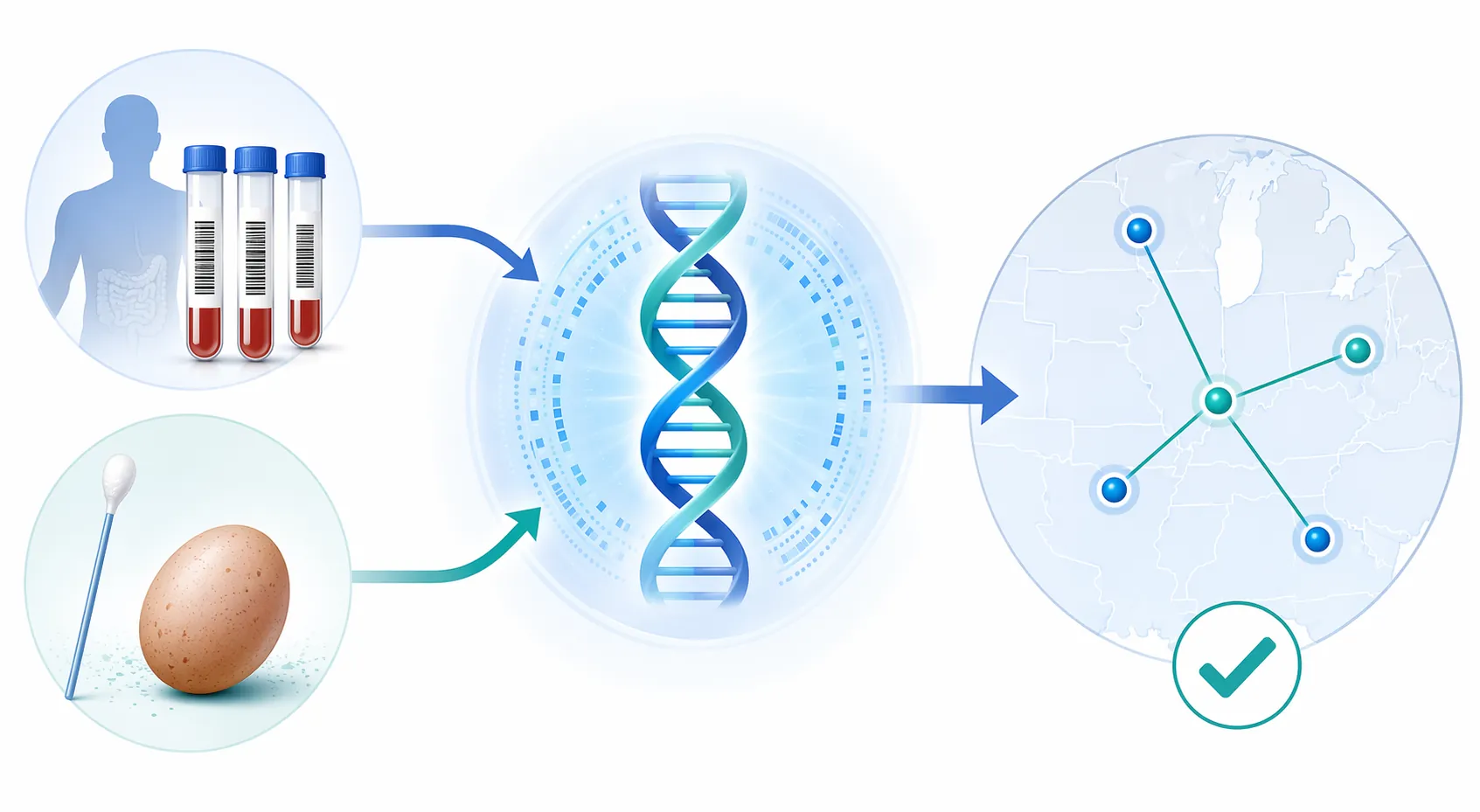
GenomeTrakr is the infrastructure behind much of that comparison work. FDA describes it as a distributed network of public health and university laboratories that share foodborne pathogen genomic data through NCBI’s Pathogen Detection portal. Since its 2013 launch, FDA says the network has supported more than 1,643 public health actions.[6]
The 2025 egg investigations show the value of that infrastructure in concrete terms. In the August Egg Company event, the WGS match to environmental samples from a cage-free laying house helped connect patients to a production environment. In the Country Eggs LLC event, three WGS-matched environmental samples linked facility evidence with clinical cases. Those are not abstract claims about innovation; they are examples of sequencing changing the strength and specificity of an outbreak investigation.[3][4]
There is a practical caveat. WGS is powerful only after isolates exist, metadata are usable, and laboratories can process and submit results. A sequencing network cannot compensate for patients who are never tested, specimens that are not forwarded, exposure interviews that are incomplete, or facility sampling that never occurs. It sharpens the signal; it does not create the entire surveillance system.
Where FDA’s AI Tools Fit Into the Workflow
AI enters food safety most credibly when it is placed inside an existing workflow: deciding which facilities deserve inspection attention, sorting complaint signals, prioritizing risky imports or firms, or helping analysts move through large volumes of records. In May 2025, FDA Commissioner Marty Makary testified that the agency was using AI to identify high-priority inspection targets. Reporting also described FDA’s Elsa generative AI platform as rolled out agency-wide by June 30, 2025, and connected the agency’s broader food safety modernization work to predictive analytics under the Smarter Food Safety Blueprint.[7]
That does not mean AI detected the 2025 egg outbreaks. The cited federal investigation details for the egg recalls rest on conventional outbreak machinery: illness reports, epidemiologic work, inspection and environmental sampling, recall notices, and WGS matching. AI inspection targeting may help decide where limited inspection resources go, and predictive analytics may help rank risks before an outbreak is obvious. Those are important contributions, but they are upstream prioritization tools, not substitutes for the clinical, laboratory, and field evidence that tied the egg events to specific firms.
The same caution applies to generative AI inside agencies. A platform that summarizes records or helps staff search internal documents may shorten administrative steps. It does not validate a Salmonella cluster, sequence isolates, interview patients, or collect environmental swabs. The defensible claim is narrower and still useful: AI may help federal staff aim attention and process information faster, while outbreak confirmation continues to depend on evidence produced by surveillance, laboratories, inspections, and epidemiology.
Emerging AI Research Is Promising, but Still Unevenly Positioned
The research pipeline around AI and food safety is growing quickly, though adoption and effectiveness should be kept separate. A June 2026 systematic review in npj Science of Food examined 161 papers and found that 35% of AI food safety research targeted microbiological hazards; it also reported that deep learning usage rose from 22% of publications in 2019 to 43% in 2023.[8] That shows where research attention is moving. It does not prove that most public health agencies can deploy these tools operationally tomorrow.
Some laboratory-facing work is more concrete. UC Davis researchers reported in 2023 that a YOLO v4 model differentiated Salmonella from 7 other foodborne bacteria with 94% precision and completed analysis in about 3 hours, compared with days for culture methods.[9] That is a meaningful experimental result for faster microbial differentiation, but it should not be read as a replacement for validated outbreak workflows. Faster classification only matters clinically and epidemiologically if the result can be trusted, integrated, reported, and acted on.
Complaint and signal detection is another plausible use case. In March 2025, the UK Health Security Agency described an evaluation of large language models analyzing more than 3,000 online restaurant reviews for gastrointestinal symptom detection.[10] The appeal is obvious: patients often talk about illness outside formal reporting channels. The limitation is equally obvious: online reviews are noisy, biased, and not equivalent to laboratory-confirmed surveillance. An LLM can help find possible signals, but public health still has to decide whether those signals correspond to real cases, shared exposures, and actionable hazards.
This is the same distinction seen in other public health modeling domains: algorithms can translate messy environmental or population-level data into risk estimates, but the estimate has to be connected to a decision pathway. ClinicalMind has covered that issue in the context of AI in air quality health risk estimation. Food safety has the same operational burden: a model output must lead to inspection, testing, communication, or care decisions, not just a more impressive dashboard.
The Surveillance Capacity Question
The policy pressure point is that AI expansion and surveillance contraction can happen at the same time. They are not the same program, and the available material does not show that one caused the other. But their timing matters for how much confidence anyone should place in smarter detection claims.
Effective July 1, 2025, CDC reduced FoodNet active surveillance from 8 pathogens to just Salmonella and Shiga toxin-producing E. coli, with reporting attributing the change to funding constraints.[11][12] Salmonella remained within the narrowed surveillance scope, which is important for the egg cases discussed here. The broader concern is what happens to the rest of the foodborne illness picture when active surveillance is reduced.
FoodNet matters because active surveillance is labor, not magic. It depends on defined catchment areas, reporting relationships, case ascertainment, and staff who can maintain data quality over time. A predictive model can help rank risks, and WGS can match isolates with high precision, but both depend on a stream of cases, specimens, metadata, and follow-up work. If that stream thins, algorithmic sophistication does not fully restore what was lost.
The 2025 egg recalls therefore support a measured conclusion. WGS through GenomeTrakr made clinical-environmental connections more specific. FDA’s AI and predictive analytics work may improve targeting and information processing. Emerging AI research may eventually accelerate laboratory differentiation and widen complaint signal detection. But the outbreak response system still rests on maintained active surveillance, laboratory capacity, reporting networks, inspection access, and human investigation. Recalled eggs become visible as a public health event only when all of those pieces continue to function.
References
- Salmonella Outbreak Linked to Eggs — CDC.
- Salmonella Outbreak Linked to Eggs — CDC.
- Outbreak Investigation of Salmonella: Eggs (June 2025) — FDA.
- Outbreak Investigation of Salmonella: Eggs (August 2025) — FDA.
- FDA Advises Consumers, Retailers and Distributors Not to Eat, Sell, or Serve Recalled Black Sheep Egg Company Eggs — FDA.
- GenomeTrakr Network — FDA.
- FDA Expanding Use of AI in Food Safety Inspection — Civil Eats, May 27, 2025.
- Systematic review of artificial intelligence applications in food safety — npj Science of Food, June 2026.
- How artificial intelligence may improve food safety — UC Davis Engineering, 2023.
- AI could help detect and investigate foodborne illness outbreaks — UK Health Security Agency, March 2025.
- CDC quietly scaled back surveillance program for foodborne illnesses — NBC News.
- CDC cuts back foodborne illness surveillance program — CIDRAP.
Comments
Join the discussion with an anonymous comment.