
A multi-state health system that piloted an ambient scribe in one clinic, computer vision in one ICU, and workflow cameras in one emergency department can no longer ask only whether the vendor signed a business associate agreement. By Q3 2026, the harder privacy question is which state law attaches to which observation, what the patient or clinician was told, who can override an AI interpretation, and whether the data was kept for a purpose no one identified when the pilot began.
HIPAA still matters. It governs covered entities and business associates, protected health information, permitted uses, disclosures, security safeguards, and patient rights. But its basic architecture is entity-based and record-centered. AI monitoring tools are increasingly behavior-centered: they listen, watch, classify, score, summarize, and sometimes trigger operational responses before a traditional medical record entry exists.
That difference is not academic. An ambient microphone may capture a patient encounter and generate a clinical note. A camera in an ICU may detect movement, agitation, fall risk, or device interference. A triage tool may route patients based on symptoms and inferred urgency. A staff monitoring system may evaluate response times or workflow bottlenecks. Each system creates a different data flow, and the compliance answer changes with the flow.

The Patchwork Is Now Operational, Not Theoretical
The volume of state activity is the first warning sign. Industry tracking cited by Censinet reported more than 215 health-data and AI-related bills introduced across 44 states in 2025, with at least 21 enacted, described as the most active legislative year on record for this category.[1] That number should not be treated as a stable inventory; state sessions move quickly, and bill tracking changes as proposals are amended or die. Its practical meaning is simpler: a privacy team cannot build a 2026 AI monitoring review around one federal checklist and assume the local overlay is incidental.
Across the current materials, three state-law obligations matter most for health systems expanding AI surveillance: transparency, human oversight, and data minimization. They are not interchangeable. A disclosure rule does not answer whether an automated interpretation can be challenged. A human-review rule does not answer whether video-derived behavioral data can be reused to train a vendor model. A minimization rule does not tell a nurse what to say when the room microphone turns on.
| AI monitoring pattern | Privacy question HIPAA may not fully settle | State-law pressure point |
|---|---|---|
| Ambient exam-room transcription | Was the patient told that AI was listening, and was consent or another permission needed? | Real-time disclosure and patient-facing notice |
| ICU or fall-detection computer vision | Is the system merely documenting care, or interpreting behavior and triggering action? | Human oversight and escalation review |
| AI triage or routing monitor | Can a patient or clinician challenge an automated classification? | Clinician-in-the-loop obligations |
| Staff workflow cameras or productivity analytics | Is the data workforce monitoring, patient care documentation, or both? | Purpose limitation, retention, and secondary-use controls |
The classification work has to happen before expansion, not after an incident. A surveillance deployment that looks clinically useful to operations may look incomplete to a regulator if the notice, review, retention, and vendor-use terms were copied from ordinary software intake.
Why HIPAA Stops Short
HIPAA was not drafted for continuous machine observation that converts behavior into predictions. It can regulate the protected health information held by a covered entity or business associate, but it does not by itself create a comprehensive state-by-state rule for when an AI system must be disclosed, when a patient may opt out of automated evaluation, or when a clinician must review a machine-generated interpretation before it affects care.
De-identification is another weak point. Censinet notes that HIPAA’s Safe Harbor and Expert Determination pathways do not account neatly for AI-driven re-identification risks that may arise from large datasets or model weights.[1] That does not mean every AI model re-identifies patients, or that every de-identified dataset is unsafe. It means health systems should be careful when a vendor says monitored data has been de-identified and therefore falls outside meaningful privacy concern. The question becomes what data was captured, what features remain, how the model uses them, and whether the same data can be linked back to a person or small group.
There is also a relational change when care is watched. Harvard Petrie-Flom’s discussion of AI watching patient care frames the issue as more than ordinary health data handling: observation can affect trust, behavior, and the clinical encounter itself.[5] A privacy review that treats an ICU camera as only another source system misses that the camera changes who is being observed and how they may behave.
None of this makes AI monitoring improper. Hospitals have legitimate reasons to reduce documentation burden, detect falls earlier, support triage, and understand workflow failures. The problem is not that a sensor exists. The problem is deploying it under the label “HIPAA-compliant AI monitoring” without tracing the actual data path and the state-law duties attached to it.
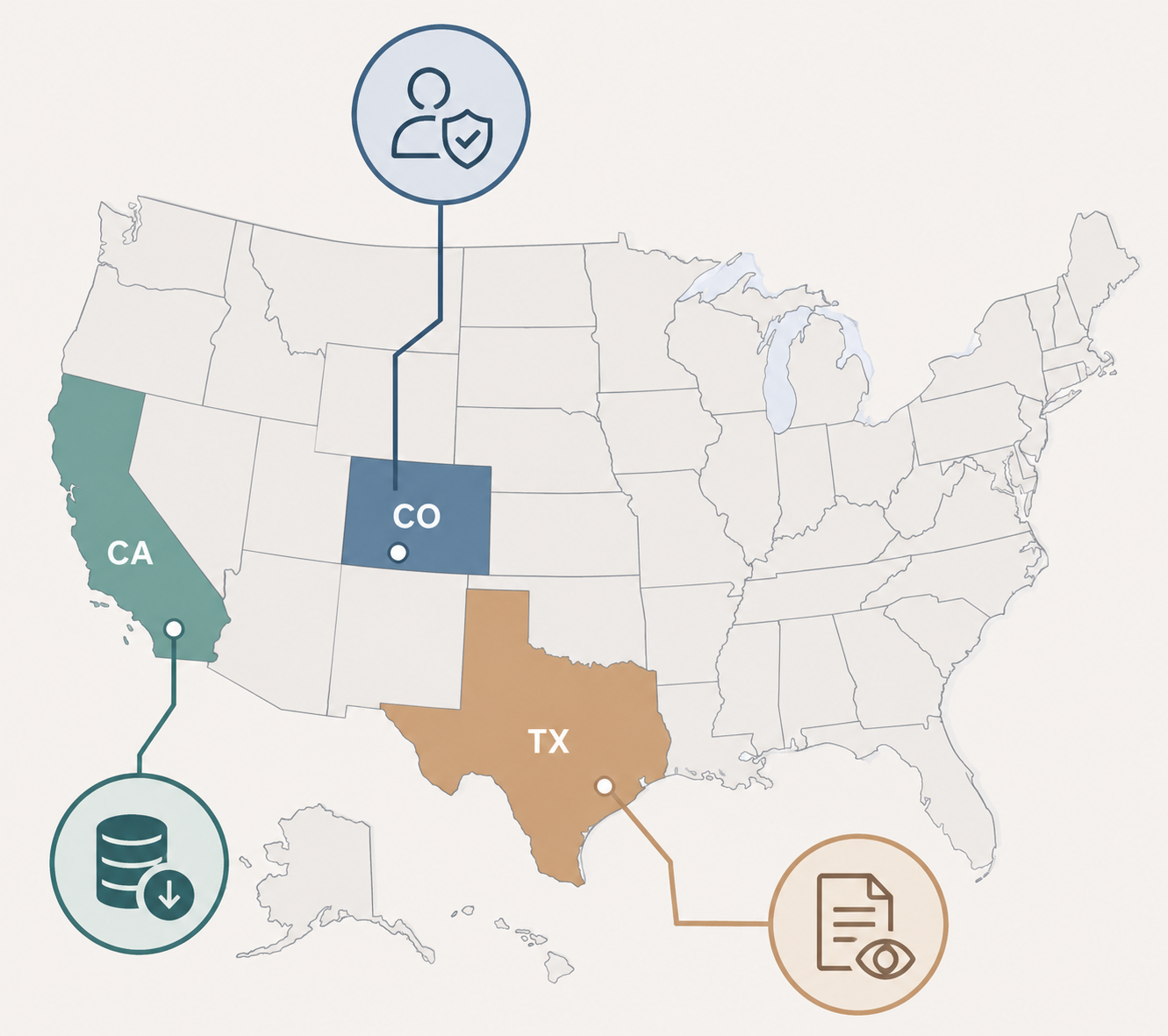
Texas: Disclosure Moves From Policy Binder To Patient Encounter
Texas is the cleanest example of the transparency obligation becoming operational. Legal commentary on Texas HB 149 describes it as effective January 1, 2026 and as the first state law to mandate explicit patient disclosure when AI is used in healthcare services, including tools used in triage, chatbots, and clinical monitoring.[2] The exact statutory application still requires bill-text review, but the compliance message is already plain: patient-facing AI use cannot be buried only in procurement files.
Surveillance tools make notice harder than ordinary software because they do not always sit at an obvious decision point. A chatbot can display a notice before the patient types. An ambient scribe may start when the clinician enters the room. A ceiling camera may operate continuously. A triage monitor may analyze data before the patient realizes an AI tool is part of intake. The notice problem is therefore a workflow problem, not just a legal drafting problem.
For a Texas facility, the implementation questions become concrete: where is the disclosure placed, who gives it, what does it say about the AI’s role, and how is it documented? A front-desk sign may not fit an exam-room transcription tool. A consent paragraph in a general conditions-of-treatment form may not be enough for a system that visibly or audibly monitors the patient encounter. A nurse script may work for one unit and fail in the emergency department if it slows intake or places staff in the position of answering technical questions they were never trained to answer.
The point is not to overbuild notice for every low-risk automation. It is to avoid discovering, after rollout, that no one can prove what the patient was told before an AI system listened, watched, or interpreted. In the ordinary compliance call, that proof gap matters as much as the elegance of the vendor’s security exhibit.
Colorado: HIPAA-Covered Does Not Mean State-Law Irrelevant
Colorado illustrates a different lesson. Ropes & Gray described Colorado S.B. 26-189, in May 2026, as scaling back the state’s 2024 AI law by exempting HIPAA-covered entities while imposing targeted obligations on healthcare AI deployers.[3] That narrowing matters. It also defeats an easy but dangerous shortcut: “We are HIPAA-covered, so the state AI law does not matter.”
A HIPAA-covered-entity exemption may protect one actor in one capacity while leaving obligations elsewhere in the deployment chain. A hospital may be covered by HIPAA. A vendor may be a business associate for some data uses but may also operate analytics, model-development, or product-improvement functions that need separate analysis. A subcontractor may touch data that is not cleanly treated as protected health information. A deployer obligation may attach because the tool is used in a healthcare setting even if the covered entity assumed HIPAA was the whole field.
Colorado’s approach is important because it shows how states may carve around HIPAA instead of duplicating it. They can narrow the statute to avoid sweeping every covered entity into a general AI regime, while still regulating particular healthcare AI deployments. For compliance teams, that means exemption analysis cannot stop at the organization’s status. It has to ask which entity is acting, what role it plays, and which data flow the AI tool creates.
Human oversight is the practical center here. If a monitoring tool flags patient deterioration, predicts fall risk, classifies triage urgency, or evaluates clinician performance, someone needs to know whether the AI output is advisory, whether a clinician must review it, whether staff can challenge it, and whether the review is recorded. The answer may differ for patient-safety alerts, clinical documentation, and workforce analytics. Treating all three as “monitoring” is how governance records become useless.
California: Opt-Out, Automated Decisions, And The Secondary-Use Problem
California adds the kind of friction health systems tend to underestimate because it reaches beyond notice into choice, automated decision-making, minimization, and secondary use. WilmerHale’s April 2026 healthcare privacy takeaways discuss California CPPA automated decision-making technology regulations as creating opt-out rights that likely extend to AI surveillance systems interpreting patient or clinician behavior.[4] Those ADMT rules were not final as of mid-2026, so they should not be described as settled law. They are still a serious planning signal.
An opt-out right is easy to describe and hard to run inside a hospital. If a patient opts out of AI transcription, does the clinician document manually, turn off the ambient tool, or move the encounter to a different room? If a patient opts out of a monitoring system used for fall-risk interpretation, does the facility have a safe substitute? If a clinician objects to automated workflow evaluation, is that a privacy request, a labor issue, a medical-staff governance issue, or all three?
Data minimization creates a separate discipline. A camera system deployed to detect falls does not automatically need to retain full video for training, quality review, litigation defense, staff coaching, and product development. An ambient scribe used to draft notes does not automatically need to keep raw audio after the note is finalized. A triage model does not automatically need to feed every interaction back into a vendor dataset. Each additional use should be named, justified, contracted for, and tested against the state law that applies.
The secondary-use issue is where vendor assurances often become too thin. “We use data to improve the service” is not a retention schedule, a training-data permission, or a jurisdictional analysis. For AI surveillance, secondary use may involve behavioral traces: how a patient moves, how long a clinician responds, what was said in a room, or which alert was ignored. Those traces may be more sensitive than the label attached to the software module.
The Liability Signal From AI Transcription
The California class action over AI transcription is useful because it is ordinary. Hall Render reported that a major health system faced a proposed class action in 2025 over AI transcription in exam rooms allegedly used without patient consent.[2] The case should not be treated as proof that all ambient transcription violates privacy law. It does show how quickly a documentation-efficiency tool can become a consent, notice, and trust dispute when patients say they did not know AI was listening.
Ambient transcription is often sold as less intrusive than video and more clinically useful than manual notes. That may be true in many deployments. But from a privacy perspective, it still captures the clinical conversation at the moment of care. The compliance file needs to show who received notice, what choices existed, whether recordings were retained, whether transcripts were reviewed, and how vendor access was limited.
The same pattern carries to other surveillance tools. The first dispute is rarely about the abstract social value of AI. It is about one patient who says no one told them, one clinician who says the AI output was wrong and unreviewable, or one data-use clause that allowed monitored behavior to be repurposed beyond the care reason that justified collection.
How Obligations Compound In A Multi-State Rollout
A single-state pilot lets a health system improvise more than it should. A multi-state rollout removes that margin. The same vendor tool may require different disclosure language in Texas, different oversight mapping in Colorado, and different opt-out and minimization analysis in California. The product name is the same; the compliance artifact is not.
- Disclosure language: identify whether the AI is listening, watching, classifying, routing, drafting, or alerting, and decide where the notice appears in the actual patient or staff workflow.
- Oversight review: document when a human must review the AI output, who can override it, and how disagreement is recorded.
- Retention limits: separate raw audio, video, derived features, transcripts, alerts, audit logs, and model-training datasets instead of assigning one retention period to the whole tool.
- Vendor data use: distinguish service delivery, support, analytics, product improvement, and model training, then map each use to contract terms and state-law constraints.
- Governance escalation: route high-risk monitoring tools through a standing AI governance process rather than treating them as routine privacy intake.
This is also where HIPAA preemption questions become uncomfortable. HIPAA can preempt contrary state law, but state privacy obligations that are more protective or that regulate different aspects of AI transparency, opt-out, or automated decision-making may survive depending on the specific provision and conflict. The current materials do not support a broad answer that all state AI duties are safe from preemption or all are displaced. Each obligation needs its own analysis.
The governance route matters because privacy, security, clinical operations, medical staff leadership, compliance, legal, procurement, and data science all hold part of the answer. A privacy officer can identify a notice gap, but may not know whether turning off a fall-detection model creates safety risk. A clinical lead can defend the operational value, but may not see the vendor’s secondary-use language. A procurement team can collect the security exhibit, but may not classify derived behavioral data correctly.
Formal AI governance structures help because they force these questions into one record. A health system expanding monitoring tools should route them through a committee process with defined scope, escalation, documentation, and review cadence; a clinical AI governance committee charter is the natural place to assign those responsibilities before a tool becomes embedded in care.
The Review That Should Happen Before Expansion
Before a 2026 rollout moves from one facility to several others, the health system should inventory the monitoring function rather than the product. The same platform may run an ambient scribe in one state, a triage assistant in another, and staff analytics in a third. The review should ask what is captured, what is inferred, who sees the output, whether the output affects care or employment, what is retained, and whether the vendor can reuse any data.
Then the system should map state obligations to the workflow. Texas-style disclosure cannot be satisfied by language no patient sees or hears. Colorado-style oversight cannot be satisfied by naming a physician if no one knows when review is required. California-style minimization cannot be satisfied by saying the data is useful. Each obligation has to land somewhere: a screen, a script, an EHR flag, a committee approval, a retention control, a contract clause, or an audit log.
The narrow but important judgment is this: by Q3 2026, AI surveillance in healthcare should be treated as a state-by-state governance problem layered on top of HIPAA. A one-time HIPAA privacy review is not enough for tools that continuously observe patients, clinicians, or staff and turn that observation into machine interpretation.
References
- Emerging AI Privacy Regulations in Healthcare, Censinet.
- Health Care Privacy Law Takeaways for a Compliant 2026, Hall Render, March 18, 2026.
- Colorado Scales Back AI Law, with Targeted Implications for Health Care, Ropes & Gray, May 2026.
- Key Takeaways on Healthcare Privacy in 2026, WilmerHale, April 6, 2026.
- When AI is watching patient care: Ethics to consider, Harvard Petrie-Flom, February 18, 2020.
Comments
Join the discussion with an anonymous comment.