
The collision over VA sleep apnea disability policy is not hypothetical anymore. As of Q3 2026, the Department of Veterans Affairs still has not finalized the sleep apnea rating rewrite first proposed in February 2022 and followed by a supplemental notice in September 2024, even after more than 2,600 public comments.[1] At the same time, the VA is already running AI-enabled claims infrastructure built to move disability evidence through summaries, search tools, exposure classifications, and possible rating recommendations at a scale no manual benefits shop could match.[2][3]
That timing matters because the proposed sleep apnea rule is not just a change in percentages. It changes the operational question inside the file. The older structure made a CPAP prescription a central rating fact. The proposed structure asks adjudicators to look harder at treatment efficacy, persistent daytime symptoms, and end-organ damage. That is a different kind of evidence problem. It requires deciding which notes show impairment after treatment, which symptoms count as residual, which comorbid consequences belong in the rating analysis, and which records are merely duplicative.

The uncomfortable question is not whether AI will replace every VA reviewer. The more precise question is where technical implementation ends and policy begins when an automated system decides which evidence is relevant under a rating framework that is still proposed, contested, and unfinished.
The proposed sleep apnea rule changes the evidence task
Under the proposal issued in February 2022, sleep apnea ratings would move away from the familiar treatment-prescribed approach, including the automatic 50% rating associated with prescribed CPAP use, toward a framework that distinguishes outcomes after treatment. The proposed levels include 0%, 10%, 50%, and 100% ratings based on factors such as whether treatment is effective, whether symptoms persist during the day, and whether there is end-organ damage.[1]
That rule is not final, and the caveat belongs in every serious discussion of this issue. The VA may revise the criteria, abandon parts of the proposal, or finalize something materially different. But the proposal already shows the agency’s preferred direction: the rating decision would depend less on the existence of a prescribed device and more on how the condition functions after treatment.
For a veteran, the difference is not semantic. A CPAP-centered rule asks whether a particular intervention was prescribed. A symptom-outcome rule asks whether the record proves ongoing impairment after that intervention. The first question is comparatively easy to find in equipment orders, sleep clinic notes, and prescription records. The second often lives across years of scattered material: primary care complaints, sleep medicine follow-ups, cardiology or pulmonary notes, employer statements, lay evidence, medication records, and disability benefit questionnaires.
A human reviewer can miss that evidence. An AI summarization system can miss it faster, more consistently, and less visibly unless its output is traceable. That is the policy hinge. Once the legal standard turns on residual symptoms and functional consequences, the evidentiary shortcut becomes the adjudicatory standard in practice.
| Operational question | CPAP-centered approach | Proposed symptom-outcome approach |
|---|---|---|
| Main fact to locate | Was treatment such as CPAP prescribed? | What symptoms and impairment remain after treatment? |
| Evidence pattern | Discrete orders, prescriptions, device documentation | Longitudinal notes, symptom reports, treatment response, complications |
| Primary risk in automation | Missing or misreading a treatment record | Filtering out symptoms as duplicative, unrelated, or not rating-relevant |
| Procedural consequence | The veteran can often point to a missing prescription record | The veteran may need to reconstruct why scattered evidence never appeared in the reviewer’s summary |
The claims system is already being rebuilt around evidence movement
The VA’s AI systems in this context are not clinical diagnostic tools deciding whether a veteran has sleep apnea. They are claims-processing tools. Their power sits in a quieter place: finding records, summarizing evidence, identifying exposures, flagging documents, and potentially recommending ratings.
The War Horse reported that the VA’s Automated Decision Support system operates under a $485 million IBM contract, has been deployed for more than 170 diagnostic codes, and can reduce evidence review into summaries of roughly 10 pages.[2] NextGov reported in March 2026 that the VA is increasingly looking to AI to enhance claims processing, including tools such as Smart Search, TERA Memo Automation, Smart Ratings Recommendation, and the pre-deployment AICES system.[3]
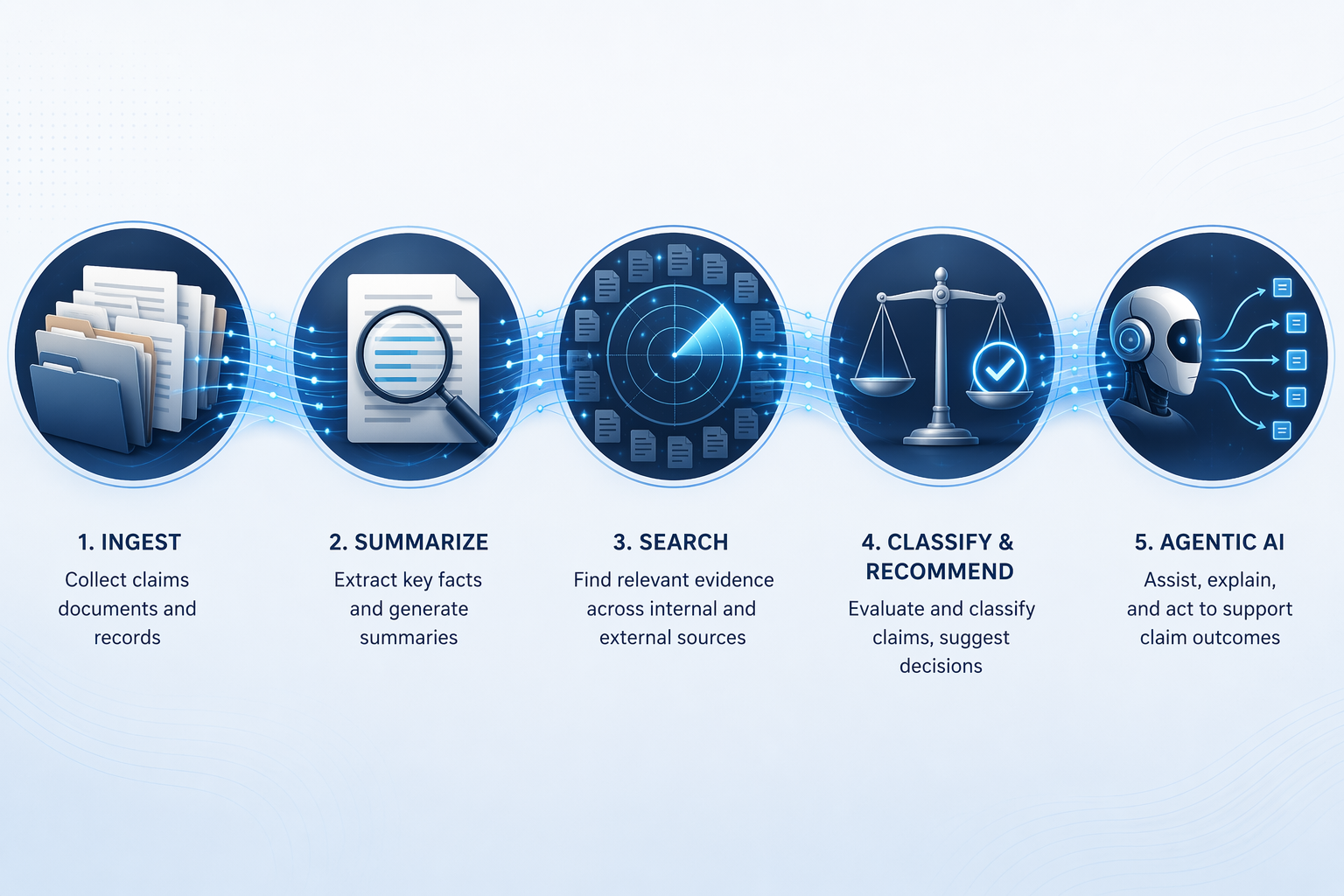
The individual labels matter less than the direction of travel. The claims environment is moving from document retrieval toward document classification, from classification toward recommendation, and from recommendation toward agentic assistance. Each move increases the chance that an upstream technical judgment becomes a downstream benefits outcome.
Automated Decision Support turns files into summaries
ADS is often described as support, and there is a legitimate place for support in a claims system drowning in records. Nobody should romanticize hand-sorted paper or pretend that a reviewer manually opening every page of a massive electronic file is a fairness guarantee. The question is what the summary leaves out, how the omission can be detected, and whether the veteran ever learns that the reviewer saw a compressed version of the file.
The failure modes are not abstract. A 2023 VA Office of Inspector General inspection cited by The War Horse found that ADS “failed to recognize duplicate evidence, identified false evidence, and missed relevant information.”[2] For an ordinary administrative memo, that would be a quality-control problem. For a symptom-based sleep apnea rating, it is potentially the difference between evidence being weighed and evidence never entering the decisional field.
Duplicate recognition sounds technical until it affects the record. If the system treats repeated symptom reports as duplicative clutter, the reviewer may never see the longitudinal persistence of daytime fatigue. If it fails to recognize actual duplicates, a file may appear to contain more support for a conclusion than it does. If it identifies false evidence, the veteran can be forced to rebut a record that should not have carried weight. If it misses relevant information, the appeal starts with a blind spot the veteran did not create.
Search and exposure tools widen the pipeline
Smart Search is described as operating across more than 1 billion documents.[3] At that scale, search is no longer a clerical convenience. It becomes an evidence gate. Search terms, ranking, relevance thresholds, and document-type filters all influence what a reviewer sees first and what may never be surfaced at all.
TERA Memo Automation is also important, although not because it decides a sleep apnea rating by itself. The tool digitizes 100% of toxic exposure risk activity records, according to NextGov reporting.[3] That matters because the PACT Act claims surge pushed the VA toward industrial-scale evidence handling. Once that infrastructure exists for exposure records, the same institutional appetite for automation can reach other evidence-heavy conditions.
Recommendation tools move closer to the legal decision
Smart Ratings Recommendation is the line that deserves particular attention. The War Horse reported that the VA paused the effort after planning to move ADS beyond evidence summarization and toward proposing actual rating decisions.[2] A pause is not a cancellation of the underlying ambition. It is evidence that the agency understands there is a meaningful boundary between helping a reviewer read a file and suggesting the compensation result.
AICES, described as a pre-deployment agentic AI tool, sits even further along that trajectory.[3] Because it remains pre-deployment, it should not be treated as if it is already deciding claims. But its presence in the planning environment matters. A claims operation that contains summarization, mass search, automated exposure memos, rating-recommendation planning, and agentic AI development is not merely digitizing paperwork. It is building a technical architecture for adjudication.
Accuracy numbers answer less than they appear to answer
The VA announced in April 2026 that it had reached 94.02% 12-month issue-level accuracy in benefits processing.[4] That sounds reassuring until the unit of measurement is put back into the sentence. Issue-level accuracy is not the same as full-claim-packet accuracy, and a veteran does not experience a disability claim as an isolated spreadsheet line.
The War Horse’s independent analysis found roughly 94% accuracy over a three-month issue-level window but about 84% accuracy for entire packets, while the VA’s stated target is 98%.[5] Those figures are not necessarily contradictions. They are different measurements. The difference is exactly why the topline number cannot carry the whole burden of reassurance.
In a sleep apnea claim under a proposed symptom-outcome framework, packet-level performance is the measurement that feels closer to procedural reality. A file can contain service connection, secondary-condition evidence, treatment records, lay statements, medical opinions, and rating-stage evidence. The veteran needs the whole packet to be handled correctly enough that the legal standard is applied to the evidence actually submitted.
Even a small percentage of error becomes large when claims infrastructure operates across millions of records. The policy question is not whether perfection is possible. It is who bears the cost of the known gap between current performance, the VA’s own target, and the complexity of the evidence standard being automated.
Sleep apnea prevalence is context, not proof of a benefits outcome
Sleep apnea is common enough in veteran populations to make any rating rewrite administratively significant. Research summarized in PubMed reports that sleep apnea prevalence among veterans can range from about 2 times to 7 times that of non-veterans depending on the study population.[6] That range should be used carefully. It does not prove that every veteran population has the same prevalence, and it does not prove that any particular rating outcome follows from diagnosis alone.
The better use of the prevalence point is narrower: sleep apnea claims are numerous enough that the VA has a strong incentive to standardize how evidence is read. When a condition is high-volume and the proposed rating criteria require more nuanced evidence sorting, automation stops being a back-office procurement matter. It becomes part of benefits policy in operation.
The veteran’s problem is notice and traceability
The central fairness problem is not that a machine touched the file. It is that the veteran may not know which machine touched the file, what it extracted, what it downgraded as irrelevant, what it treated as duplicate, and whether the human reviewer relied on a summary rather than the underlying record.
That is why DAV’s March 2026 statement on planned AI review of disability benefit questionnaires is more useful than generic warnings about automation. DAV demanded transparency about AI-based review of DBQs dating back more than 15 years, including validation metrics, flagging criteria, veteran notification protocols, and appeal rights.[7] Those are not decorative governance requests. They are the minimum conditions for a veteran to understand and challenge the path by which evidence became a decision.
If the VA uses AI to flag a DBQ as inconsistent, incomplete, or suspicious, the veteran needs to know enough to respond. If an AI-generated summary omits evidence of persistent hypersomnolence, the veteran needs a way to identify that omission before the appeal turns into a scavenger hunt. If a classification model tags certain records as not rating-relevant under a proposed sleep apnea framework, the agency should be able to explain the criteria in terms that can be tested against the governing law.
The legal standard and the operational standard must match. A regulation can say that residual symptoms matter, but if the claims pipeline privileges device prescriptions, structured fields, or certain note types while suppressing scattered functional evidence, the veteran is being judged under a narrower system than the rule describes. Conversely, if the proposed rule is not final, the agency has to be careful that preparatory automation does not start treating a preferred future standard as a present one.
The February 2026 medication-rule episode damaged trust
The VA’s February 2026 medication-rule episode is not the same issue as sleep apnea AI adjudication, but it belongs in the same trust file. The VA published a rule changing how medications are considered in disability ratings and then rescinded it within 10 days after public backlash.[8] The episode showed how quickly technical-sounding rating changes can become legitimacy problems when veterans believe the agency is altering compensation standards without adequate public understanding.
That history makes transparency around AI implementation less optional. When the agency is simultaneously revising rating concepts, expanding automated evidence handling, and asking the public to trust accuracy metrics that do not fully describe packet-level performance, process becomes substance.
Section 108 would accelerate the same unresolved problem
Section 108 of the Take Care of America’s Veterans Act raises the stakes because it would codify sleep apnea and tinnitus rating changes before the VA completes the normal rulemaking process. As of the latest reporting in late June 2026, the proposal had not received a final vote, so its trajectory remains uncertain.[9]
DAV estimated that the proposal would cut $57 billion over 10 years and affect 1.5 million veterans.[9] The VFW criticized the bill in a June 22, 2026 op-ed, arguing that Congress was treating “disability compensation as a budget offset.”[10] Those are advocacy positions, not neutral fiscal findings, but they show why the procedural route matters. Codifying rating changes legislatively while the VA’s technical evidence pipeline is being built would compress the space for public testing of both the legal standard and the operational system used to apply it.
This is not only a separation-of-powers concern or a veterans-service-organization fight. It is an implementation problem. If Congress hardens proposed criteria into law before the VA has resolved the practical mechanics of evidence classification, then the AI systems reading, sorting, and summarizing records may become the fastest path by which the new standard reaches veterans’ files.
Where the policy may actually be made
A proposed symptom-outcome sleep apnea rule requires a more delicate evidence analysis than a treatment-prescribed rule. A large AI claims infrastructure gives the VA the capacity to perform that analysis across vast numbers of records. Put those two facts together, and the decisive choices may happen inside validation documents, flagging rules, search parameters, model thresholds, summary templates, and reviewer instructions.
There is a responsible version of this future. It would make AI use visible in the claim record. It would preserve access to the underlying evidence behind a summary. It would publish or otherwise disclose meaningful validation metrics by task, not just broad accuracy rates. It would distinguish issue-level accuracy from packet-level accuracy. It would tell veterans when AI flagged, summarized, or classified their evidence. It would give appeal bodies enough traceability to determine whether the legal standard was applied to the full file rather than to a compressed substitute.
There is also a less defensible version, and it does not require a dramatic announcement that AI is denying claims. It only requires the VA to implement symptom-based adjudication through tools whose relevance criteria, duplicate handling, omission rates, and reviewer reliance patterns are not visible to the veteran. In that version, evidence classification becomes compensation policy before anyone calls it policy.
By Q3 2026, the VA has the infrastructure to operationalize symptom-based sleep apnea adjudication faster than the formal policy process has resolved the standard. That does not prove mass denials are coming, and it does not prove the final rule will match the proposal. It does mean that transparency around validation metrics, flagging criteria, veteran notice, and appeal rights is not a secondary implementation detail. It is where the real benefits policy may be made.
References
- VA Sleep Apnea Changes: Proposed 2024 Ratings Update, NVF.org
- The VA is using AI to process veterans’ disability claims. The technology has made mistakes., The War Horse
- VA increasingly looking to AI to enhance claims processing, NextGov, March 2026
- VA announces major improvements in benefits processing and delivery, U.S. Department of Veterans Affairs, April 2026
- VA Backlog Drops 57 Percent, But Accuracy Still Matters, CCK Law
- Sleep apnea in United States military veterans: a scoping review, PubMed
- DAV statement on VA’s planned use of AI to review benefit questionnaires, DAV, March 2026
- How VA AI Could Reduce Your Disability Rating, Sean Kendall Law
- DAV condemns congressional proposal to cut disability benefits for 1.5 million veterans, DAV, 2026
- Congress Can’t Do Its Own Job, Much Less Determine Veteran Disability Status, VFW, June 22, 2026
Comments
Join the discussion with an anonymous comment.