
The practical edge of automation in veterans disability benefits is not a chatbot answering a question. It is a claims file arriving at the Department of Veterans Affairs, being sorted, classified, searched for missing evidence, and prepared for a human employee who still has to sign off on what happens next. That is where legislation’s impact is now most visible: not in a formal transfer of adjudicatory power to machines, but in the growing amount of claims development work being done before a rater ever reaches the file.
The VA’s Automated Decision Support system, or ADS, is the clearest example. It uses machine learning to automate up-front claims development, including document classification, evidence gathering, and preliminary analysis. The agency’s position is that ADS does not make final disability decisions; human claims processors retain final adjudication authority.[1]

That distinction matters, and it also needs pressure-testing. A benefits decision is rarely only the final sentence in a notification letter. It is built from earlier acts: whether a document is recognized as relevant, whether a toxic-exposure pathway is flagged, whether the right evidence is requested, whether a medical or service record is placed in front of the reviewer at the right moment. If automation changes those upstream steps, it can change the practical shape of the decision even while the legal authority remains with a VA employee.
Automation Is Already Inside the Claims Workflow
The VA’s automation program is not a pilot tucked away from the main benefits system. The agency’s 2025 AI inventory identified 367 active AI systems across VA operations, with 28 focused on government benefits processing. Most of those benefits-processing systems were still in a pre-deployment phase, but the direction of travel is plain: the claims system is being redesigned around machine assistance at scale.[1]
The systems cited in public reporting do different kinds of work. ADS handles up-front development. Tools associated with toxic-exposure review can auto-populate TERA memos, reducing repetitive preparation work tied to Toxic Exposure Risk Activity analysis. AICES, described as an agentic indexing tool, is aimed at organizing claim materials so employees can locate and use evidence more efficiently.[1]
None of that is trivial back-office tidying. Claims development determines what is ready for adjudication and what still needs to be found. In a high-volume system, an error at that stage can become a delay, an incomplete record, or a rating decision that looks administratively clean while resting on a flawed evidentiary path.
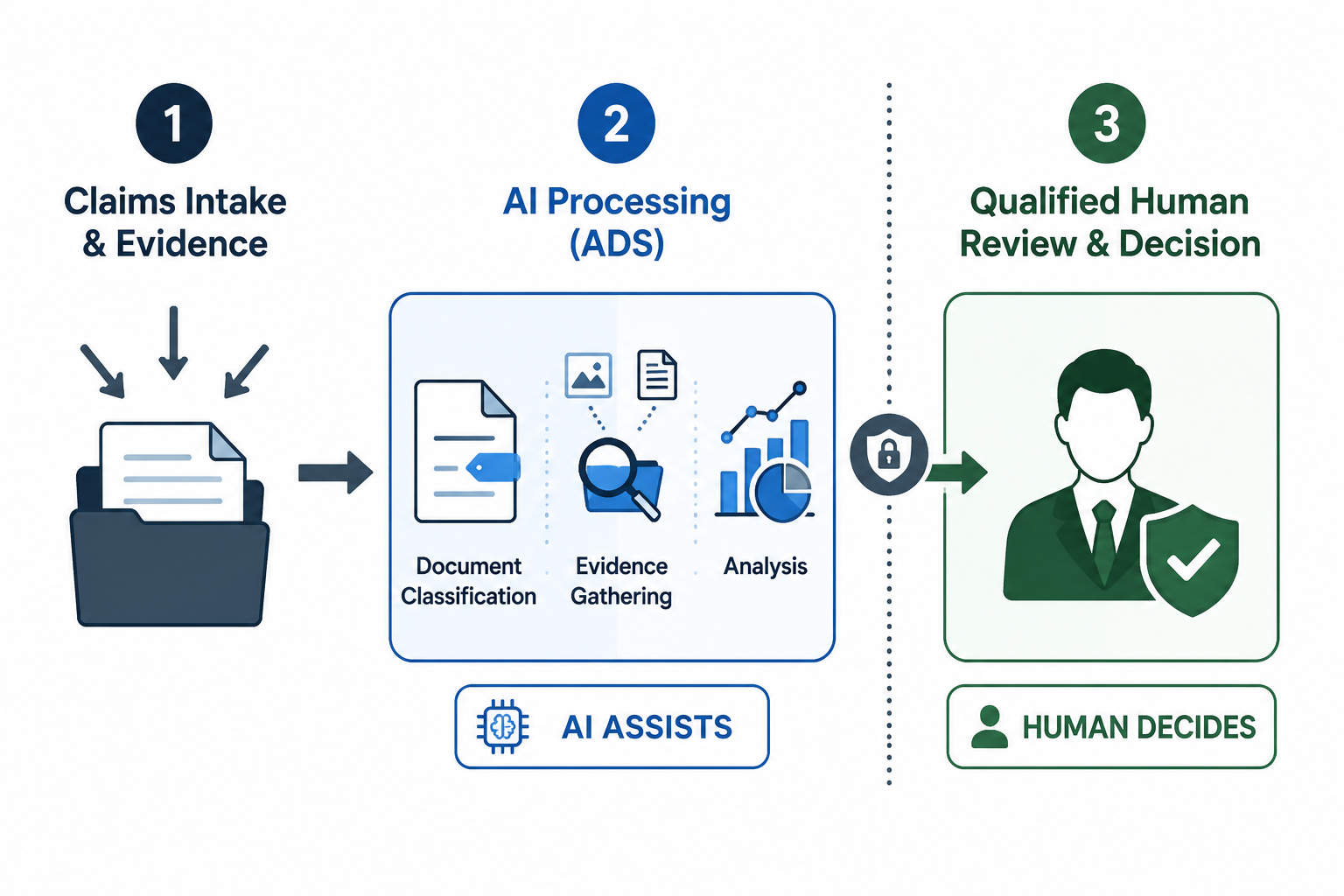
The official boundary is therefore simple to state but harder to administer: AI can assist the claims process; a qualified human must decide the claim. The more consequential the assistance becomes, the more important it is to know whether human review is substantive or merely a last click in a process already shaped by automated classifications.
Why Congress Gave the VA Room to Automate
The statutory opening came through the PACT Act. Among its effects, the law gave the VA secretary authority to use appropriations to enhance claims processing capacity and automation, a provision the agency used as toxic-exposure claims surged under the Act.[1]
That authority did not appear in a vacuum. The PACT Act expanded access to benefits for veterans exposed to burn pits, Agent Orange, and other toxic hazards, and the resulting claims volume put direct pressure on an already burdened disability system. A purely manual processing model would have meant more veterans waiting longer for decisions that determine monthly compensation, access to related benefits, and financial stability.
The administrative case for automation is strongest at this point. If software can identify documents, assemble evidence, and reduce avoidable development work, the benefit is not abstract. It can mean a claim moves to a trained reviewer faster. It can also mean employees spend less time performing repetitive sorting and more time evaluating the claim record.
But capacity authority is not adjudication authority. The PACT Act helped the VA use automation to handle volume; it did not erase the legal and procedural obligation to issue defensible benefits decisions. That is the line on which the current policy debate turns.
The Numbers Explain the Temptation
The performance claims are large enough that no serious analysis can ignore them. VA reported processing more than 3 million claims in fiscal year 2025 and more than 2 million by June 2026. Since January 2025, the claims backlog fell by 72%, and average processing time dropped from 141.5 days to 78.6 days. VA also reported accuracy above 94%.[2][3]
| Measure | Reported Result | Why It Matters |
|---|---|---|
| Claims processed | More than 3 million in FY2025; more than 2 million by June 2026 | Shows the scale of demand and the administrative pressure behind automation |
| Backlog | Reduced by 72% since January 2025 | Indicates shorter queues, though not necessarily perfect decision quality |
| Average processing time | Dropped from 141.5 days to 78.6 days | Measures speed from the claimant’s perspective |
| Accuracy | Reported above 94% | Supports the agency’s quality claim, while still requiring scrutiny of what is being measured |
These are official VA figures, and they deserve both attention and caution. They show that the agency has moved claims faster during a period of heavy demand. They do not, by themselves, prove that every automated step is well governed, that every class of claimant benefits equally, or that human review remains equally meaningful as the upstream workflow becomes more machine-mediated.
A backlog reduction can coexist with new procedural risks. Accuracy can remain high in aggregate while specific categories of claims still need bias testing or validation. Faster average processing time can be a real gain for veterans and still leave open the question of who catches the mistake when an automated system misclassifies a document or fails to surface evidence.
The Guardrail Is Human Review, Not Human Presence
The Veterans of Foreign Wars has been direct about the minimum safeguard. In January 2026 testimony on VA disability modernization, the organization said all AI-generated work products must be reviewed by a qualified VA employee before a decision is issued. It also called for quality assurance that includes routine testing, independent validation, and bias auditing.[4]
That formulation is more demanding than a human-in-the-loop slogan. It asks whether the reviewer is qualified, whether the AI output is identifiable as AI-generated, whether there is enough time and authority to challenge it, and whether the agency is checking system performance outside the production pressure of daily claims processing.
A weak review model would leave the human employee downstream from a largely settled machine-produced file, expected to approve quickly unless something obviously looks wrong. A stronger model gives the employee the record, the provenance of the automated work product, the ability to demand additional development, and institutional backing when speed targets and case quality point in different directions.
For claimants, the difference is not philosophical. If a veteran’s file becomes a test of automated efficiency, the veteran bears the delay or denial that follows. If a VA employee is asked to rubber-stamp an output that no one has independently validated, that employee becomes the visible decision-maker without having had real control over the evidentiary path.
What Meaningful Review Has to Include
- A qualified VA employee reviews every AI-generated work product before decision issuance.
- The system output is traceable enough for the reviewer to see what the tool did and what it may have missed.
- Routine testing checks whether performance changes over time, especially as claim types and evidence patterns shift.
- Independent validation examines whether the tool performs as represented, not merely whether it is popular inside the workflow.
- Bias auditing looks for uneven effects across claimant groups, conditions, exposure categories, or record types.
The VFW returned to the point in July 2026 testimony on PACT Act implementation and technology integration, again emphasizing human review and transparency in AI deployment.[5] That persistence is important. Once automation begins producing attractive throughput numbers, the political system tends to treat oversight as a secondary implementation detail. In veterans benefits, oversight is part of the benefit.
The Line Between Development and Adjudication Can Blur
The VA’s stated position is that tools such as ADS do not make final decisions.[1] That should be acknowledged clearly. Claims processors retain adjudicatory authority, and the public record does not support saying that the VA has handed final disability ratings to AI.
Still, the distinction between claims development and adjudication is not airtight in practice. Development determines the universe of materials that adjudication will consider. A system that classifies evidence, identifies missing records, drafts or populates internal work products, and organizes the claim file may not decide the case, but it can shape the case the human reviewer sees.
That is where procedural fairness can erode without any formal announcement that the decision-maker has changed. No regulation needs to say “AI decides” for automation to carry practical weight. The weight accumulates through defaults, queues, prefilled fields, confidence scores, and workflow designs that make one path easier than another.
This is also why transparency cannot stop at procurement descriptions. A claimant does not need a technical white paper to understand an adverse decision, but the system does need an accountable record of how automated tools contributed to the file. A reviewer cannot meaningfully review an output if the tool’s role is invisible, and an appellant cannot meaningfully challenge a flawed record if no one can say how it was assembled.
Oversight Has a Management Problem, Too
The Government Accountability Office’s October 2025 report supplies a useful corrective to any claim that modernization is self-validating. GAO found that VA undertook 23 reform initiatives from fiscal years 2017 through 2020 for the disability program, but did not consistently follow leading management practices such as establishing clear goals and involving key stakeholders.[6]
That finding was not limited to AI, but it lands directly on the AI debate. A modernized workflow can still be poorly governed. A faster system can still lack clear goals. A reform initiative can be technically ambitious and still fail to involve the people who understand how claims actually move: veterans, service organizations, claims processors, raters, quality reviewers, and appeals personnel.
The management question is not whether VA leaders can announce new tools. It is whether they can define what each tool is supposed to do, measure whether it does that job fairly, and stop or revise the tool when evidence shows a problem. In a benefits system, disciplined management is not bureaucracy for its own sake. It is part of due process infrastructure.
This is where the GAO finding and the VFW testimony point in the same direction from different angles. GAO emphasizes management discipline and stakeholder involvement. VFW emphasizes qualified review, validation, and bias auditing. Together, they describe an oversight model in which automation must earn trust repeatedly, not acquire it permanently because a dashboard improved.
The Legislative Fight Is Not Finished
The PACT Act is enacted authority. It gave the VA room to use automation to increase claims processing capacity. A separate House-passed bill addressing AI automation in VA claims processing shows that Congress is still trying to define the oversight framework, but that bill should not be treated as a settled regulatory endpoint while Senate action remains unresolved.[1]
That distinction matters for anyone assessing how legislation affects veterans disability benefits in 2026. The existing legal environment already permits substantial automation inside the claims workflow. The next legislative question is how explicit Congress will be about testing, disclosure, independent validation, bias auditing, appeal rights, and the qualifications required for human review.
The risk is not only that Congress will do too little. It is also that lawmakers will write broad AI provisions that sound protective while leaving the hard parts to agency implementation. A requirement for “human review,” for example, can mean very different things depending on staffing levels, training, time allowances, auditability, and whether employees are rewarded primarily for speed.
The better legislative target is operationally specific without pretending Congress can manage every claim. The law can require human review before issuance, mandate testing and independent validation, require bias audits, preserve records showing automated tool involvement, and force public reporting that distinguishes adoption from demonstrated effectiveness.
Efficiency Helps Only If Accountability Stays Attached
There is a weak version of the anti-AI argument that ignores the actual claims burden. It is not persuasive. Veterans waiting months for benefits are not served by a romantic attachment to manual paperwork, especially when automation can reduce repetitive work and move files toward review faster.
There is also a weak version of the pro-AI argument that treats speed as proof of legitimacy. It is no better. The disability compensation system is not a parcel-delivery network. A claim is an application for a legal entitlement, supported by records that may be incomplete, old, inconsistent, or difficult to interpret. The government’s obligation is not only to move the file. It is to decide the claim according to law and evidence.
The current settlement is therefore narrow but important. The VA can use AI to assist with claims development and processing capacity. It can point to substantial gains in throughput and processing time. But the work product of those systems still has to be reviewed by qualified human employees before decisions issue, and the systems themselves need testing, validation, and bias auditing if the review function is to mean anything.
For 2026 and 2027, the central question is no longer whether automation will enter veterans disability claims processing. It already has. The question is how far it can move upstream, how much practical force its outputs can carry, and whether human review remains an act of judgment rather than a ceremony performed after the machine has arranged the answer.
References
- VA is increasingly looking to AI to enhance claims processing, Nextgov, March 2026.
- VA processes 2M disability benefits claims in record time – again, U.S. Department of Veterans Affairs.
- VA announces major improvements in benefits processing and delivery, U.S. Department of Veterans Affairs.
- Reevaluating the Rating Schedule: Examining VA's Efforts to Modernize Disability Benefits, Veterans of Foreign Wars, January 2026.
- PACT Act Implementation: Modernizing VA Disability Claims Through Effective Technology, Veterans of Foreign Wars, July 2026.
- VA Disability Benefits: Agency Has Taken Steps, but Challenges Remain with Managing and Modernizing Its Program, U.S. Government Accountability Office, October 2025.
Comments
Join the discussion with an anonymous comment.