
Open the FDA AI-Enabled Medical Devices Database expecting a complete registry and the first correction is simple: it is not one. It is an FDA-curated list of authorized devices identified through keyword matching in public authorization summaries and product code classifications. That makes it useful, especially when a team needs an official starting point, but it also means the list depends on the language available in FDA records rather than on a comprehensive audit of every marketed device that may use AI or machine learning.[1]
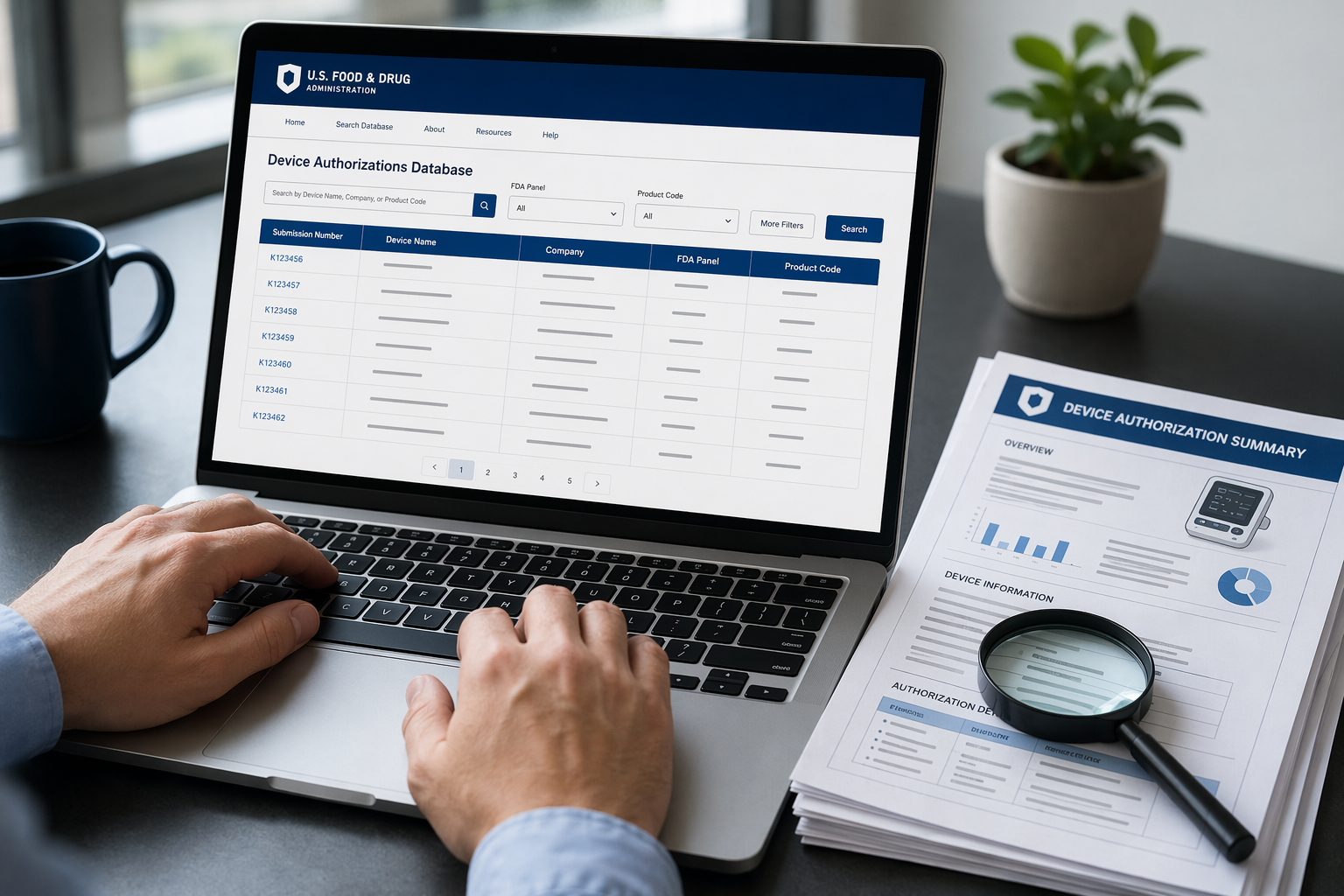
As of the FDA page's March 4, 2026 update, the database covers more than 1,400 authorized AI/ML-enabled medical devices from 1995 onward. The page provides downloadable CSV, Excel, and XML files, with fields such as submission number, device name, company name, FDA panel, product code, and links back to the underlying 510(k), De Novo, or PMA decision summaries.[1] Those links are the reason the database is worth using. The row is the lead; the FDA record is where the claim has to be checked.
What the FDA Database Actually Contains
The FDA page is best understood as an index into public authorization records. It does not evaluate clinical performance, compare products, or tell a purchaser whether one device is better supported than another. It gives a structured way to find devices that the FDA has associated with AI or machine learning terms in the public record.[1]
| Field or feature | How to use it | What not to assume |
|---|---|---|
| Submission number | Use it to locate the corresponding 510(k), De Novo, or PMA record. | Do not treat the number alone as evidence that the marketed product version is unchanged. |
| Device name | Use it for an initial product match, then verify against the decision summary. | Do not assume naming is consistent across company materials, FDA records, and secondary trackers. |
| Company name | Use it to identify the listed applicant or sponsor in the FDA record. | Do not assume it reflects current parent ownership after acquisitions or corporate restructuring. |
| FDA panel | Use it to group devices by regulatory specialty area. | Do not use panel alone as a proxy for clinical setting, risk, or evidence quality. |
| Product code | Use it to find devices regulated under the same classification. | Do not assume all devices under a code use AI in the same way. |
| Decision-summary link | Use it to verify intended use, pathway, predicate references, and authorization language. | Do not stop at the database row when making procurement, research, or policy claims. |
The database is especially helpful when a claim arrives without enough context. A vendor may say its tool is FDA cleared. A report may say a specialty area has seen rapid AI adoption. A policy memo may cite a device count without naming the extraction date. In each case, the database can help identify the submission record that should be read before the claim is repeated.
A Practical Workflow for Using the Database
For most users, the cleanest workflow is not complicated. The discipline is in keeping the row, the authorization record, and the interpretation separate.
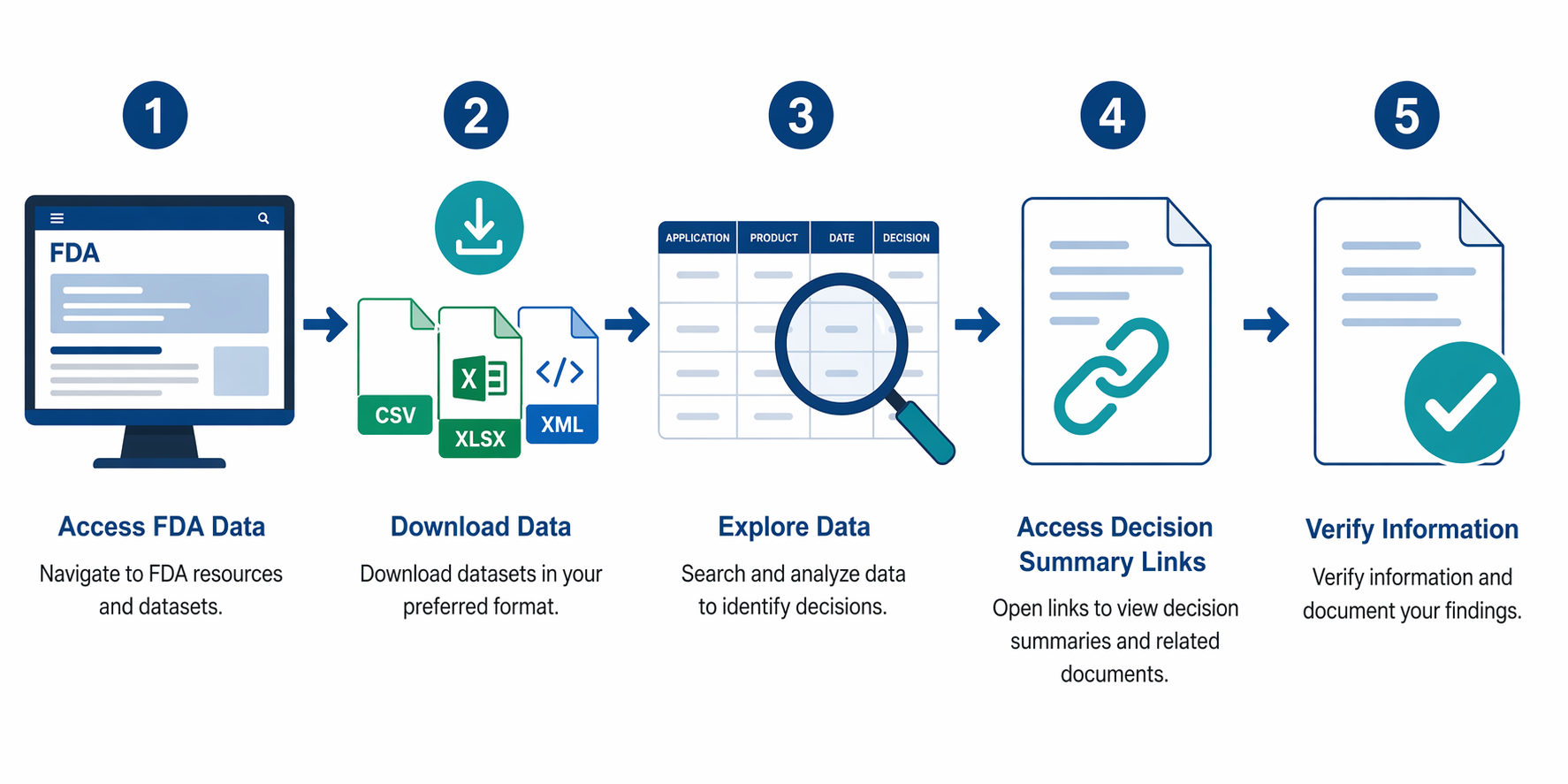
- Go to the FDA Artificial Intelligence-Enabled Medical Devices page and note the update date before using any count or trend statement.[1]
- Download the file format that fits the task: CSV for quick analysis, Excel for spreadsheet review, or XML for structured processing.[1]
- Filter by the field that matches the question: company name for vendor checks, device name for product matching, FDA panel for specialty analysis, product code for regulatory grouping, or submission number for record verification.
- Open the linked FDA decision summary or authorization record for each device that matters.[1]
- Record the extraction date, the filters used, and whether the count is based on rows, submissions, products, companies, or parent-company groupings.
That last step is not administrative fussiness. It is what prevents two people from producing different totals and then treating the discrepancy as an error in one source. A count built from the FDA's March 2026 file, a count built from a later download, and a count that consolidates acquired companies can all be defensible if the method is disclosed.
If You Are Checking a Vendor Claim
Start with the company name and device name, but do not rely on either field alone. Product names in sales materials may differ from the names used in FDA submissions, and company names may reflect the applicant at the time of authorization rather than current ownership. If the vendor provides a submission number, use that as the anchor.
Once the row is found, open the underlying FDA record. Check the intended use, indications for use, device description, and regulatory pathway. A clearance or authorization may apply to a specific function, workflow, population, imaging modality, or clinical use. If a purchasing document says the device is cleared for one use and the FDA summary describes a narrower use, the FDA summary should control the internal note until the vendor supplies a better source.
If You Are Building a Research Sample
Download the full file rather than copying rows from the web page. Keep the original file unchanged, then create a working copy with filters and derived fields. MedTech Dive's May 2026 tracker illustrates this more careful pattern: download the FDA list, clean the data, and cross-reference FDA device databases rather than simply publish a raw total.[2]
For a defensible sample, record inclusion and exclusion rules in plain language. For example, a study might include only devices in a named FDA panel, only devices with decision summaries available through the FDA link, or only authorizations within a stated date window. Those choices change the denominator. They should not be hidden in a spreadsheet tab.
If the project is about authorization volume or pathway mix, related ClinicalMind coverage of record 2025 FDA AI device authorizations can provide context. If the question is evidence quality after authorization, the better exit is the AI medical devices evidence-gap analysis. The database itself is not designed to answer either question by itself.
If You Are Doing Competitive or Policy Intelligence
Use the FDA panel and product code fields to avoid comparing unlike devices too quickly. A company with many entries in one panel may not be competing with a company whose authorizations sit in a different specialty area or support a different clinical workflow. Product codes can help narrow the comparison, but they still do not prove that devices solve the same operational problem.
Manufacturer rankings deserve particular caution. A row-level company count can change when analysts consolidate subsidiaries, account for acquisitions, or group current parent companies. That is not a minor formatting issue. It can change the apparent market position of a manufacturer without any new FDA authorization occurring.
Why Counts Differ Across Sources
One source may say 1,430 devices, another may say 1,451, and the FDA page may use the broader phrase "over 1,400." Those differences are not automatically contradictions. They may reflect different download dates, whether the analyst counted authorization rows or product entries, how duplicates were handled, and whether company ownership was normalized.
The FDA's own wording matters here. The agency identifies AI-enabled devices using keyword matching in public summaries and product code classifications, and it states that the list is not comprehensive.[1] A device can be absent because the public summary did not use the searched terms, because the relevant classification was not captured by the method, or because a later update has not yet incorporated it. Absence from the list is a signal to investigate, not proof that a marketed device has no AI component.
The reverse is also important. Presence on the list does not mean the FDA has endorsed a broad AI claim in marketing language. It means the authorization record met the FDA's inclusion method for this database. The underlying decision summary still has to be read to understand what was actually reviewed.
What Clearance Pathway Tells You, and What It Does Not
The database includes devices authorized through 510(k), De Novo, and PMA pathways, with links to the relevant decision materials.[1] For many users, the pathway is one of the first fields worth checking because it changes the kind of regulatory question the FDA was answering.
Independent analyses have reported that roughly 97% of devices in the FDA AI-enabled device list were cleared through the 510(k) pathway, meaning they were generally found substantially equivalent to predicate devices rather than reviewed as entirely novel devices through De Novo or PMA routes.[3][4] That statistic is useful context for evidence review, but it should not be stretched into a device-by-device conclusion. A 510(k) clearance does not, by itself, tell you whether a particular clinical validation package is strong, weak, current, or relevant to your setting.
For procurement and clinical governance, pathway information should trigger the next document check, not end it. Look for the intended use, performance testing described in the summary, predicate relationship when applicable, and any conditions or limitations that affect the proposed deployment. If the question is how FDA policy is changing for adaptive AI/ML devices, including predetermined change control plans, ClinicalMind's PCCP glossary entry and regulatory reform analysis are better places to go next.
The Current Database Does Not Tag Foundation Models or LLMs
The FDA database is not yet a map of modern AI architectures. The agency has said it is developing methods to identify and tag devices that incorporate foundation models, large language models, and multimodal architectures in future updates, but those tags are not currently part of the list.[1]
That limitation matters for anyone trying to separate older pattern-recognition software from newer generative or multimodal systems. At present, the database can help find authorized devices associated with AI/ML language in FDA records. It cannot reliably answer how many authorized devices use foundation models, which ones use LLMs, or whether a device's AI method matches a current marketing description.
If the assignment is specifically about imaging, it may be more efficient to pair the FDA file with a specialty-focused landscape review, such as ClinicalMind's AI medical imaging companies landscape. The FDA list will still be the authorization anchor, but it will not supply every market or technical classification a landscape project needs.
How to Write a Defensible Note From the Database
A useful internal note does not need to be long. It needs to make the source, method, and limits visible. For a procurement file, that may mean a short entry such as: "FDA AI-enabled device database reviewed on [date]. Device located by submission number [number]. FDA decision summary reviewed. Cleared indication appears to cover [specific use]. Evidence review handled separately."
For a policy or research memo, the note should be more explicit about counting. State the FDA update date, the file format used, the filters applied, and the unit counted. If company totals are included, say whether subsidiaries were rolled up into parent companies. If excluded rows were removed because of missing links, duplicate names, or out-of-scope panels, say so.
- Use "identified in the FDA AI-enabled device list" rather than "all FDA-authorized AI devices" unless the method supports the broader phrase.
- Use "as of the March 4, 2026 FDA update" when citing the current FDA count from the page.[1]
- Use "cleared through 510(k)" only after checking the device's actual pathway in the record.
- Use "vendor states" for marketing claims that are not confirmed in the FDA decision summary.
- Use separate evidence sources when the question is clinical performance, real-world effectiveness, bias, workflow impact, or safety after deployment.
This language may feel restrained, but restraint is the point. The database is strong enough to support traceable regulatory discovery. It is not strong enough to support every market-size claim, evidence claim, or technology-classification claim that gets attached to it.
Use It as an Index, Then Verify
The FDA AI-Enabled Medical Devices Database is valuable because it gives busy teams an official place to start: downloadable files, submission numbers, product codes, FDA panels, company names, and links into the authorization record. It becomes risky when users treat the row count as a complete census of AI in medical devices or treat presence on the list as a full assessment of clinical value.
For research, procurement, and regulatory intelligence, the safer pattern is straightforward: find the row, open the FDA record, verify the intended use and pathway, document the extraction method, and move to separate evidence sources when the question goes beyond authorization. The database does its job best when it is treated as an official starting index, not as the final answer.
References
- Artificial Intelligence-Enabled Medical Devices, FDA.
- AI in medtech is booming. Track new devices here., MedTech Dive, May 2026.
- FDA's AI Medical Device List: Stats, Trends & Regulation, IntuitionLabs.
- 2025 Year in Review: AI/ML Medical Device 510(k) Clearances, Innolitics.
Comments
Join the discussion with an anonymous comment.