
 Multiple institutions (Stanford, Harvard, Johns Hopkins, MIT Sloan, UIUC, AAFP, Medmastery)
The Myth: You Must Code to Understand Healthcare AI
Walk into any hospital conference room where AI is being discussed, and within ten minutes someone will say, "I should probably learn Python." It is the reflexive response of clinicians who sense that artificial intelligence is reshaping medicine but assume the only way to engage with it is to become a programmer. That assumption is not just inaccurate — it is actively keeping capable clinicians from contributing to AI decisions that directly affect their patients.
The reality is that a growing number of high-quality AI in healthcare courses are designed specifically for non-coders. These programs focus on strategic understanding, clinical evaluation of AI tools, and responsible deployment — not on writing algorithms. A 2024 article in eClinicalMedicine proposed a three-tier framework for clinician AI education: basic skills (practical ability to use AI tools), proficient skills (critical assessment of AI utility and ethical implications), and expert skills (deep technical understanding to drive innovation). The authors were explicit on one point: "The average clinician will not need to code; instead a conceptual understanding combined with practical experience and critical appraisal skills is required."
Who These No-Coding Courses Are For
These courses are built for a specific audience: practicing clinicians — physicians, nurses, physician assistants, and allied health professionals — who want to understand and apply AI in their current roles. You are the target reader if you:
- See AI tools being deployed in your department and want to evaluate whether they actually work
- Have been asked to serve on a hospital AI committee or procurement team
- Want to understand what your institution's data science team is actually doing
- Need to explain AI concepts to colleagues, patients, or administrators
- Are curious about AI but have no interest in becoming a software developer
This audience is distinct from data scientists, health IT developers, or career changers who want to pivot into full-time AI roles. If your goal is to become a machine learning engineer, you will need to learn Python. But if your goal is to remain a clinician who can lead AI adoption in your practice, the no-coding path is not only viable — it is often the more efficient route.
Top AI for Healthcare Courses That Require No Coding
The following programs have been verified as explicitly not requiring programming experience. They range from free introductory modules to comprehensive certificate programs, and each serves a different combination of budget, time commitment, and depth.
| Program | Institution | Cost | Duration | Format | Coding Required? | CME / CEU |
|---|---|---|---|---|---|---|
| AI in Healthcare Specialization | Stanford / Coursera | $49/mo (free audit) | ~4 weeks (10 hrs/wk) | Self-paced online | No | ACCME-accredited |
| AI in Health Care: From Strategies to Implementation | Harvard Medical School | $3,050 | 8 weeks | Online cohort | No | Digital certificate (non-degree) |
| AI in Healthcare Certificate Program | Johns Hopkins University | $2,990 | 10 weeks | Online with live masterclasses | No | 6 CEUs |
| Solutions for the Future of Healthcare with AI | MIT Sloan | $3,250 | 6 weeks | Online cohort | No | Certificate of completion |
| Artificial Intelligence in Medicine Certificate | University of Illinois Urbana-Champaign | $750 | 6 modules | Self-paced online | No | CME credits available |
| AI in Family Medicine (3-part series) | AAFP | Free | Self-paced | Online | No | Free CME |
| ChatGPT Essentials for Clinicians | Medmastery | Free | 14 short lessons | Self-paced online | No | Not specified |
The Stanford/Coursera specialization is the most accessible entry point. With 79,929 enrolled learners and a 4.7 rating from 2,560 reviews, it covers machine learning in healthcare, clinical data analysis, and evaluating AI applications. The beginner-level rating and free audit option make it a low-risk starting point for any clinician.
For clinicians who prefer a structured cohort experience with live faculty interaction, the Johns Hopkins University program offers weekly live sessions with industry mentors, 1:1 guidance from a Program Manager, and case studies covering AI-assisted chest X-rays, hospital readmission prediction, sepsis detection, and AI-driven medical scribes. The curriculum also includes a self-paced module on Claude-based AI workflows.
The Harvard Medical School Executive Education program ($3,050, 8 weeks) includes a capstone project where participants pitch an AI-first healthcare solution. Guest speakers include Lily Peng (NEJM AI), Sunny Virmani (Google Health), and Karandeep Singh (UC San Diego Health). No coding background is required.
What You Actually Learn Without Writing a Line of Code
The no-coding curriculum is not a watered-down version of a technical course. It is a different body of knowledge — one that is arguably more relevant for clinicians than learning to tune hyperparameters. These programs teach the skills that healthcare organizations actually need from their clinical AI leaders.
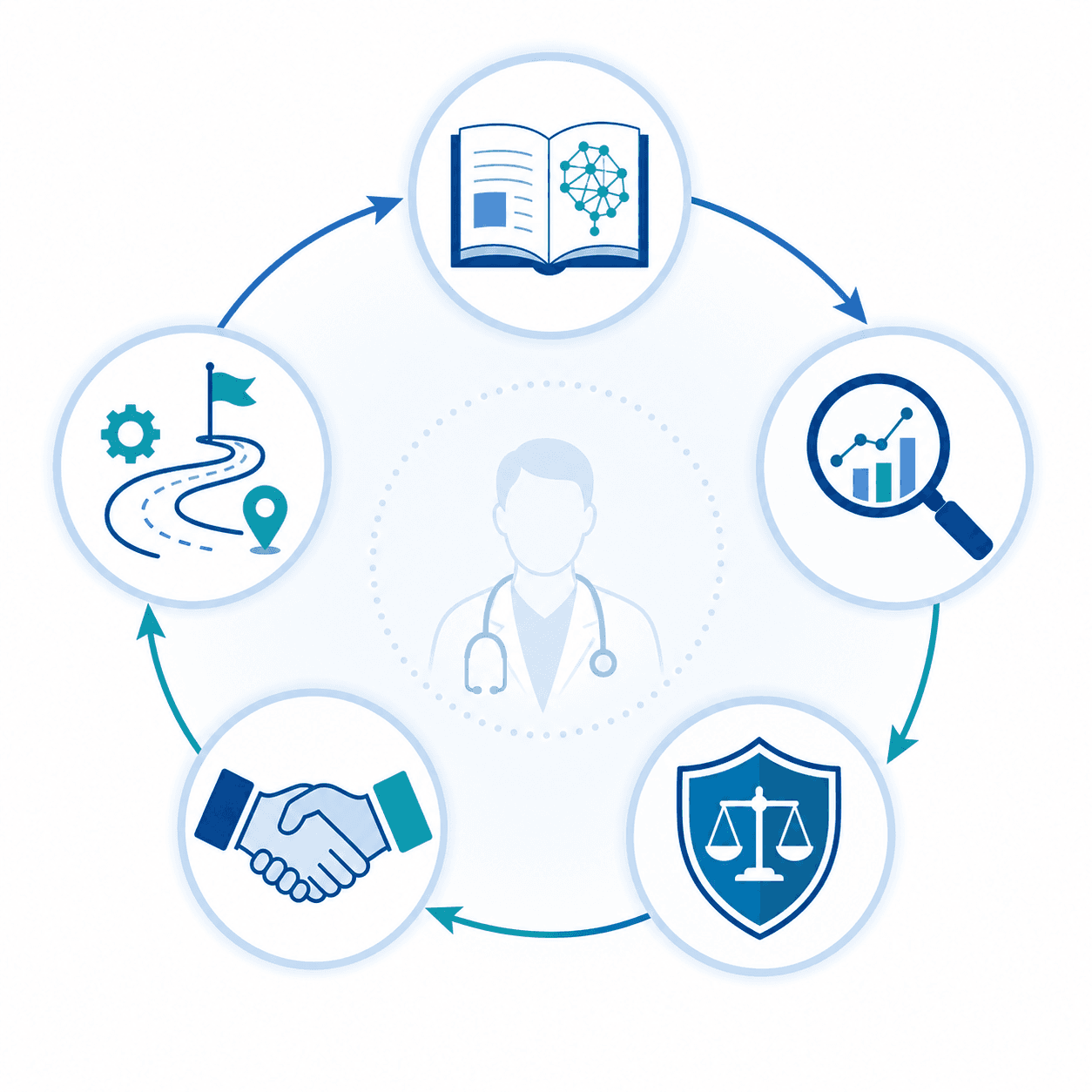
The typical no-coding curriculum covers five core areas:
- AI literacy: How machine learning, deep learning, and natural language processing work at a conceptual level — enough to understand what a model can and cannot do.
- Model evaluation: How to read and interpret performance metrics like AUC, sensitivity, specificity, positive predictive value, and F1 score. This is the clinical equivalent of understanding a diagnostic test's operating characteristics.
- Ethics and bias assessment: How to identify algorithmic bias, evaluate dataset diversity, and assess whether a model will perform equitably across the patient populations you serve.
- Procurement strategy: How to evaluate vendor claims, read FDA clearance documents, assess real-world evidence, and ask the right questions during product demonstrations.
- Implementation planning: How to plan workflow integration, manage change, train staff, and monitor model performance after deployment.
The PMC three-tier framework reinforces that for most clinicians, the basic and proficient levels are sufficient. You do not need expert-level coding skills to spot a biased dataset, question a vendor's claimed AUC, or design a pilot implementation plan. These are clinical and leadership skills, not programming skills.
How to Spot a Truly No-Coding Course vs. One That Assumes Python
Not every course that markets itself to healthcare professionals is actually accessible to non-coders. Some quietly list prerequisites that assume a technical background. Here is a practical checklist for evaluating course descriptions before you enroll.
Green Flags: Signs of a Genuinely No-Coding Course
- Explicit "no coding required" or "no programming experience necessary" language in the course description or FAQ
- Curriculum focused on evaluation, strategy, ethics, and implementation rather than algorithm development
- Case-study-based learning using real-world clinical AI examples
- Capstone projects that involve designing an implementation plan or pitching a solution — not building a model
- Target audience explicitly listed as "clinicians," "healthcare leaders," or "practitioners"
Red Flags: Courses to Avoid If You Do Not Code
- Prerequisites listed in Python, R, calculus, linear algebra, or machine learning libraries (scikit-learn, TensorFlow, PyTorch)
- Curriculum that spends significant time on model building, hyperparameter tuning, or neural network architecture
- Target audience described as "data scientists," "engineers," or "technical professionals"
- Capstone projects that require submitting working code or building a functional model
The MIT xPRO Artificial Intelligence in Healthcare program is another program to approach with caution. It requires previous knowledge of calculus, linear algebra, statistics, probability, and basic Python. While it earns participants 4.9 CEUs, it is designed for technical healthcare professionals and entrepreneurs — not for the average clinician seeking foundational AI literacy.
CME Pathways for Clinicians
For clinicians who need to maintain licensure or board certification, CME-eligible AI courses offer a way to build AI literacy while earning required credits. The following programs offer accredited pathways:
- Stanford/Coursera AI in Healthcare Specialization: ACCME-accredited through Stanford University School of Medicine
- Johns Hopkins University AI in Healthcare Certificate Program: 6 CEUs from Johns Hopkins University
- University of Illinois Urbana-Champaign Artificial Intelligence in Medicine Certificate: CME credits available
- AAFP AI in Family Medicine (3-part series): Free CME for practicing family physicians
For a deeper dive into accredited programs, including detailed information on credit hours and ACCME status, see our dedicated guide: CME-Eligible AI in Healthcare Courses: A Clinician's Guide to Accredited Programs That Fit Your Schedule.
Decision Guide: Which Course Fits Your Role and Budget?
The right course depends on your role, your budget, and how deeply you want to engage with AI. The table below maps the top no-coding programs to common clinician scenarios.
| Your Situation | Recommended Program | Why It Fits |
|---|---|---|
| Clinician on a tight budget, just exploring | Stanford/Coursera (free audit) or AAFP (free) | Zero financial risk, low time commitment, foundational content |
| Clinician who wants CME credits at low cost | UIUC ($750) or AAFP (free) | CME-eligible, designed for clinicians, affordable |
| Clinician who wants a structured cohort experience | JHU ($2,990) or Harvard Med ($3,050) | Live sessions, faculty interaction, capstone projects |
| Administrator or department chair evaluating AI procurement | MIT Sloan ($3,250) or Harvard Med ($3,050) | Strategic focus, implementation planning, vendor evaluation |
| Clinician who wants to start with generative AI basics | Medmastery ChatGPT Essentials (free) | 14 short lessons, no commitment, immediately applicable |
| Clinician considering a deeper career exploration | JHU ($2,990) or Stanford/Coursera ($49/mo) | Broad curriculum covering multiple AI applications in healthcare |
For a more detailed framework that includes additional factors like time commitment, learning style, and institutional prestige, see How to Choose the Right AI in Healthcare Course: A Structured Decision Framework.
If you are still on the fence about whether to invest in a paid program, start with a free option — the Stanford/Coursera audit track or the AAFP family medicine course — to build baseline literacy. From there, you will have a much clearer sense of which paid program aligns with your specific clinical context and career goals.
For clinicians interested in a deeper career-focused exploration of AI roles, see From Clinician to AI Specialist Without a Computer Science Background.
Comments
Join the discussion with an anonymous comment.