
 Multiple universities (Yale, University of Rochester, Florida State, Chamberlain, UAB, Louisville)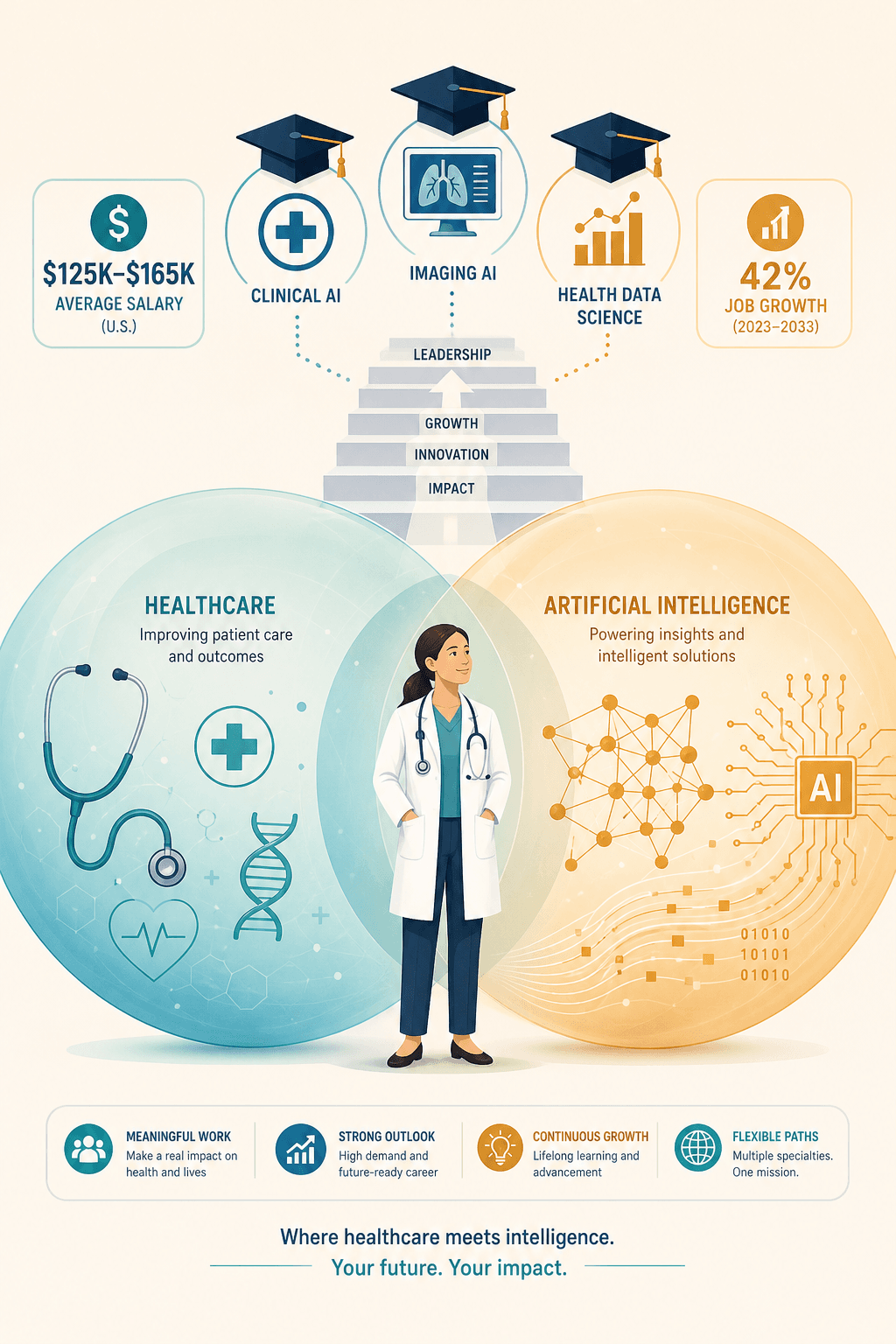
Every working clinician or healthcare administrator who searches for "AI in healthcare masters" is really asking one question: is this worth the money, the time, and the risk of stepping away from a stable career? The answer, as with most high-stakes educational investments, depends on individual circumstances — but the aggregate data provides a clearer signal than many prospective students expect.
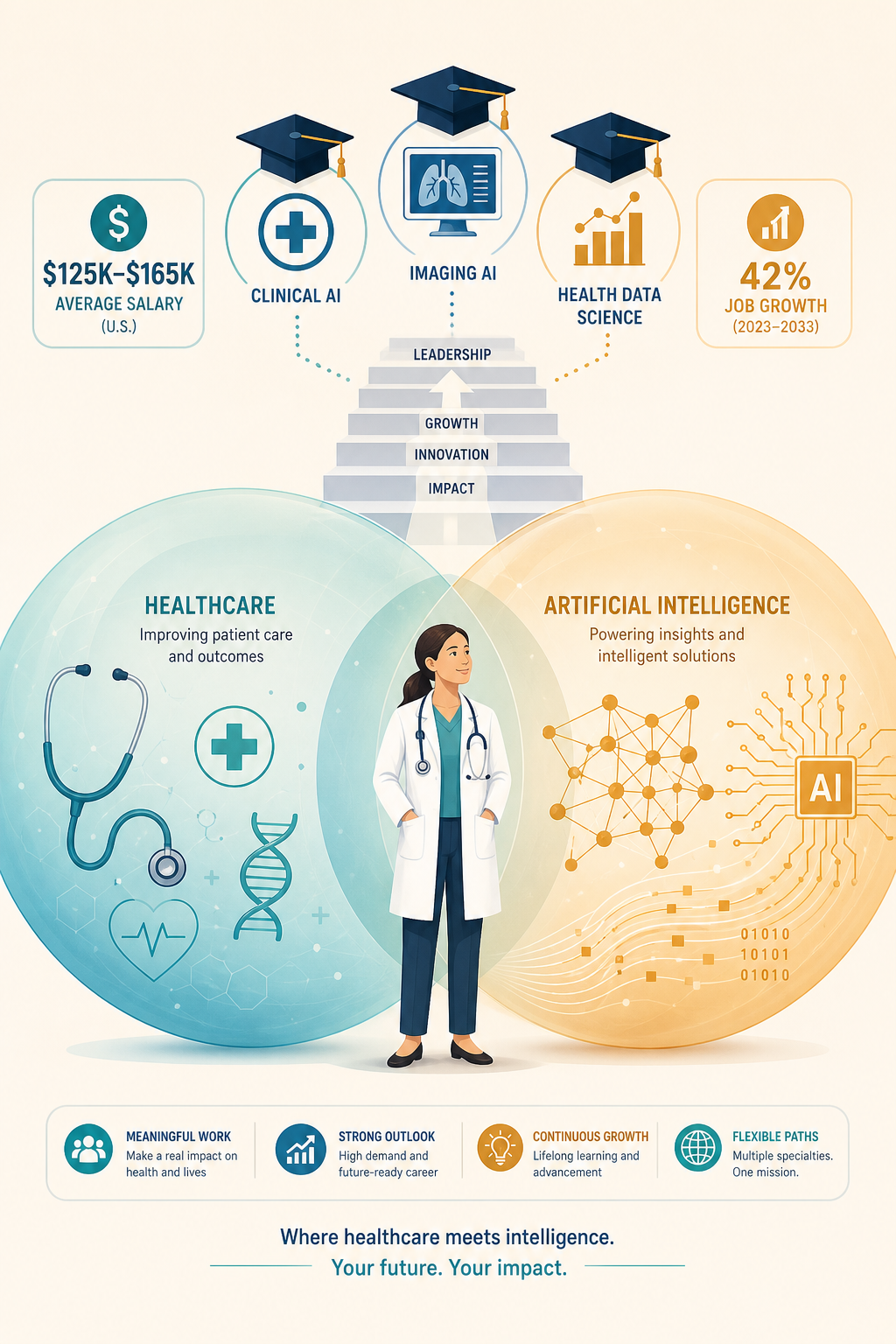
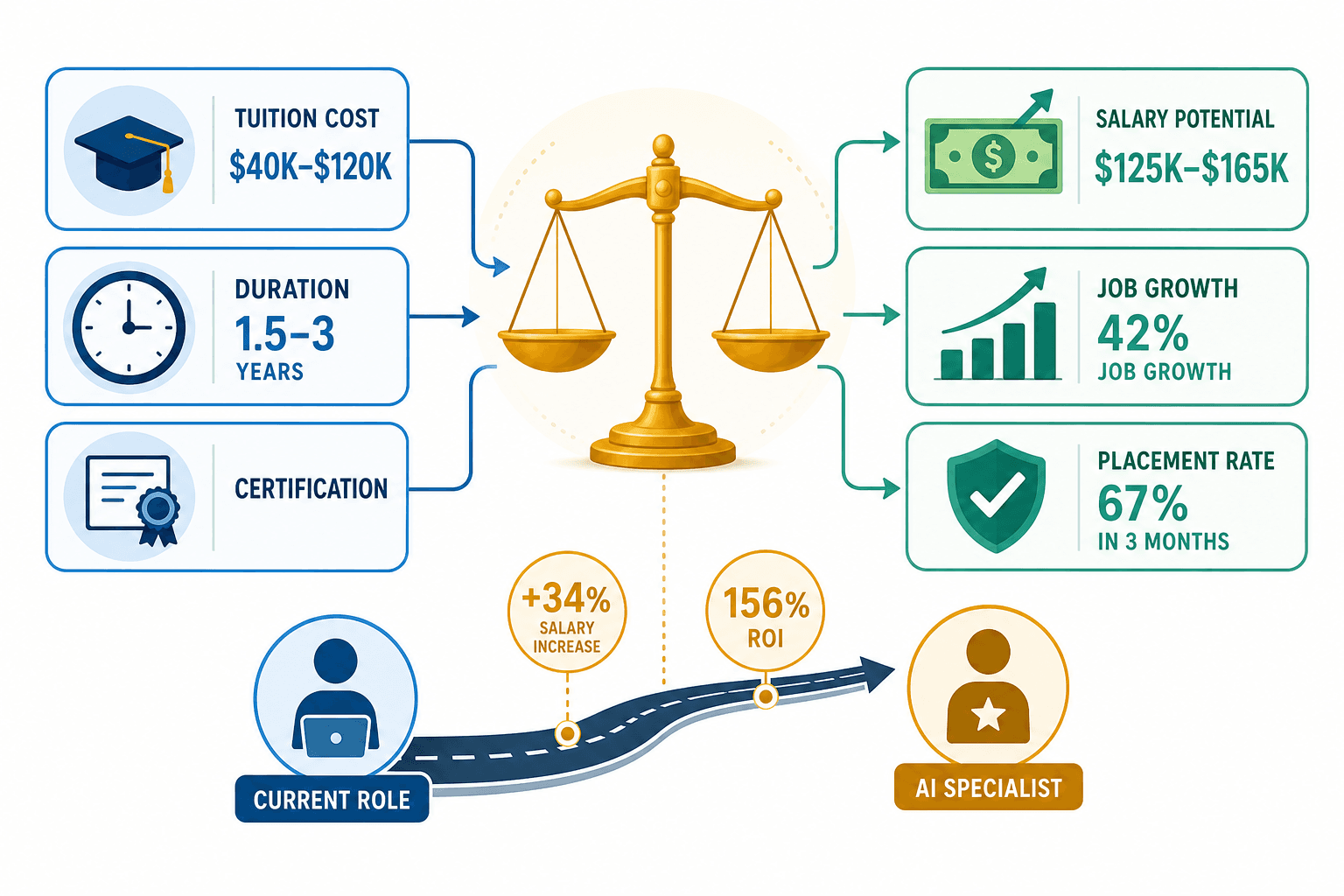
Healthcare AI specialist roles are projected to grow 42% through 2029 (Bureau of Labor Statistics), compared to roughly 5% across all occupations. Graduates of AI master's programs report a median 156% return on investment within five years (GMAC), and median salaries for degree holders range from $125,000 to $165,000. But those headline figures conceal important variation: tuition spans $40,000 to $120,000, completion rates differ sharply between online and campus-based programs, and the certification strategy a graduate pursues can swing total compensation by more than a third.
This article builds a data-driven ROI framework specifically for healthcare professionals. It does not recommend a single program or claim the degree is universally worthwhile. Instead, it lays out the salary data, tuition ranges, certification premiums, opportunity costs, and placement rates so you can run your own numbers.
The Demand Signal: Why Healthcare Organizations Are Racing to Hire AI Talent
The market context for this decision is unusually favorable. Deloitte's 2025 AI report found that 74% of organizations expect AI to grow their revenue but name workforce skills as the single biggest obstacle to adoption. In healthcare specifically, the AI market is projected to reach $67.4 billion by 2027, growing at a compound annual rate of 38.1%. That growth creates a talent vacuum: organizations need professionals who understand both clinical workflows and AI methods, and that combination remains rare.
The supply side is responding. U.S. master's programs focused on AI increased by 58% between 2022 and 2024, with 23% of new offerings specifically targeting healthcare fields (Research.com). Core curricula across 87% of accredited programs now cover machine learning, natural language processing, and predictive analytics (AAMC, 2024). The infrastructure for training is expanding, but the demand for graduates is expanding faster.
What AI Healthcare Professionals Earn: Salary Ranges by Role
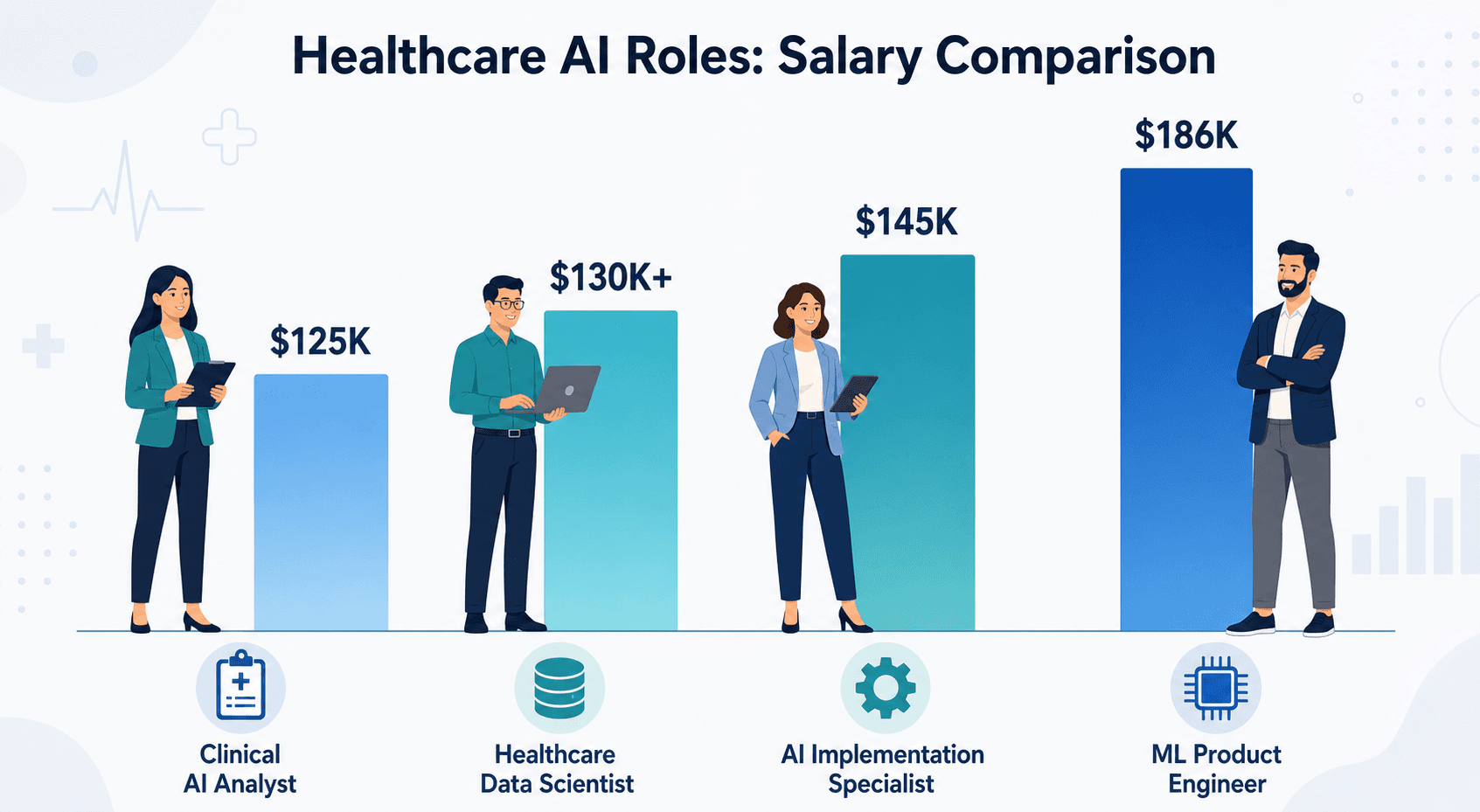
Salary expectations drive the ROI calculation more than any other variable. The table below compiles data from the Bureau of Labor Statistics, Indeed averages cited by Boston University, and Research.com's analysis of graduate outcomes. These are national U.S. figures; geographic variation is substantial and addressed later in this article.
| Role | Median Salary Range | Source / Notes |
|---|---|---|
| Clinical AI Analyst | $125,000 | Research.com; common entry point for clinicians |
| Healthcare Data Scientist | $130,000 – $140,000 | BLS; median for data scientists exceeds $100K |
| AI Implementation Specialist | $145,000 | Research.com; 19% of graduates enter this role |
| Machine Learning Product Engineer | $186,152 | Indeed average (BU Virtual, 2026) |
| AI Systems Architect | $146,776 | Indeed average (BU Virtual, 2026) |
| Digital Transformation Consultant | $125,506 | Indeed average (BU Virtual, 2026) |
The spread matters. A Clinical AI Analyst earning $125,000 represents a meaningful salary increase for many clinicians — registered nurses, for example, had a median annual wage of $86,070 in 2023 (BLS). But the ML Product Engineer figure of $186,152 is in a different tier, typically requiring deeper technical skills or prior engineering experience. The median salary band of $125,000–$165,000 for all graduates (Research.com) is a useful planning range, but individual outcomes depend heavily on role, geography, and prior background.
Tuition and Total Cost of Attendance: What Programs Actually Cost
Tuition for AI in healthcare master's programs ranges from approximately $40,000 at public universities to over $120,000 at premium private institutions (Research.com). The table below shows representative programs with verified tuition figures. Note that total cost of attendance includes fees, materials, and — for programs requiring in-person components — travel and lodging.
| Program | Institution | Tuition (Approx.) | Format | Duration |
|---|---|---|---|---|
| MHS in Medical AI | Yale School of Medicine | $51,100 | Online + 1-week in-person bootcamp per semester | 1 year full-time / 2 years part-time |
| MS in Healthcare Data Science & AI | University of Rochester | Varies by credit load (32 credits) | Online | 1 year full-time / 15 months part-time |
| MSN with AI Concentration | Florida State University | Varies (public university rates) | Online | Varies |
| Accelerated MSN (AI Specialization) | Chamberlain University | Varies | Online | As few as 8 months |
| MS in AI in Medicine | University of Alabama at Birmingham | Varies | Online or in-person | Varies |
| MS in AI in Medicine | University of Louisville | Varies | Online | Varies |
Yale's MHS in Medical AI, at $51,100 total tuition, sits near the lower end of the private-program range. The program launched its inaugural cohort in 2027 and is fully online except for a one-week in-person bootcamp each semester. Chamberlain's Accelerated MSN with AI specialization can be completed in as few as eight months online and includes 144 total practicum hours, with 48 hours specifically focused on AI technology — a structure designed for working nurses who cannot pause their careers.
The format choice has a measurable impact on completion and employment. Online and hybrid learners achieve an 89% completion rate compared to 76% for campus-based programs (Gallup Education & Skills Survey, 2024). More critically for ROI calculations, online students maintain employment 94% of the time during study — meaning the opportunity cost of lost wages is substantially lower than for full-time, campus-based programs.
The Certification Multiplier: 34% Higher Salaries for Degree + Certification Holders
One of the most actionable findings for prospective students is the certification premium. According to Burning Glass Technologies Labor Insights, healthcare professionals who hold both an AI master's degree and industry certifications earn approximately 34% higher salaries than those with the degree alone. This is not a small edge — it can mean the difference between a $125,000 salary and a $167,500 salary.
The mechanism is straightforward: certifications signal specific, verifiable competencies to employers who are wary of hiring candidates with theoretical knowledge but no demonstrated practical skills. Relevant certifications for AI in healthcare include the Certified Artificial Intelligence Practitioner (CAIP), the AWS Certified Machine Learning – Specialty, and the Google Professional Machine Learning Engineer credential. Some master's programs now embed certification preparation into their curricula, which effectively bundles the certification premium into the degree cost.
Time to Completion and Opportunity Cost: What You Give Up While Studying
The time investment for an AI master's degree ranges from approximately 8 months (accelerated programs like Chamberlain's MSN) to 3 years (part-time enrollment in a standard program). The table below compares representative program durations and their implications for opportunity cost.
| Program | Duration | Format | Opportunity Cost Profile |
|---|---|---|---|
| Chamberlain Accelerated MSN (AI) | As few as 8 months | Online | Low — designed for working nurses; 48 AI practicum hours |
| U of Rochester MS in Healthcare Data Science & AI | 1 year full-time / 15 months part-time | Online | Low to moderate — online format supports continued employment |
| Yale MHS in Medical AI | 1 year full-time / 2 years part-time | Online + 1-week bootcamp | Low to moderate — online format; bootcamp requires short travel |
| FSU MSN with AI Concentration | Varies | Online | Low — designed for working nurses |
| Traditional campus-based MS | 1.5–2 years full-time | In-person | High — typically requires leaving clinical employment |
The 94% employment-maintenance rate for online students (Gallup, 2024) is the single most important factor for clinicians who cannot afford to stop working. A full-time campus program, by contrast, typically requires leaving clinical practice for 18–24 months, which means not only tuition costs but also forgone salary — potentially $150,000 or more in lost income for a mid-career professional.
For readers concerned about whether they meet technical prerequisites, note that 73% of healthcare professionals pursuing AI master's degrees start without a computer science background (Coursera & LinkedIn Learning Skills Report, 2024). Our companion article From Clinician to AI Specialist: How Healthcare Professionals Can Pivot Into AI Without a Computer Science Background covers the transition pathway in detail.
Job Placement: 67% Employed Within 3 Months of Graduation
The LinkedIn Career Outcomes Report (2024) found that 67% of AI master's graduates find employment within three months of graduation. The distribution of roles among those graduates provides a realistic picture of where degree holders actually land:
- Clinical AI Analyst — 28% of graduates
- Healthcare Data Scientist — 24% of graduates
- AI Implementation Specialist — 19% of graduates
- Other roles (ML engineer, product manager, consultant) — 29% of graduates
Placement success is not uniform across programs. Northeastern University's analysis of AI graduate outcomes emphasizes that programs with hands-on projects, capstone experiences, and industry partnerships deliver stronger ROI. A program that includes a practicum — like Chamberlain's 48 AI-specific practicum hours or the University of Rochester's Healthcare Data Science Practicum — gives graduates concrete portfolio pieces that employers can evaluate directly.
How to Calculate Your Personal ROI: A Step-by-Step Framework
The following framework lets you estimate your own ROI using the data presented above. The calculation is deliberately simplified — it does not account for geographic cost-of-living differences, salary growth trajectories beyond five years, or non-financial benefits like career satisfaction — but it provides a defensible starting point.
- Determine your current annual salary (including benefits). For a registered nurse, this might be $86,000. For a healthcare administrator, $95,000. For a physician, $250,000 — though physicians typically pursue different credentialing pathways.
- Estimate your post-degree salary using the role you are targeting. Use the table in Section 1: Clinical AI Analyst ($125,000), Healthcare Data Scientist ($130,000–$140,000), or ML Product Engineer ($186,000). Be conservative — assume the lower end of the range.
- Calculate the annual salary delta: post-degree salary minus current salary. For a nurse moving to Clinical AI Analyst: $125,000 – $86,000 = $39,000 per year.
- Add the certification premium if you plan to earn industry certifications. Multiply your post-degree salary by 1.34 if you intend to hold both a degree and certification. For the nurse example: $125,000 × 1.34 = $167,500, for a delta of $81,500.
- Total your investment: tuition ($40,000–$120,000) plus opportunity cost (forgone salary during study, if any). For an online program where you maintain employment, opportunity cost is near zero. For a full-time campus program, multiply your current salary by the program duration in years.
- Calculate payback period: total investment divided by annual salary delta. For the nurse example with a $50,000 tuition and $39,000 delta: $50,000 ÷ $39,000 = 1.28 years. With the certification premium: $50,000 ÷ $81,500 = 0.61 years.
- Estimate five-year ROI: (5 × annual delta – total investment) ÷ total investment. For the nurse example without certification: (5 × $39,000 – $50,000) ÷ $50,000 = 290%. With certification: (5 × $81,500 – $50,000) ÷ $50,000 = 715%.
Risks and Caveats: When the ROI Math Doesn't Work
The data in this article supports a strong median ROI, but several factors can undermine the calculation for individual professionals. These risks deserve explicit attention before any enrollment decision.
- Geographic variation in salaries. The BLS and Indeed figures are national averages. A Clinical AI Analyst in San Francisco or Boston will earn more than one in a rural health system, but the cost of living is also higher. Conversely, remote roles may compress geographic premiums. Research salary data for your specific metro area before projecting income.
- Market saturation risk. The 58% growth in AI master's programs means more graduates entering the market each year. While demand is also growing rapidly, the supply of credentialed candidates is not static. Early movers in the current cycle have an advantage; late entrants may face more competition.
- Program quality variation. Not all AI master's programs deliver equal outcomes. Programs without hands-on projects, industry partnerships, or practicum components produce graduates who are less competitive in the job market. The 67% three-month placement rate is an average; top-tier programs likely exceed it, while weaker programs likely fall below.
- Accreditation and recognition. Some programs are housed in schools of engineering, others in schools of medicine or nursing. Employer recognition of the degree varies by industry segment. A degree from a well-known medical school may carry more weight in clinical settings, while a degree from a computer science department may be preferred by health tech companies.
- Personal circumstances. The 94% employment-maintenance rate for online students assumes a stable job and manageable workload during study. Clinicians in high-stress roles or those with significant family obligations may find the dual demands unsustainable, increasing the risk of non-completion.
Conclusion: A Decision Framework for Your AI Master's Investment
The data supports a clear conclusion for many healthcare professionals: an AI master's degree can deliver a strong financial return, with median five-year ROI of 156%, median salaries of $125,000–$165,000, and a 34% certification premium for those who also earn industry credentials. The 42% projected job growth through 2029 (BLS) and the 74% of organizations citing workforce skills as their biggest AI obstacle (Deloitte 2025) suggest that demand for qualified professionals will remain robust for the foreseeable future.
But the decision is not universal. The ROI calculation depends on your current salary, your target role, the program format you choose, your geographic market, and whether you pursue certifications. A nurse earning $86,000 who completes an online program for $50,000 and moves into a Clinical AI Analyst role has a dramatically different payback period than a physician earning $250,000 who would need to leave practice for two years to attend a campus-based program.
The most important takeaway: the data is favorable, but the decision is personal. Use the framework in Section 6 to run your own numbers. If the payback period is under two years and the program format fits your life circumstances, the investment is likely sound. If the numbers are tight or the opportunity cost is high, consider the staged, non-degree pathway outlined in our From Hype to Competency: A Staged Pathway for Healthcare Professionals to Build Real AI Skills article, or explore the broader decision framework in How to Choose the Right Healthcare AI Course.
Comments
Join the discussion with an anonymous comment.