
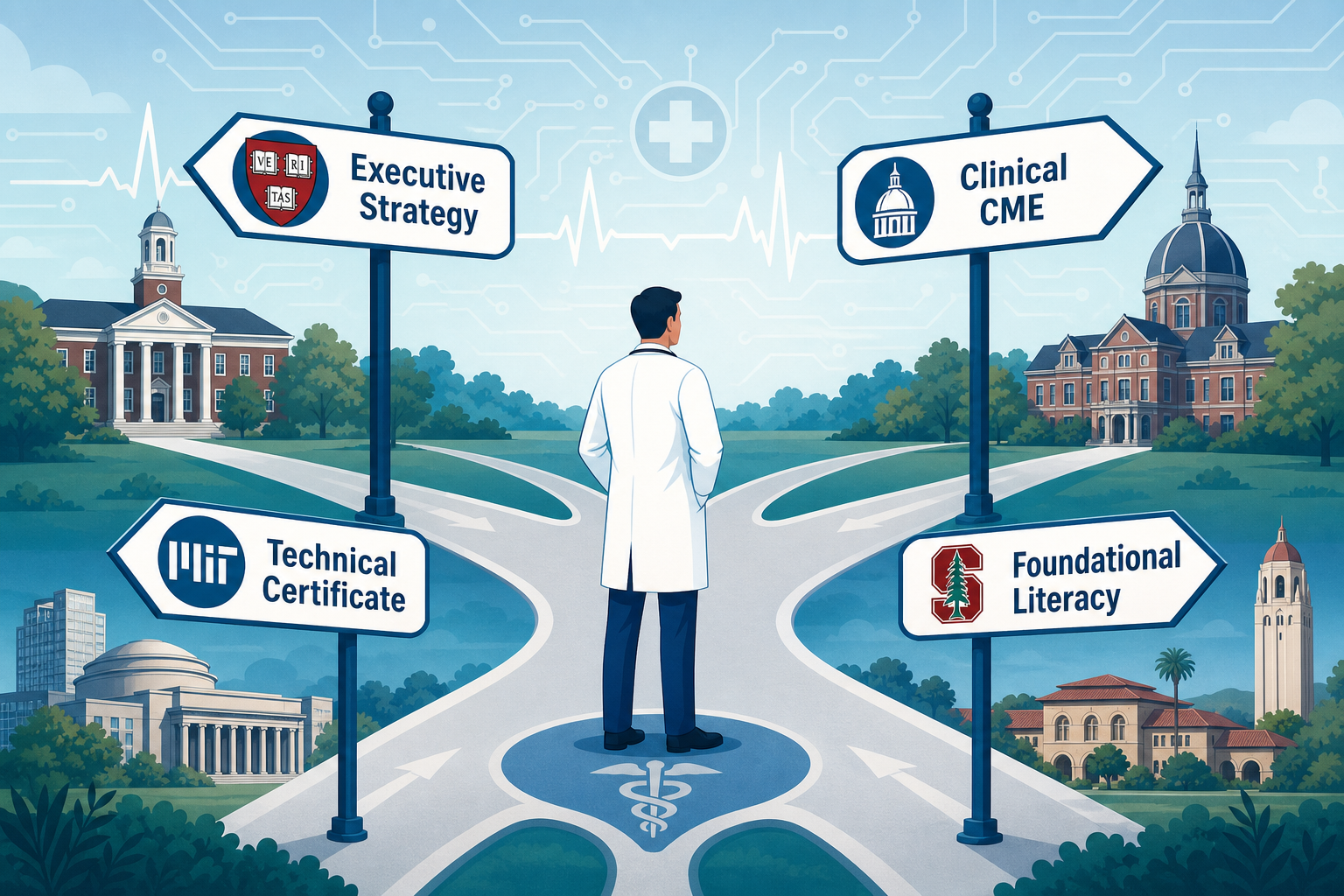
 Multiple (Stanford, JHU, MIT Sloan, Harvard Chan, ACPM, Harvard Medical School, University of Illinois, Medmastery, AAFP, Massachusetts Medical Society, Mayo Clinic)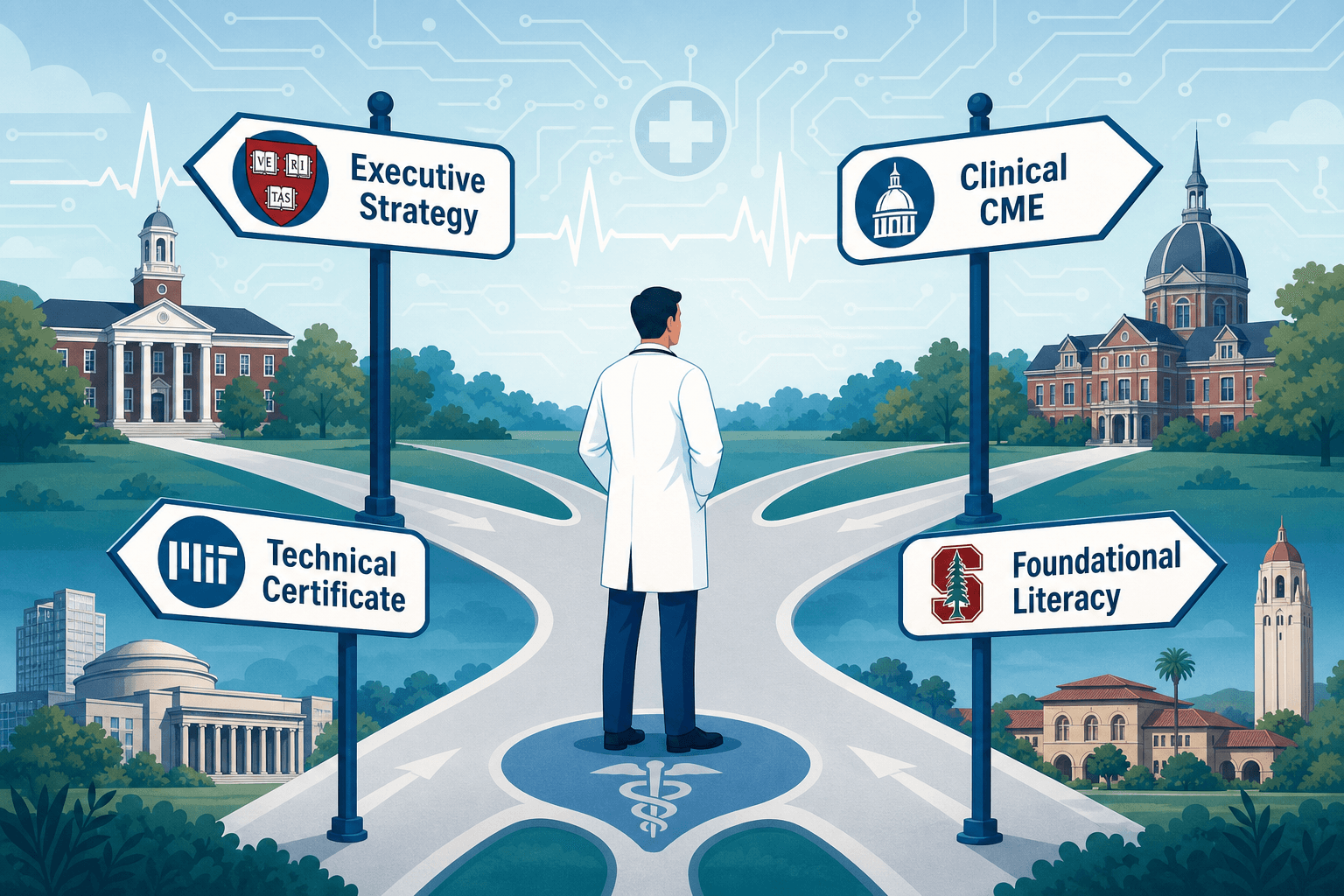
The Proliferation of Healthcare AI Courses: Why Choice Requires a Framework, Not a List
In 2026, a healthcare professional searching for AI training faces a bewildering landscape. Stanford offers a five-course specialization on Coursera that has enrolled over 79,000 learners. Johns Hopkins University runs a 10-week live online certificate. MIT Sloan delivers a six-week executive program. Harvard Chan School provides a flexible multi-course certificate. The American College of Preventive Medicine (ACPM) offers a 10-module certification with 11.5 CME credits. Free options exist from Medmastery and the American Academy of Family Physicians (AAFP). The list goes on.
This abundance creates a paradox of choice. A clinician needing CME credits and practical workflow knowledge has different requirements than a health IT director building an AI deployment team, who in turn has different needs than a hospital executive crafting an AI governance strategy. Ranking programs by prestige or cost alone ignores these fundamental differences.
This article provides a structured decision framework. Instead of a simple list of "best courses," it maps learner profiles to program attributes — cost, duration, format, CME availability, curriculum depth, and target audience — so you can select the program that aligns with your role, career goals, and constraints. For broader context on why course quality and evidence-based literacy matter, see our companion article on Healthcare AI Courses: Closing the Evidence-Based Literacy Gap.
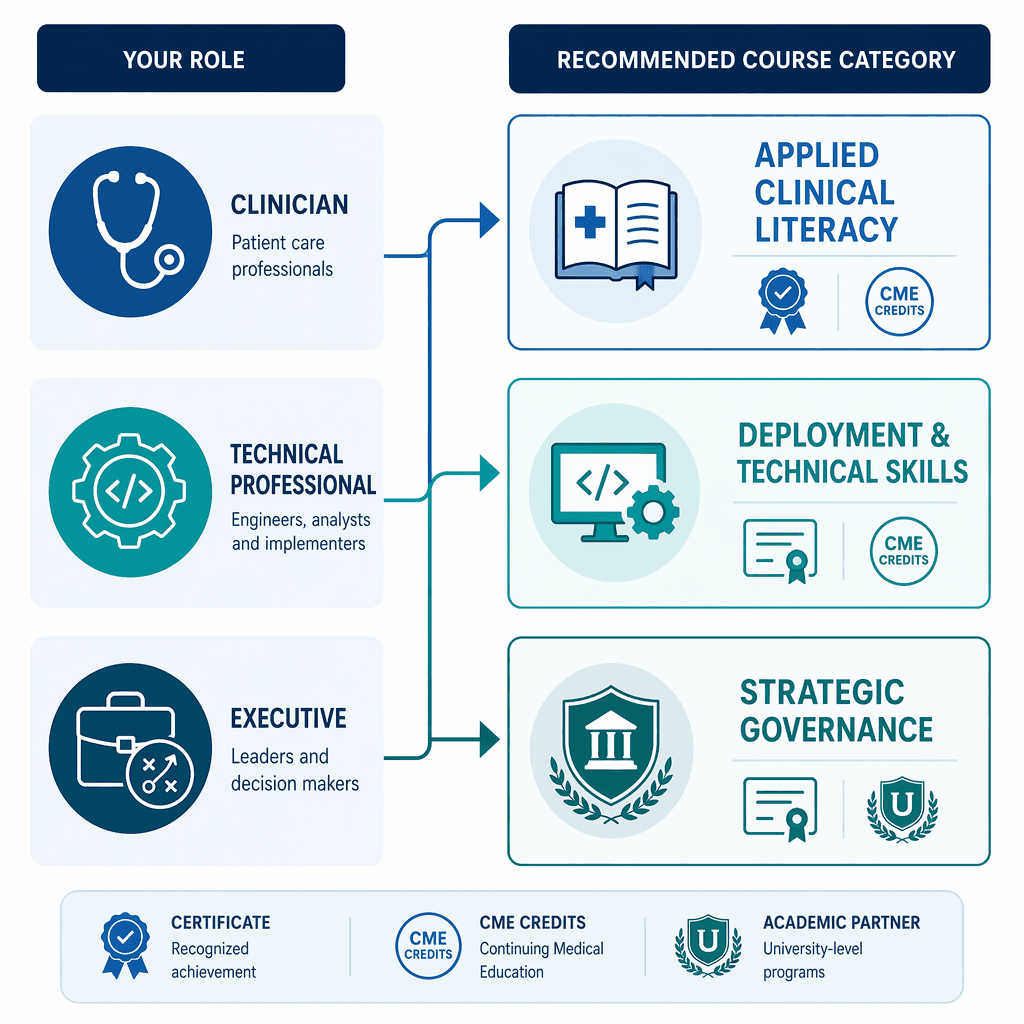
Three Audience Tiers: Who Needs What from a Healthcare AI Course
Healthcare AI courses vary widely in technical depth, pedagogical approach, and intended outcomes. The first step in choosing wisely is identifying which broad learner tier you belong to.
Tier 1: Clinicians Seeking Applied Literacy and CME
This group includes physicians, nurses, physician assistants, and allied health professionals whose primary goal is to understand what AI can and cannot do in clinical practice. They need to evaluate AI tools, communicate with technical teams, and maintain licensure through CME credits. Technical depth is secondary to clinical relevance.
- Key decision criteria: CME/CEU accreditation, clinical case studies, practical workflow integration, manageable time commitment.
- Typical budget: Free to $1,000.
- Desired outcome: Confidence to discuss AI with colleagues and patients, ability to critically appraise AI research, and maintenance of professional credentials.
Tier 2: Technical Professionals Building Deployment and Integration Skills
Health IT specialists, data scientists, clinical informaticists, and biomedical engineers fall into this tier. They need hands-on skills in machine learning pipelines, EHR integration, model validation, and regulatory compliance. A certificate from a recognized university often carries weight with employers.
- Key decision criteria: Hands-on projects, programming components (Python, R), coverage of ML algorithms and LLMs, faculty with technical credentials, CEUs or university credit.
- Typical budget: $1,000 to $3,500.
- Desired outcome: Ability to lead or contribute to AI deployment projects, interpret model performance metrics, and navigate regulatory pathways.
Tier 3: Executives and Administrators Needing Strategic Governance and Procurement Knowledge
Chief medical officers, chief information officers, hospital administrators, and policy makers need a strategic overview. They must understand AI's potential and limitations, evaluate vendor claims, set governance policies, and manage organizational change. Deep technical skills are less important than frameworks for decision-making and risk assessment.
- Key decision criteria: Strategic frameworks (e.g., R.O.A.D. management framework), case studies on implementation and failure, regulatory and ethics coverage, peer network, executive education credentials.
- Typical budget: $2,500 to $5,000+.
- Desired outcome: Ability to lead AI strategy, evaluate procurement options, and communicate AI risks and benefits to boards and clinical staff.
Comparison Table: Leading Healthcare AI Programs (2026)
The following table compares 12 prominent healthcare AI programs across the dimensions that matter most for decision-making. All data reflects publicly listed information as of June 2026.
| Institution / Program | Cost | Duration | Format | CME / CEU | Target Audience | Key Curriculum Highlights |
|---|---|---|---|---|---|---|
| Stanford AI in Healthcare (Coursera) | $79/month | ~4 weeks at 10 hrs/wk (5 courses) | Self-paced online | CME (ACCME, Stanford Medicine) | Clinicians, CS professionals | 5 courses incl. capstone; clinical data, ML fundamentals, evaluation of AI apps |
| JHU AI in Healthcare Certificate | $2,990 | 10 weeks | Online cohort with live masterclasses | 6 CEUs | Healthcare professionals, IT | R.O.A.D. framework, 6 ML algorithms, LLMs, robotic process automation, 8+ case studies |
| MIT Sloan AI in Health Care | $3,250 | 6 weeks (6-8 hrs/wk) | Self-paced online | 2.0 EEUs | Executives, leaders | NLP, disease diagnosis, patient risk stratification, hospital management optimization |
| Harvard Chan AI in Health Care Certificate | Pay per course (no set total) | 3 courses within 5 years | Self-paced online | CME eligible | Healthcare professionals, leaders | Flexible electives: Innovation, Implementation, Building AI Solutions |
| Harvard Chan Leadership Advanced Certificate | Pay per course (no set total) | 5 courses within 7 years | Self-paced online | CME eligible | Senior leaders, executives | Deeper strategic focus; builds on core certificate |
| ACPM AI in Preventive Medicine Certification | Not listed | 10 modules (self-paced) | Self-paced online | 11.5 CME credits | Physicians (preventive medicine focus) | AI/ML fundamentals, data literacy, ethics, equity, legal/regulatory (HIPAA, FDA), LLMs |
| Harvard Medical School Executive Program | Not listed | 8 weeks (4-6 hrs/wk) | Online cohort | CME eligible | Executives, clinical leaders | Capstone project, AI fundamentals, data governance, ethics, regulatory compliance |
| University of Illinois AI in Medicine | $750 | Self-paced | Online | CE credits | Clinicians, students | Foundational AI in clinical contexts |
| Medmastery ChatGPT Essentials for Clinicians | Free | 14 lessons | Self-paced online | Not specified | Clinicians | Practical LLM use in clinical workflows |
| AAFP AI in Family Medicine | Free | 3 parts | Self-paced online | CME eligible | Family physicians | AI applications in primary care |
| Massachusetts Medical Society AI Course | $40–$90 | Self-paced | Online | CME | Physicians | Introductory AI for clinical practice |
| Mayo Clinic AI in Cardiology | $675–$825 | Self-paced | Online | CME | Cardiologists | AI applications specific to cardiology |
Decision Matrix: Mapping Learner Profiles to Recommended Programs
The comparison table provides raw data. The decision matrix below translates that data into actionable recommendations based on the three audience tiers defined earlier.
| Learner Profile | Primary Goal | Top Recommendation | Alternative Options | Rationale |
|---|---|---|---|---|
| Clinician (Tier 1) | CME credits, applied literacy | ACPM AI Certification (11.5 CME) | Stanford Coursera, AAFP, Medmastery, Mass Medical Society | ACPM offers the most CME credits in a clinical-focused package; Stanford provides broader foundation at lower cost; free options (AAFP, Medmastery) suit budget-constrained learners. |
| Clinician (Tier 1) | Broad foundation, self-paced | Stanford AI in Healthcare (Coursera) | University of Illinois, Medmastery | Stanford's 5-course specialization covers clinical data, ML, and evaluation with CME accreditation; monthly subscription model is low-risk. |
| Technical Professional (Tier 2) | University credential, hands-on skills | JHU AI in Healthcare Certificate | MIT Sloan, Harvard Chan | JHU offers 6 CEUs, live masterclasses, LLM module, and 8+ case studies; ranked #1 in Biomedical Engineering by U.S. News & World Report (2026). |
| Technical Professional (Tier 2) | Deep technical ML focus | MIT Sloan AI in Health Care | JHU, Stanford Coursera | MIT Sloan's program features faculty from MIT CSAIL and covers NLP, disease diagnosis, and risk stratification; awards 2.0 EEUs. |
| Executive / Administrator (Tier 3) | Strategic governance, leadership | Harvard Chan Leadership Advanced Certificate | MIT Sloan, Harvard Medical School Executive Program | Harvard Chan's flexible 5-course certificate allows deep exploration of strategy, implementation, and innovation over 7 years. |
| Executive / Administrator (Tier 3) | Short-term strategic overview | MIT Sloan AI in Health Care | Harvard Medical School Executive Program | MIT Sloan's 6-week program is intensive and focused on decision-making frameworks; faculty include MacArthur Fellow Dina Katabi. |
These recommendations are starting points. A clinician who wants both CME and a university credential might combine the ACPM certification with the JHU certificate. An executive with a technical background might prefer the JHU program's depth over a purely strategic course. The matrix is designed to be flexible, not prescriptive.
Red Flags and Quality Indicators: How to Evaluate Any Healthcare AI Course
Not all healthcare AI courses are created equal. Some are rigorous, evidence-based, and clinically grounded. Others are superficial, vendor-funded, or already outdated. Use the following checklist to separate quality programs from weak ones.
Quality Indicators
- Accreditation: Look for ACCME (CME), CEU, or EEU accreditation. This ensures the program meets professional education standards and that your time counts toward licensure or professional development requirements.
- Faculty expertise: Instructors should have both clinical and AI credentials. For example, MIT Sloan's program features Regina Barzilay (MIT CSAIL AI Faculty Lead, Jameel Clinic) and Dina Katabi (MacArthur Fellow). JHU's program is led by Dr. Ian McCulloh (Director of AI Executive & Professional Education) and Dr. Abhinanda Sarkar (Ph.D. Stanford).
- Hands-on components: Case studies, capstone projects, and interactive exercises indicate that the program values practical application over passive learning. Stanford's specialization includes a capstone project; JHU's program features 8+ healthcare case studies and a self-paced Claude-based AI workflows module.
- Curriculum recency: The field moves fast. Programs that include modules on large language models (LLMs), generative AI, and regulatory updates (e.g., FDA guidance, EU AI Act) are more likely to be current. JHU's program explicitly covers LLMs; ACPM's includes a module on "Large Language Models & Preventive Medicine."
- Independent reviews: Look for testimonials from verified learners, not just marketing copy. Harvard Chan's program features an alumni testimonial from Dr. Anuja Joshi (CareMount Medical – Optum).
Red Flags
- No CME/CEU accreditation: If a program aimed at clinicians does not offer CME credits, question its relevance and rigor.
- Outdated content: If the curriculum does not mention LLMs, generative AI, or recent regulatory changes (e.g., FDA's predetermined change control plans), it may be behind the curve.
- Vendor-funded curricula: Programs sponsored by a single AI vendor may present biased information. Look for courses developed by academic institutions or professional societies with transparent funding.
- Lack of clinical context: A course that teaches AI in isolation from clinical workflows, patient safety, and ethical considerations is incomplete for healthcare professionals.
- Exaggerated claims: Be wary of programs promising to make you an "AI expert" in a few weeks or guaranteeing career outcomes without evidence.
Step-by-Step Selection Guide: From Self-Assessment to Enrollment
Use the following seven-step process to move from confusion to a confident enrollment decision.
- Identify your role and primary goal. Are you a clinician needing CME? A technical professional building deployment skills? An executive crafting strategy? Be honest about your current position and where you want to go.
- Determine your budget and time commitment. Programs range from free (Medmastery, AAFP) to $3,250 (MIT Sloan). Time commitments vary from 14 short lessons to 10-week intensive programs. Be realistic about what you can afford and how many hours per week you can dedicate.
- Check CME/CEU requirements. If you need credits for licensure or professional development, filter for programs that offer accredited CME or CEUs. ACPM's 11.5 CME credits and JHU's 6 CEUs are strong options for clinicians and technical professionals respectively.
- Evaluate curriculum against your technical comfort level. If you are new to AI, look for programs that start with fundamentals (Stanford Coursera, ACPM). If you have a technical background, seek programs with hands-on ML components (JHU, MIT Sloan).
- Verify faculty and accreditation. Check that instructors have relevant clinical and AI expertise. Confirm accreditation through the issuing body's website (e.g., ACCME database for CME).
- Read independent reviews. Look for testimonials from learners with similar backgrounds. Check platforms like Coursera reviews, professional forums, or trusted third-party sites like LITFL or Keragon for candid assessments.
- Choose a program and commit. Analysis paralysis is common. Once you have identified a program that meets your criteria, enroll and set a schedule. The best course is the one you actually complete.
Conclusion: Making an Informed Choice in a Crowded Market
The right healthcare AI course is not the most prestigious, the cheapest, or the one your colleague took. It is the one that aligns with your professional role, career goals, budget, and time constraints. A clinician seeking CME credits will find value in ACPM's focused certification. A technical professional building deployment skills will benefit from JHU's hands-on certificate. An executive crafting AI strategy will gain more from MIT Sloan's or Harvard Chan's strategic programs.
Use the decision matrix and red-flag checklist in this article as your starting point. Start with step one of the selection guide: identify your role and primary goal. From there, the path becomes clearer. The goal is not to find the perfect course — it is to find the right course for you, and then commit to learning.
Comments
Join the discussion with an anonymous comment.