
AI in medicine and healthcare is already past the stage where adoption alone tells us much. By 2026, more than 1,200 AI/ML-enabled medical devices have been cleared by the FDA, 81% of physicians in an AMA survey reported using some form of health AI, and the healthcare AI market is measured in the tens of billions of dollars.[1] Those numbers establish scale. They do not establish clinical maturity.
The more useful distinction is narrower. AI performs best when the task is bounded, the handoff is visible, and a clinician remains responsible for interpretation. Deterioration prediction, sepsis early warning, ambient documentation, and screening augmentation now have real-world evidence worth taking seriously. Open-ended diagnostic reasoning, broad generative AI advice, and tools evaluated mainly on exam-style questions remain in a different evidentiary category.
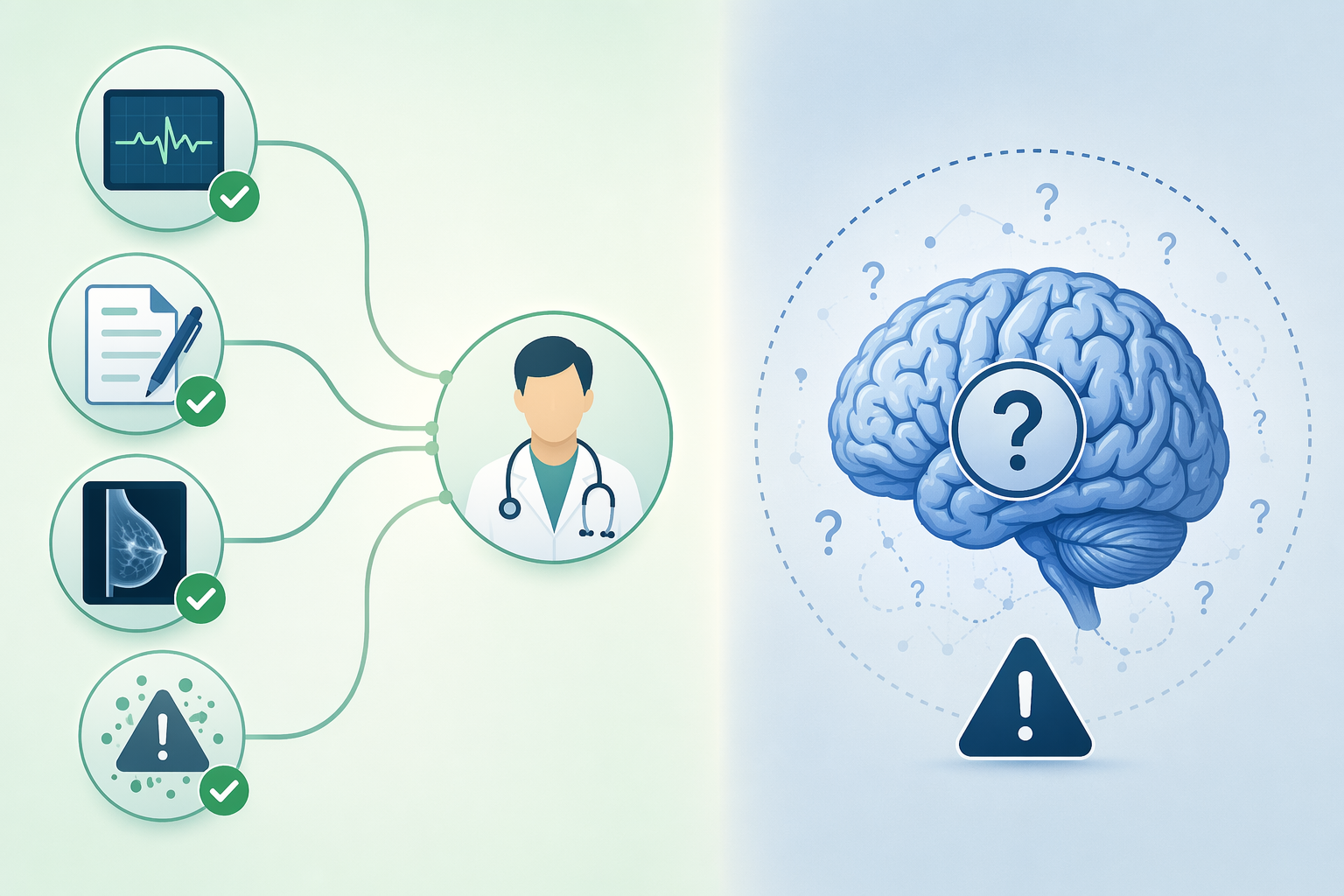
A Practical Evidence Map for 2026
| Application area | What the evidence supports | What still needs caution |
|---|---|---|
| Deterioration prediction and sepsis early warning | Signals can identify risk before conventional alerts, and AI-assisted sepsis programs are associated with mortality reductions across studies.[1][2] | Benefit depends on alert design, escalation workflow, and whether teams can act before deterioration becomes clinically obvious. |
| Ambient documentation | Multiple health systems report large reductions in note-writing time; the UCLA randomized trial showed a smaller but credible reduction across a large clinical sample.[1][3] | A clean note is not the same as a correct note. Review burden and error correction remain part of the work. |
| Screening augmentation | Large-scale breast screening evidence shows improved detection when AI assists standard reading rather than replacing it.[3] | Performance in one screening program should not be generalized to every imaging modality, population, or deployment design. |
| Medical image analysis more broadly | Many tools are clinically useful in defined imaging tasks, and regulatory clearance is common.[1] | Clearance is not proof of outcome benefit; only a small share of cleared devices with clinical studies have randomized trial support.[1] |
| Open-ended diagnostic reasoning and general LLM advice | Useful as constrained support in selected settings, especially when a clinician checks the output. | Models can fail when framing shifts, ambiguity increases, or users accept recommendations too readily.[2] |
This map is deliberately uneven. It gives more room to tools that have been asked to survive clinical workflow, not just answer questions impressively. A model score may be interesting; a ward nurse receiving another interruptive alert at 3 a.m. needs a higher standard.
The Strongest Pattern: Narrow Tools With a Real Job
The most convincing clinical AI evidence in 2026 comes from tools that do not try to be a doctor. They watch for a defined signal, draft a defined artifact, or add a second read to a defined screening process. That limitation is not a weakness. It is often the reason the tool can be evaluated, governed, and improved.
In patient deterioration, the practical value is time. AI systems described in the Stanford-Harvard ARISE summary identified clinical decline 8 to 24 hours before standard hospital alerts.[2] That does not mean every alert saves a life, and it does not make the model a substitute for bedside assessment. It means the model may create a usable window in which a team can review vitals, labs, medications, trajectory, and goals of care before the patient crosses a conventional threshold.
Sepsis is the same kind of problem: high stakes, time-sensitive, messy enough to punish crude automation, but structured enough that early warning can matter. The 2026 AI Index reports AI-assisted sepsis mortality reductions of 17% to 27% across studies.[1] The responsible reading is not that every sepsis alert system should be bought. It is that early warning has moved beyond novelty when it is tied to a response pathway that clinicians trust and can act on.
The operational details are not cosmetic. If the alert fires into an inbox no one owns, the patient receives no benefit. If it pages a clinician for every marginal risk fluctuation, it becomes another piece of alarm debt. If it appears alongside the relevant trend, the reason for concern, and a clear escalation expectation, it has a chance to change behavior. Readers looking for a more implementation-focused approach can compare these questions with a structured clinical AI evaluation framework.

Ambient Documentation Is Useful, but the Size of the Benefit Depends on the Study
Ambient AI scribes are one of the few generative AI applications where the task is constrained enough to evaluate in daily practice. The system listens to a clinical encounter and drafts documentation; the clinician reviews, edits, and signs. It is not diagnosing. It is not deciding treatment. It is attempting to reduce the clerical residue of care.
The headline evidence can look dramatic. Across multiple health systems, ambient AI scribes have been reported to reduce physician note-writing time by up to 83%, with absolute reductions in burnout prevalence of 21 to 31 percentage points.[1][3] Those figures help explain why documentation AI has spread quickly. They also deserve to be read next to less spectacular trial data.
In a UCLA Health randomized trial involving 238 physicians and 72,000 encounters, ambient documentation produced a nearly 10% reduction in documentation time, with fewer than 10% of patients declining use.[1][3] That result is smaller than the largest pooled estimates, and it is more useful because of that. It shows a real but modest gain in a large clinical environment rather than a perfect pilot-world outcome.
For a health system, the difference between an 83% reduction and a 10% reduction is not a rounding error. It changes the business case, the staffing assumptions, and the expectations placed on clinicians. A documentation tool that saves six minutes per clinic session is still worth considering if it improves after-hours work or reduces cognitive load. It simply should not be sold internally as if every specialty, visit type, and physician will experience the best reported outcome.
The safety question is equally concrete. Who checks medication names, negated symptoms, follow-up instructions, and copied context? Who is accountable when a fluent note contains a subtle error? A scribe that gives time back to clinicians is valuable. A scribe that shifts proofreading and medicolegal risk into invisible after-work time has not solved the documentation problem; it has rearranged it. The evidence base for scribes is strong enough to justify serious adoption discussions, but only with audit processes and specialty-specific review expectations. A deeper discussion of this evidence is available in the 2026 evidence on AI scribes and burnout.
Screening AI Works Best as Augmentation, Not Displacement
Screening is another area where the task is bounded enough for AI to help. The point is not that the model has general clinical judgment. The point is that, in a repetitive visual task with a defined target, AI can flag patterns a human reader might miss or help prioritize attention.
Germany’s PRAIM breast screening study is a useful example because of its scale. In 463,094 participants, AI-assisted screening achieved a breast cancer detection rate of 6.7 per 1,000, which was 17.6% higher than standard double reading.[3] That is not a laboratory benchmark. It is a result from a screening workflow, which is why it deserves more weight than a model leaderboard.
Even here, the conclusion should stay within the evidence. PRAIM supports AI-assisted breast screening in that context; it does not prove that every imaging AI tool improves outcomes, reduces workload, or generalizes across populations. Imaging AI has matured faster than many other clinical AI categories, but the study quality still varies. The distinction matters because regulatory clearance and clinical benefit are not the same thing. The AI Index notes that only 2.4% of FDA-cleared AI devices with clinical studies were supported by randomized trial data.[1]
That low randomized-trial share should not be misused as an argument against all imaging AI. Some imaging applications may be better evaluated through reader studies, prospective workflow studies, or post-deployment monitoring, depending on the clinical question. It should, however, stop anyone from treating the clearance count as a quality measure. For readers focused specifically on radiology and imaging evidence, see AI in medical image analysis in 2026 and a separate critical appraisal of the medical image AI evidence base.
Why Broad Diagnostic Reasoning Still Breaks Down
Diagnostic reasoning is not one task. It includes hypothesis generation, uncertainty management, test selection, pattern recognition, patient-specific context, and the discipline to change course when the story no longer fits. That is why open-ended diagnostic AI should not be judged by the same yardstick as a sepsis early warning tool or a mammography reader.
The weakness is most visible when the clinical frame shifts. The ARISE summary reports that large language model accuracy drops sharply when clinical framing changes and that models tend to commit to answers under ambiguity. On reasoning-under-uncertainty tests, performance was closer to medical students than experienced physicians.[2] That is a serious limitation for real care, where the problem is often not recognizing a textbook disease but deciding how much confidence the available information deserves.
This does not make diagnostic AI useless. A constrained system may help generate a differential diagnosis, retrieve overlooked possibilities, summarize prior records, or prompt a clinician to ask a missing question. The danger begins when a fluent answer is treated as a conclusion rather than a candidate for review. In that setting, the model’s confidence can become contagious.
The evidence gap is not subtle. A review of more than 500 medical AI studies found that nearly half tested models on exam-style questions, while only 5% used real patient data.[2] Exam questions have clean stems, implied relevance, and hidden guarantees that the correct answer is among the choices or can be inferred from the question stem. Patients do not arrive that way. They arrive with incomplete histories, contradictory signals, social constraints, prior treatment, missing records, and competing explanations.
That review explains why some impressive claims should be kept at arm’s length. A model that answers licensing-style questions may demonstrate medical knowledge. It has not demonstrated that it can improve diagnostic accuracy, reduce harm, or change clinician behavior in a real clinic. The same caution applies to conversational systems marketed ahead of evidence; the gap between market maturity and clinical maturity is examined more closely in the evidence and regulatory landscape for conversational AI in healthcare.
Generative AI Needs Guardrails That Match the Clinical Task
Generative AI is not one clinical intervention. An ambient scribe, a patient-message draft, a discharge-instruction assistant, a prior-authorization letter generator, and a diagnostic chatbot all generate language, but they do not carry the same risk. The more the system moves from drafting toward reasoning, recommending, or reassuring, the more its evaluation must shift from productivity metrics to patient-safety metrics.
A constrained generative tool can be useful when the source material is visible, the output is reviewable, and the clinician has time and responsibility to correct it. A discharge summary assistant that drafts from the chart is a different object from a chatbot that tells a patient whether chest pain can wait. The first can be audited against source documents. The second may alter care-seeking behavior before a clinician ever sees the patient.
The right implementation question is therefore not whether the underlying model is impressive. It is whether the clinical task has a safe failure mode. If the tool is wrong, does a clinician catch it before harm? Does the interface show why the output was produced? Does the workflow make review easier than blind acceptance? Does the system degrade gracefully when the chart is incomplete or the patient’s presentation is ambiguous?
The Teammate Model Is More Persuasive Than the Replacement Model
The strongest pattern across clinical AI is not machine superiority. It is supervised collaboration. The AI Index reports that AI-assisted physicians make better treatment decisions than either AI or physicians alone, and it describes Microsoft’s experimental multi-agent AI system scoring 85.5% on complex case studies compared with 20% for unaided physicians.[1] The second result is striking, but it remains experimental; the first pattern is more important for deployment.
A teammate model keeps the clinician in the loop in a meaningful way. The clinician can see the output, compare it with the patient in front of them, reject it, escalate it, or document why it does not apply. That is not a ceremonial human-in-the-loop checkbox. It is the mechanism by which the tool’s strengths and weaknesses are managed.
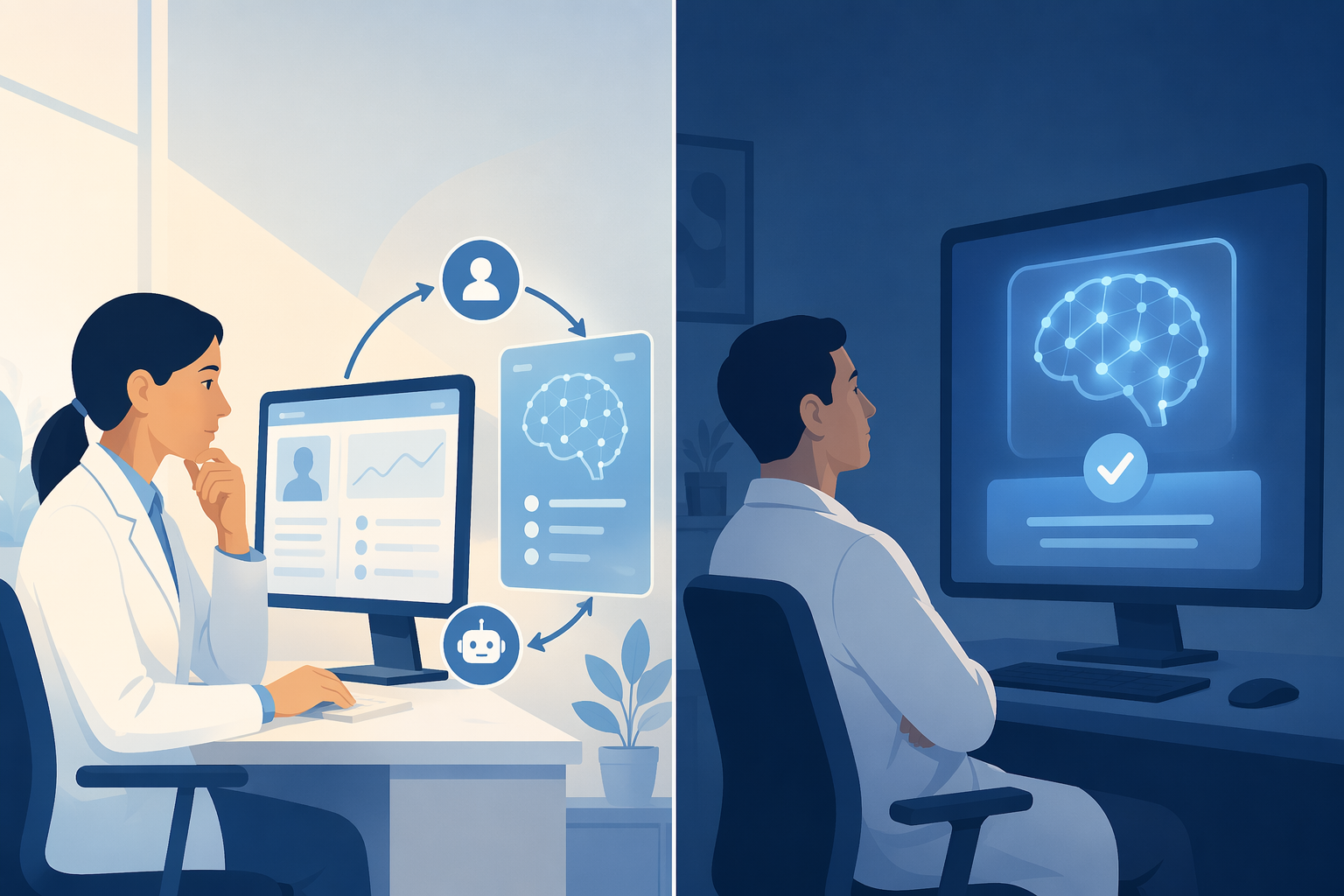
Over-reliance is the predictable failure mode. The ARISE summary notes studies in which clinicians followed incorrect AI recommendations even when errors were detectable.[2] That is not a reason to ban AI from clinical settings. It is a reason to treat interface design, alert framing, training, and audit as safety controls rather than implementation details.
A poorly designed system can make a clinician less careful. A better-designed one can make the next right action easier: review this trend, call this patient, double-check this imaging finding, reconcile this medication, ask this missing question. The difference is not philosophical. It changes who notices the error and when.
What Health Systems Should Require Before Deployment
By mid-2026, a responsible health system does not need to ask whether AI belongs anywhere in care. It already does. The harder question is which task has earned deployment in this workflow, for this patient population, under this supervision model.
- Define the clinical action first: an alert, draft, triage suggestion, second read, or risk estimate should map to a real decision someone is authorized to make.
- Use evidence that matches the intended use: randomized trials, prospective workflow studies, multi-site deployments, and real patient data carry more weight than exam benchmarks.
- Measure clinician behavior, not only model performance: review rates, override rates, time saved, escalation timeliness, missed deterioration, documentation corrections, and downstream testing matter.
- Plan for post-launch monitoring: performance can change when patient mix, staffing, documentation habits, or care pathways change.
- Make accountability explicit: the tool may assist, but someone must own review, escalation, correction, and patient communication.
These requirements are stricter than a procurement demo and less dramatic than a ban. They fit the evidence. Deterioration alerts, sepsis tools, documentation assistants, and screening augmentation can justify deployment when the local workflow supports them. General diagnostic reasoning systems and unconstrained generative tools need narrower use cases, tighter supervision, and better real-world validation before they are treated as routine clinical infrastructure.
The adoption judgment in 2026 is therefore selective rather than skeptical. Use AI where it has a defined job, measurable benefit, and a clinician who can challenge it. Be much slower where the system is asked to reason broadly under uncertainty and the evidence still comes mostly from artificial cases.
References
- Stanford HAI 2026 AI Index Report — Medicine, Stanford HAI.
- Clinical AI has boomed. So has the need for better evidence., Stanford Medicine, January 2026.
- 100+ AI Healthcare Statistics, Dialog Health.
Comments
Join the discussion with an anonymous comment.