
By mid-July 2026, the U.S. Cyclospora outbreak had already outgrown the normal seasonal frame. CDC case counts and CIDRAP analysis described 1,645 confirmed cases and more than 5,100 additional illnesses under investigation by July 13, a case burden 6.6 times higher than the 249 cases reported by the same point in 2025.[1] Yet the public federal alarm arrived late in the operational sense that matters for foodborne disease: cases had been documented since May 1, while CDC issued its Health Alert Network advisory on July 14.[2]

That six-week interval is not a cosmetic problem. Cyclospora is already a difficult pathogen for surveillance: symptoms may begin after a long incubation period, patients are asked to reconstruct meals after memories have blurred, and the parasite does not fit neatly into the culture-based laboratory infrastructure used for many bacterial outbreaks. A late advisory means local health departments, clinicians, and patients are trying to solve a food-history puzzle after the best evidence has started to disappear.
The available record does not support a Durham schools-specific exposure narrative. The documented center is a national surveillance failure and a produce recall complication involving Taylor Farms de Mexico shredded iceberg lettuce.
The health risk is still clinically real. Cyclospora can cause prolonged gastrointestinal illness, and the practical public health problem is that individual symptom reports may exist well before those reports become a usable outbreak signal. This article is not medical advice for symptomatic patients; it is about the surveillance workflow that determines when clinicians, investigators, regulators, and the public can act.
The delay was a data-system failure before it was an AI question
It is tempting to treat the 2026 outbreak as proof that an AI system would have found the signal earlier. That overstates what the evidence shows. The useful conclusion is more specific: several AI and machine-learning components already match known weak points in Cyclospora surveillance, but they are not assembled into a deployed federal architecture with standardized inputs, validation rules, and authority to trigger investigation.
The May 1 to July 14 chronology identifies the first weak point. A model looking for abnormal clusters in clinical symptom streams can only help if the relevant data arrive quickly enough and in comparable form. Existing anomaly-detection approaches, including systems in the family of CDC’s Early Aberration Reporting System and FINDER-type models, are technically positioned to notice unusual syndromic patterns before confirmed case reporting matures. They do not replace epidemiology; they change who gets alerted while the epidemiology is still possible.
That distinction matters because a confirmed Cyclospora case is not the same thing as an early warning. Confirmation depends on testing, reporting, case definition, and jurisdictional movement of data. Anomaly detection works earlier in the chain, where clinicians may be seeing compatible symptoms but the surveillance apparatus has not yet converted scattered encounters into an outbreak record.
| Surveillance gap exposed in 2026 | Why Cyclospora makes it hard | AI/ML tool family that could help | Deployment reality |
|---|---|---|---|
| Reporting lag | Documented cases began May 1; federal HAN advisory arrived July 14 | Anomaly detection from clinical symptom and syndromic streams | Useful only with timely, standardized feeds and clear alert thresholds |
| Subtyping gap | Cyclospora cannot be cultured like many bacterial pathogens | Targeted amplicon sequencing and ML-assisted parasite genotyping | Published components exist, but no PulseNet-equivalent parasite system is deployed |
| Food-exposure recall failure | Patients may need to remember meals across a roughly two-week incubation window | NLP extraction from clinical notes, interviews, menus, and online food mentions | Promising for triage, but not a substitute for validated epidemiological investigation |
Three gaps, three partial technical answers
The 2026 outbreak is most useful as a workflow map. It shows where the system loses time, where it loses laboratory resolution, and where it loses exposure detail. The relevant AI question is not whether a model can pronounce an outbreak. It is whether specific tools can reduce the time and uncertainty at each point without pretending that a probabilistic signal is a regulatory finding.
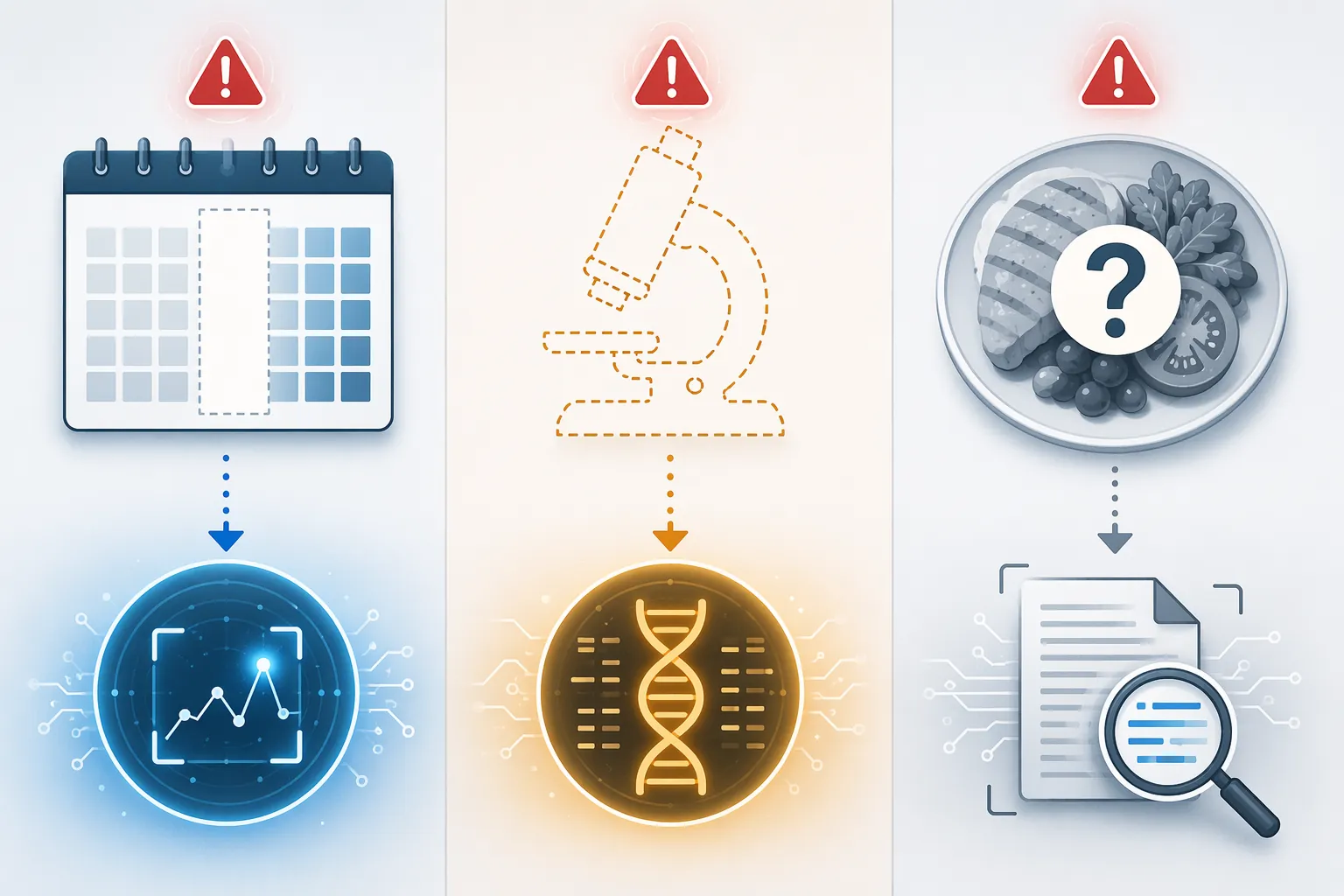
1. Clinical anomaly detection belongs at the front of the timeline
A late outbreak advisory does not mean no one was sick before the advisory. It means the confirmed, reportable, interpreted signal took time to surface. Anomaly-detection models can examine streams such as emergency department syndromic data, laboratory orders, diagnosis codes, or symptom text for unusual patterns. In a Cyclospora season, that kind of system might flag an unexpected increase in compatible gastrointestinal illness before formal case counts accumulate.
The word “might” is doing important work. A syndromic signal is noisy. It can be caused by unrelated gastrointestinal infections, local testing patterns, coding changes, or care-seeking behavior. The value is not automatic certainty; it is earlier queueing. A signal can tell epidemiologists where to look, which jurisdictions to compare, and whether interviews should begin before the recall window collapses.
2. Food-history NLP targets the part of the interview that decays fastest
Cyclospora’s incubation period turns ordinary food recall into weak evidence. By the time a patient is interviewed, the relevant meal may be nearly two weeks old. Even diligent patients may remember the restaurant but not the garnish, the salad mix but not the supplier, or the brand but not the lot.
Natural-language processing can help by extracting foods, locations, brands, menu items, and timing from messy text: clinical notes, case interviews, patient messages, receipts when available, and other unstructured records. The UK Health Security Agency’s pilot using AI to analyze online restaurant reviews for symptom and food mentions is relevant for the method, not because it proves U.S. readiness for parasite surveillance.[1] It shows that public text can be screened for possible foodborne illness signals; it does not validate a national Cyclospora detection program.
This is also where false precision would be dangerous. A restaurant-review model may notice symptom language and food mentions, but it cannot know whether a reviewer has laboratory-confirmed cyclosporiasis, whether the exposure occurred at that meal, or whether a shared ingredient crossed multiple locations. The operational use is triage: find recurring foods and venues faster, then hand them to investigators who can test the hypothesis against case interviews, purchasing records, traceback, and laboratory data.
3. Parasite genotyping is the missing laboratory backbone
For many bacterial foodborne outbreaks, culture-based subtyping and whole-genome sequencing allow investigators to see whether cases are closely related. Cyclospora does not offer the same path. The parasite cannot be cultured in the laboratory, and CDC lacks a PulseNet-equivalent whole-genome sequencing tool for parasites. FDA researchers published a targeted amplicon sequencing method for Cyclospora in 2023, providing partial genotyping capacity rather than a fully deployed national equivalent to bacterial PulseNet.[3]
Machine learning can support this layer by helping classify genetic variation, cluster related parasite samples, and compare partial sequences when full-genome data are not available. That would not make laboratory uncertainty disappear. It would give investigators a stronger way to separate likely connected cases from background seasonal noise, especially when food histories are incomplete.
The Taylor Farms de Mexico shredded iceberg lettuce recall illustrates why this matters. FDA traced a five-state Taco Bell cluster to the lettuce and announced a recall because of a possible health risk, while later reporting that a product sample result had been a false positive.[4][5] That laboratory complication did not erase the epidemiological evidence behind the recall. It did make public messaging harder, because the visible lab signal and the epidemiological signal no longer appeared to point in the same direction.
Better parasite clustering would not necessarily have changed the recall decision. It could have changed the confidence profile around that decision: which illnesses appeared linked, which exposures belonged in the same cluster, and how strongly the outbreak signal persisted when one product test became unreliable.
The policy bottleneck is now the technical bottleneck
The obstacle is not simply that public health agencies need better algorithms. An anomaly detector without timely feeds is an alarm disconnected from the wall. An NLP model without standardized interview data is a clever parser of uneven paperwork. A genotyping classifier without routine specimen flows is an academic tool waiting for samples.
That is why the FoodNet change belongs at the center of the story. Effective July 1, 2025, mandatory surveillance in the program was reduced from eight pathogens to two: Salmonella and Shiga toxin-producing E. coli. Cyclospora reporting became optional across 10 sentinel sites covering about 54 million people, or 16% of the U.S. population.[6] NBC News and CIDRAP reported that some states continued tracking all eight pathogens while others did not, leaving the post-cut landscape fragmented.[6][7]
Calling that a program change understates the downstream effect. Optional reporting changes the denominator, the timeliness, and the comparability of the signal. If one state keeps a broader surveillance net and another narrows it, an AI system may learn the surveillance policy as much as the disease pattern. A model can smooth missingness; it cannot manufacture a reliable national baseline from inconsistent obligations.
This is the same deployment problem that appears in other parts of food-safety AI. FDA can test machine-learning tools for inspection targeting, import screening, or laboratory prioritization, but those tools only become public health infrastructure when agencies define the data pipeline, validation standard, and action threshold. ClinicalMind’s earlier discussion of how the FDA uses AI in food safety testing and inspection is relevant here because Cyclospora surveillance is not only a detection problem; it is a testing, traceback, and regulatory-capacity problem.
The governance problem is just as concrete. If an AI system flags a possible multistate Cyclospora cluster from symptom notes and food mentions, who reviews it? What evidentiary standard moves it from internal signal to state investigation? When does FDA get involved? What happens if the signal points toward a commodity before laboratory confirmation exists? How are false positives audited, and how are underserved or lower-data communities protected from being missed or overflagged? Those are not philosophical questions once a recall, restaurant inspection, or public advisory is on the line.
Algorithmic bias also has a surveillance-specific form. Communities with less access to testing, fewer digitized records, lower review-platform use, or inconsistent care access may generate weaker signals even when illness is present. Any federal framework for AI-assisted outbreak detection would need to handle that unevenness directly, not after a model is already embedded in practice. That governance issue connects to the broader regulatory debate over algorithmic bias in public health AI.
What AI could realistically change
A practical Cyclospora surveillance architecture would not be a single model. It would be a chain of constrained tools: early anomaly detection to flag unusual gastrointestinal patterns, NLP to extract and rank food exposures while interviews are still fresh enough to matter, and parasite genotyping support to strengthen clustering when culture-based methods are unavailable.
- Earlier detection: symptom-stream anomaly detection could shorten the interval between scattered clinical encounters and investigator awareness.
- Better exposure extraction: NLP could reduce manual review time and surface recurring foods, venues, and menu items across interviews or notes.
- Stronger clustering: targeted sequencing and ML-assisted genotyping could help compare parasite samples when full culture-based workflows are unavailable.
- More disciplined escalation: predefined validation rules could keep AI-generated signals from becoming public claims before epidemiological and regulatory review.
Those gains depend on the same non-algorithmic commitments: maintained surveillance coverage, consistent state reporting, interoperable data feeds, and a federal rulebook for acting on probabilistic outbreak signals. The 2026 Cyclospora outbreak did not reveal a lack of plausible algorithms. It revealed a lack of connected authority, funding continuity, and deployment rules.
References
- What we truly know about huge US Cyclospora outbreak — and what we don’t, CIDRAP.
- Health Alert Network (HAN) - 00531, CDC.
- Development and validation of a targeted amplicon sequencing assay for Cyclospora cayetanensis genotyping, Frontiers in Microbiology, 2023.
- Taylor Fresh Foods Recalls Iceberg Lettuce from Central Mexico Because of Possible Health Risk, FDA.
- Investigation of 5-State Outbreak of Cyclospora Illnesses: Iceberg Lettuce, July 2026, FDA.
- CDC cuts back foodborne illness surveillance program, CIDRAP.
- CDC quietly scaled back surveillance program for foodborne illnesses, NBC News.
Comments
Join the discussion with an anonymous comment.