
1,561 AI-related bills introduced in 45 states by March 2026. That is the number meant to impress. But I work in compliance, so I ask a different question: how many of those actually became law? In 2025, state lawmakers introduced 1,208 such bills; 145 were enacted. That is a 12% enactment rate. In 2024, 635 introduced and 99 enacted. The volume is rising, but the signal-to-noise ratio is still low. I have watched state healthcare regulation long enough to be skeptical of raw legislative counts.
The 1,561 figure from MultiState includes every introduced bill—resolutions, study committees, bills that die in committee. What matters for a compliance team is what is enacted. The enactment rate has hovered around 12–15% over the past two years. That still leaves dozens of new laws each year, and in 2026 the pace has accelerated. But I do not want to overstate it: the 1,561 figure is a conversation starter, not a compliance burden. Look at effective dates and enforcement mechanisms, not bill counts.
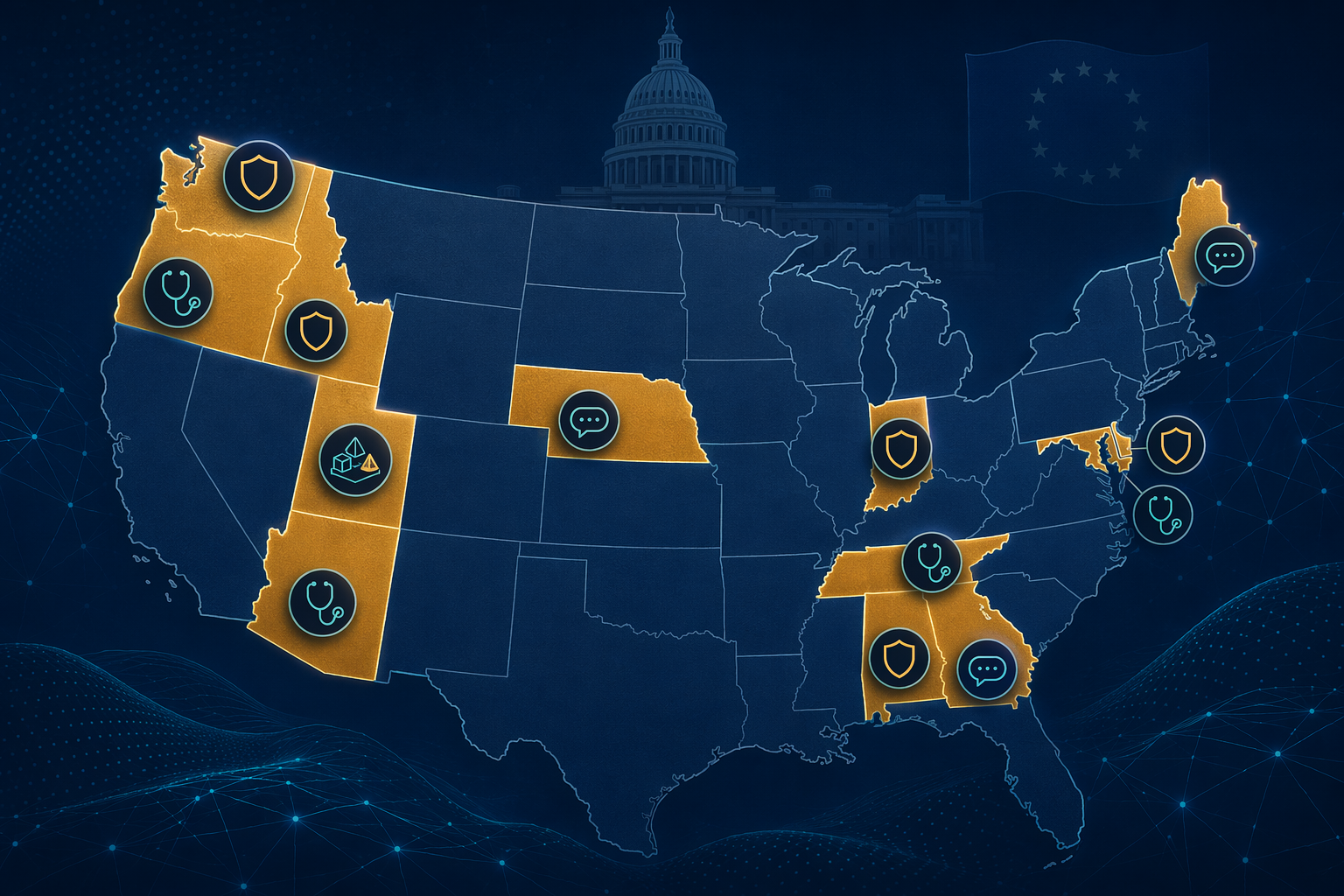
Six insurer laws, six different requirements
The most concentrated cluster of enacted laws governs how health insurers use AI in prior authorization and claims decisions. At least six states passed such laws in 2026. The details matter because they are not uniform. Some require human review, some require reporting, some require certification. A compliance team operating across state lines needs to track each one separately. Here is the summary:
| State | Bill | Effective Date | Key Requirement |
|---|---|---|---|
| Alabama | SB 63 | Oct 1, 2026 | Annual certification that AI does not rely on group datasets or discriminate |
| Indiana | HB 1271 | Jul 1, 2026 | Prohibits AI as sole basis for downcoding without human review |
| Washington | SB 5395 | Effective 2026 | Prohibits sole reliance on AI; requires reporting AI-related denials to insurance commissioner |
| Maryland | HB 1563 | Jun 1, 2026 | Quarterly reporting of adverse decisions with AI involvement |
| Georgia | SB 544 | Jan 1, 2027 | Licensed provider review required before AI adverse determinations |
| Utah | SB 319 | Jan 1, 2027 | Disclosure and independent medical judgment for adverse determinations |
Washington’s law stands out because it requires health insurers to report AI-related denials directly to the insurance commissioner. That is an actual enforcement mechanism, not just a prohibition. Maryland’s quarterly reporting requirement is similar. By contrast, Alabama’s law asks for an annual certification but does not specify how the state will verify it. I would not assume all these laws are equally binding. If you operate in Maryland, HB 1563 took effect June 1, 2026—you are already required to report quarterly. That is not a suggestion.
For a deeper dive into the evidence behind insurer AI in prior authorization and the broader regulatory response, see our related article: The AI Arms Race in Health Insurance Utilization Review.
Maine says no, Arizona says maybe
Maine’s HB 2082, effective April 8, 2026, is a direct statutory ban. It bars licensed mental health professionals from using AI for therapeutic communications or treatment decisions. It also requires patient consent before using ambient listening or other AI-powered recording tools. That is clear, enforceable, and carries the weight of law. Arizona took a different path: the Board of Behavioral Health Examiners issued regulations effective January 1, 2027, requiring informed consent before using AI, machine learning, or other human simulation modalities. A board regulation is narrower in enforcement—it can lead to board sanctions, but it does not carry the same legal exposure as a statute. The difference in legal weight matters. A violation of Maine’s law is a violation of state statute, potentially subject to attorney general enforcement. A violation of Arizona’s board regulation may only result in professional licensing sanctions. Compliance teams need to assess which framework applies to their operations.
Chatbot laws: four states, four enforcement styles
Four states enacted laws in 2026 specifically targeting AI chatbots and companions, particularly in mental health contexts. The laws vary in effective dates and enforcement mechanisms, but they share a common theme: no AI pretending to be a licensed professional.
- Idaho and Nebraska – Nearly identical Conversational AI Safety Acts (effective July 1, 2027). Require clear disclosure of AI interaction, crisis-response protocols for suicidal ideation, and prohibit chatbots from representing themselves as mental health professionals.
- Oregon SB 1546 (effective January 1, 2027) – Adds a private right of action for users who suffer harm and imposes heightened safeguards for minors. This is the most aggressive enforcement mechanism among the four.
- Tennessee SB 1580 (effective July 1, 2026) – Treats misrepresentation of an AI system as a licensed mental health professional as an unfair or deceptive practice, enforceable by the consumer protection division.
- Delaware HB 191 (April 23, 2026) – Prohibits any nonhuman entity (including AI) from being licensed or certified as a nurse, physician, or physician assistant, and from using protected professional titles.
The variation in enforcement is critical. Oregon’s private right of action means a user can sue for damages. Tennessee’s law relies on consumer protection enforcement, which is less direct. Idaho and Nebraska’s laws have a two-year runway before they take effect. Agencies using chatbots for public health outreach need to assess which state’s rules apply to their users. I would flag Oregon as the most urgent: if your chatbot causes harm, you can be sued directly.
Utah’s sandbox: don’t overread it
Utah’s AI Policy Act created a state-run regulatory sandbox, including a pilot program that allows AI to autonomously renew certain routine prescriptions for chronic conditions under state supervision. That is a novel approach, but its scope is narrow. It covers only prescription renewal for specific conditions, and it is a pilot, not a broad governance framework. I would not cite it as evidence that states are embracing permissive AI regulation. It is an experiment. Do not confuse it with the restrictive laws elsewhere.
The gap no law can fix
Here is where the legislative activity collides with reality. According to the ASTHO 2025 Profile of state and territorial health agencies, 64% cite the lack of established guidance around public health use of AI as their top challenge. Over half—55%—say they lack workforce skills. 39% lack resources (funding, staff, partners). 34% report not using AI at all. Among agencies that do have AI policies, only 34% address bias and only 34% address leadership and workforce readiness. The disconnect is plain: states are passing laws that require AI oversight, but the agencies on the front line have neither the guidance nor the capacity to implement them. The laws create obligations; the agencies lack the infrastructure to meet them.
This gap is not new, but the acceleration of state legislation makes it urgent. A health agency operating across multiple states may need to comply with Maryland’s quarterly reporting requirement (already in effect since June 1, 2026), Maine’s ban on AI in mental health therapy (effective April 8, 2026), and Tennessee’s chatbot rule (effective July 1, 2026), all without a dedicated AI compliance team. The laws are real. The support is not.
What to do this week (effective dates don’t wait)
Given the patchwork, here is a practical starting point for health system and public health agency compliance teams:
- Check effective dates immediately. Maryland HB 1563 (June 1, 2026) and Maine HB 2082 (April 8, 2026) are already in effect. Tennessee SB 1580 (July 1, 2026) and Washington SB 5395 (2026) are imminent. Prioritize these before the 2027 laws.
- Map your operating states. Identify which of the six insurer laws, two provider restrictions, and four chatbot laws apply to your organization. Do not assume your compliance team in one state can automatically cover another.
- Assess enforcement variation. A private right of action (Oregon) is more urgent than a consumer protection designation (Tennessee). A reporting requirement to an insurance commissioner (Washington) creates a paper trail that demands data infrastructure.
- Build internal AI governance even in absent state guidance. The ASTHO data shows most agencies lack policies. Do not wait for the state to tell you what to do. Establish a baseline: who approves AI tools, who monitors their use, who reports outcomes.
For operational benchmarks on AI in healthcare administration, including adoption rates and cost reduction metrics, see our companion article: AI in Healthcare Administration: Evidence-Based Benchmarks.
The patchwork is real. No federal comprehensive AI legislation is coming soon. State laws will continue to diverge. The question is not whether your agency will be affected—it is whether you know which laws you are subject to, and whether you can meet their requirements before the effective date.
Comments
Join the discussion with an anonymous comment.